- Plants
- ›Vascular Plants
- ›flowering plants
- ›monocots
- ›Agaves, Orchids, Irises, and Allies
- ›Orchids
- ›Lower Epidendroid Orchids
- ›Neottieae
- ›Neottia
- ›Neottia
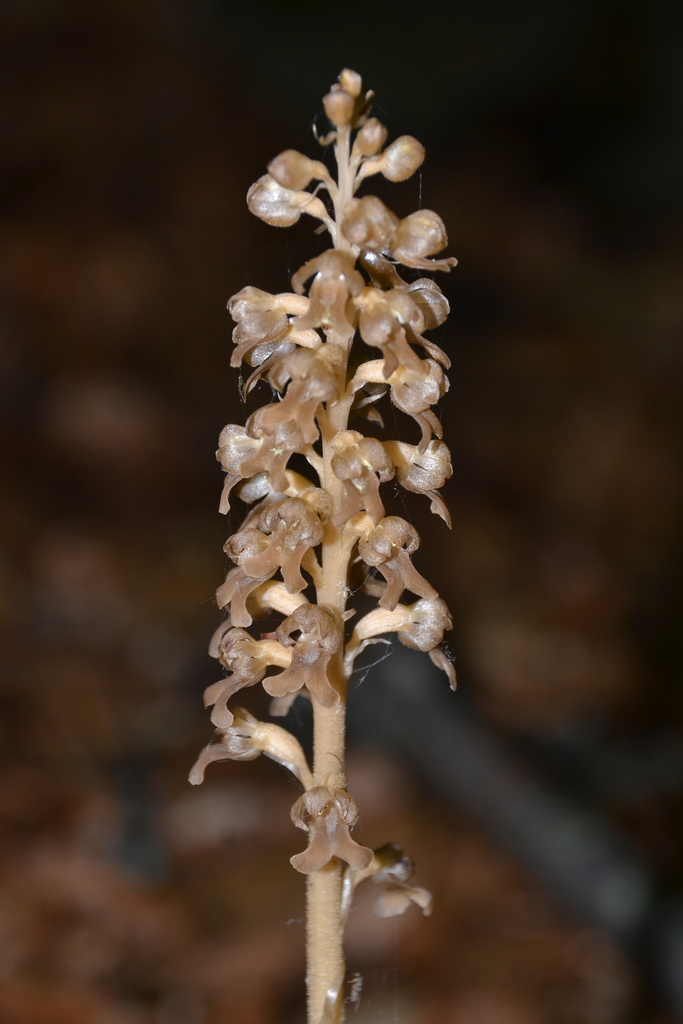
bird's-nest orchid
Neottia nidus-avis
Neottia nidus-avis, the bird's-nest orchid, is a non-photosynthetic orchid, native to Europe, Russia, with sporadic presence in North-Africa, and some parts of the Middle East.
From the article Neottia nidus-avis on Wikipedia (CC BY-SA), quoted section by section
Description
Neottia nidus-avis grows to 40 cm (16 in) tall and each shoot can carry up to 60 flowers. Plants are not in any part green, deriving all their nutrition from a mycorrhizal fungus in the soil/litter, which in turn derives nutrition from the roots of trees. Plants are generally beige-brown, though sometimes yellowish or white forms are discovered. The flower labellum splits and strongly diverges at its lower end. This species of orchid can be hard to spot, being camouflaged against the leaf litter. Across Europe, this species flowers May–June.
Range & habitat
It is widespread across most of Europe, occurring also in Algeria, Tunisia, western Siberia, the Caucasus, Iran and Turkey. In the British Isles, Neottia nidus-avis is found in shady woodland, especially beech, on basic soils. Its conservation status in the UK is near-threatened.
Wikipedia: “Distribution and habitat”
What it does
Neottia nidus-avis has been found to flourish only in partnership with mycorrhizal fungi in the genus Sebacina, particularly Sebacina dimitica in the UK. Pollination is carried out by Diptera and possibly also ants. Self-pollination may occur if insects do not pollinate the plants.
Wikipedia: “Ecology”
Where it lives
Recorded sightings
—
geo-referenced records in GBIF, from museums, herbaria and field observers.
Drag the globe to turn it. Dots are where records exist, not a range map; darker means more records.
In the old herbals & bestiaries

In the stacks
Searching the stacks…
Every page naming Neottia nidus-avis in the Biodiversity Heritage Library →
This page is assembled live from iNaturalist, GBIF, Wikipedia, the Source Library and the Internet Archive. It is not yet part of the hand-edited codex. iNaturalist taxon 81895.