- Plants
- ›Vascular Plants
- ›flowering plants
- ›Dicots
- ›Heathers, Balsams, Primroses, and Allies
- ›heath family
- ›blueberries, cranberries, huckleberries, and allies
- ›Vaccinieae
- ›Vaccinium
- ›Batodendron
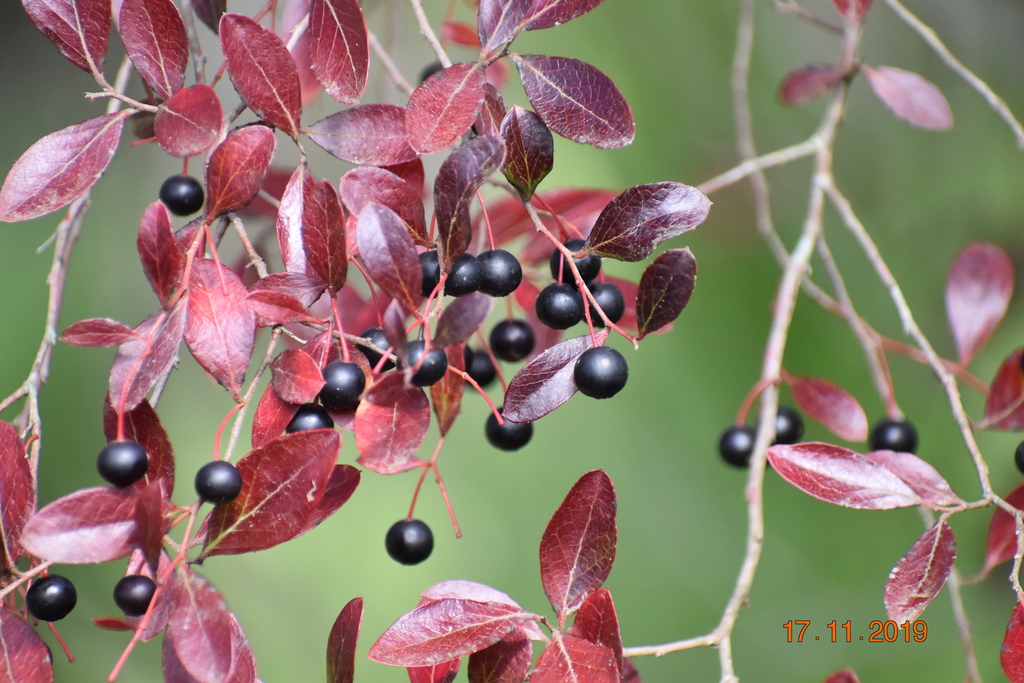
sparkleberry
Vaccinium arboreum
Vaccinium arboreum (sparkleberry or farkleberry) is a species of Vaccinium native to the southeastern and south-central United States, from southern Virginia west to southeastern Nebraska, south to Florida and eastern Texas, and north to Illinois.
From the article Vaccinium arboreum on Wikipedia (CC BY-SA), quoted section by section
Description
Vaccinium arboreum is a shrub (rarely a small tree) growing to 3–5 metres (10–16+1⁄2 ft), rarely 9 m (30 ft) tall, with a diameter at breast height of up to 35 centimetres (14 in). The leaves are evergreen in the south of the range, but deciduous further north where winters are colder; they are oval-elliptic with an acute apex, 3–7 cm (1+1⁄4–2+3⁄4 in) long and 2–4 cm broad, with a smooth or very finely toothed margin. The flowers are white, bell-shaped, and 3–4 millimetres (1⁄8–3⁄16 in) in diameter with a five-lobed corolla, produced in racemes up to 5 cm (2 in) long. The fruit is a round dry berry about 6 mm (1⁄4 in) in diameter, green at first, black when ripe, bitter and tough. Cytology is 2n = 24.
Range & habitat
Sparkleberry could be found in the United States from southern Virginia west to southeastern Nebraska, south to Florida and eastern Texas, and north to Illinois. It grows in sandy and rocky habitats, including dry woods. It also grows on a variety of moist sites such as wet bottomlands and along creek banks.
Wikipedia: “Distribution and habitat”
At the table
Because of its relative hardiness in comparison to other Vaccinium species, V. arboreum has been investigated as a potential rootstock for expanding the range of blueberry cultivation to less acidic soils (pH>6.0) and reducing the severity of bacterial leaf scorch.
Wikipedia: “Uses”
Where it lives
Recorded sightings
—
geo-referenced records in GBIF, from museums, herbaria and field observers.
Drag the globe to turn it. Dots are where records exist, not a range map; darker means more records.
In the stacks
Searching the stacks…
Every page naming Vaccinium arboreum in the Biodiversity Heritage Library →
This page is assembled live from iNaturalist, GBIF, Wikipedia, the Source Library and the Internet Archive. It is not yet part of the hand-edited codex. iNaturalist taxon 81818.