- Plants
- ›Vascular Plants
- ›flowering plants
- ›Dicots
- ›Nances, Willows, and Allies
- ›Spurge Family
- ›Crotonoideae
- ›Manihoteae
- ›Cnidoscolus
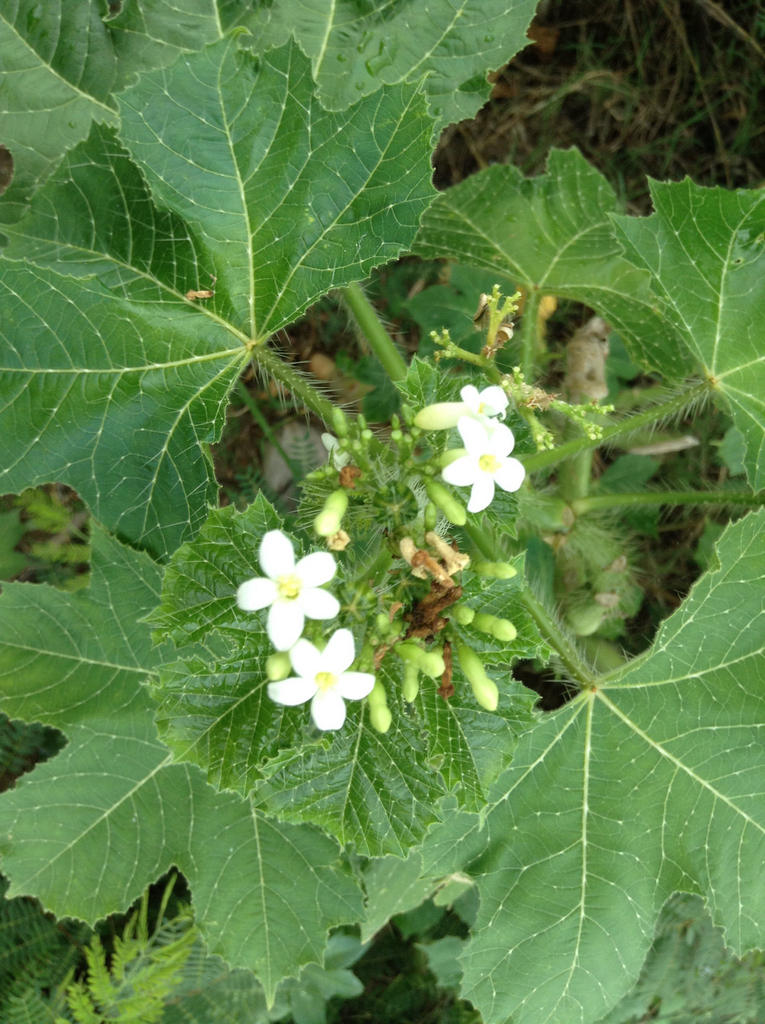
tropical bull nettle
Cnidoscolus urens
Cnidoscolus urens is a perennial, tropical American stinging herb of the family Euphorbiaceae, and is one of some 100 species belonging to the genus Cnidoscolus (from Gk. knidē "nettle", skōlos "thorn", and Latin urens "burning"). The plant is locally known as bull nettle, spurge nettle, pringamosa, bringamosa and mala mujer ("evil woman").
This species has an erect stem and is herbaceous when young, turning woody with age and from 50 to 150 centimeters tall. Leaves are lobed and large, while the white flowers occur in cymes, producing a spiny 3-seeded capsule with seeds rich in fats and proteins, resembling those of Ricinus communis. Its carunculate seeds are usually dispersed by ants (myrmecochory) attracted by the edible elaiosome. The entire plant is covered in stinging hairs, and has a native range covering Central and South America, being found in Costa Rica, El Salvador, Guatemala, Honduras, Mexico, Nicaragua, Panama, Peru, Colombia and Venezuela.
From the article Cnidoscolus urens on Wikipedia (CC BY-SA), quoted section by section
What it does
Cnidoscolus urens is insect pollinated and is recorded to have been visited in northern Florida by Lasioglossum pectorale and Lasioglossum weemsi/leviense. '
Wikipedia: “Ecology”
Where it lives
Recorded sightings
—
geo-referenced records in GBIF, from museums, herbaria and field observers.
Drag the globe to turn it. Dots are where records exist, not a range map; darker means more records.
In the stacks
Searching the stacks…
Every page naming Cnidoscolus urens in the Biodiversity Heritage Library →
This page is assembled live from iNaturalist, GBIF, Wikipedia, the Source Library and the Internet Archive. It is not yet part of the hand-edited codex. iNaturalist taxon 81817.