- Plants
- ›Vascular Plants
- ›flowering plants
- ›Dicots
- ›honeysuckles, moschatels, and allies
- ›elder family
- ›Viburnum
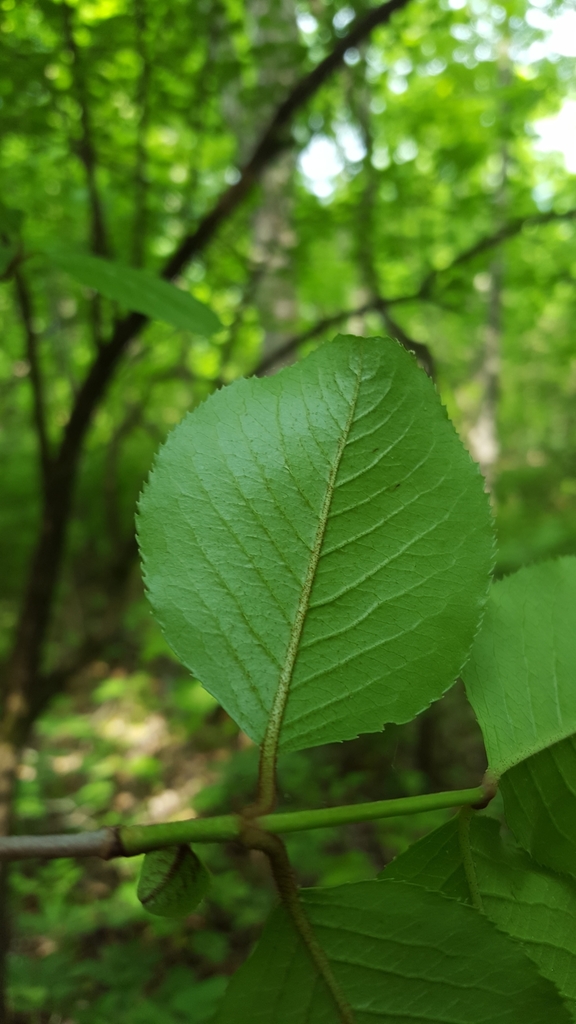
Rusty Blackhaw
Viburnum rufidulum
Viburnum rufidulum, also known as the rusty blackhaw, blue haw, rusty nanny-berry, or southern black haw, is a flowering species of shrub or small tree that is common in parts of the Eastern and Central United States. It produces attractive flowers and fall foliage, as well as fruits that are popular with some species of bird.
From the article Viburnum rufidulum on Wikipedia (CC BY-SA), quoted section by section
Description
Leathery deciduous leaves are simple and grow in opposite blades ranging from 0.5-3 inches in length and 1-1.5 inches in width. Petioles are "rusty hairy" with grooves and sometimes wings. Leaf margins are serrate. Autumn leaf colors are bronze to red. Twigs range in color from "reddish brown to gray"; young twigs are hairy, and get smoother with age. Bark is similar that of the flowering dogwood, ranging in color from "reddish brown to almost black" and forming "blocky plates on larger trunks". Viburnum rufidulum blooms in April to May with creamy white flowers that are bisexual, or perfect and similar to those of other Viburnum species, but with clusters as large as six inches wide. The fruits are purple or dark blue, glaucous, globose or ellipsoid drupes that mature in mid to late summer. The edible fruit has been said to taste like raisins and attract birds. It is similar to Viburnum prunifolium (blackhaw). Petioles of V. prunifolium do not have the rusty hairs that those of V. rufidulum do.
Range & habitat
The rusty blackhaw prefers dry habitats with elevations generally below 750 m. It grows in Alabama, Arkansas, Florida, Georgia, Illinois, Indiana, Kansas, Kentucky, Louisiana, Mississippi, Missouri, North Carolina, Ohio, Oklahoma, South Carolina, Tennessee, Texas, Virginia, and West Virginia. V. rufidulum often occurs in loamy sand environments. Individuals have been observed in habitats such as upland woods, deciduous woods, and palm hammocks.
Wikipedia: “Distribution and habitat”
Where it lives
Recorded sightings
—
geo-referenced records in GBIF, from museums, herbaria and field observers.
Drag the globe to turn it. Dots are where records exist, not a range map; darker means more records.
In the stacks
Searching the stacks…
Every page naming Viburnum rufidulum in the Biodiversity Heritage Library →
This page is assembled live from iNaturalist, GBIF, Wikipedia, the Source Library and the Internet Archive. It is not yet part of the hand-edited codex. iNaturalist taxon 81801.