- Plants
- ›Vascular Plants
- ›flowering plants
- ›Dicots
- ›Buttercups, Poppies, and Allies
- ›buttercup family
- ›Columbines and Meadow-Rues
- ›Enemion
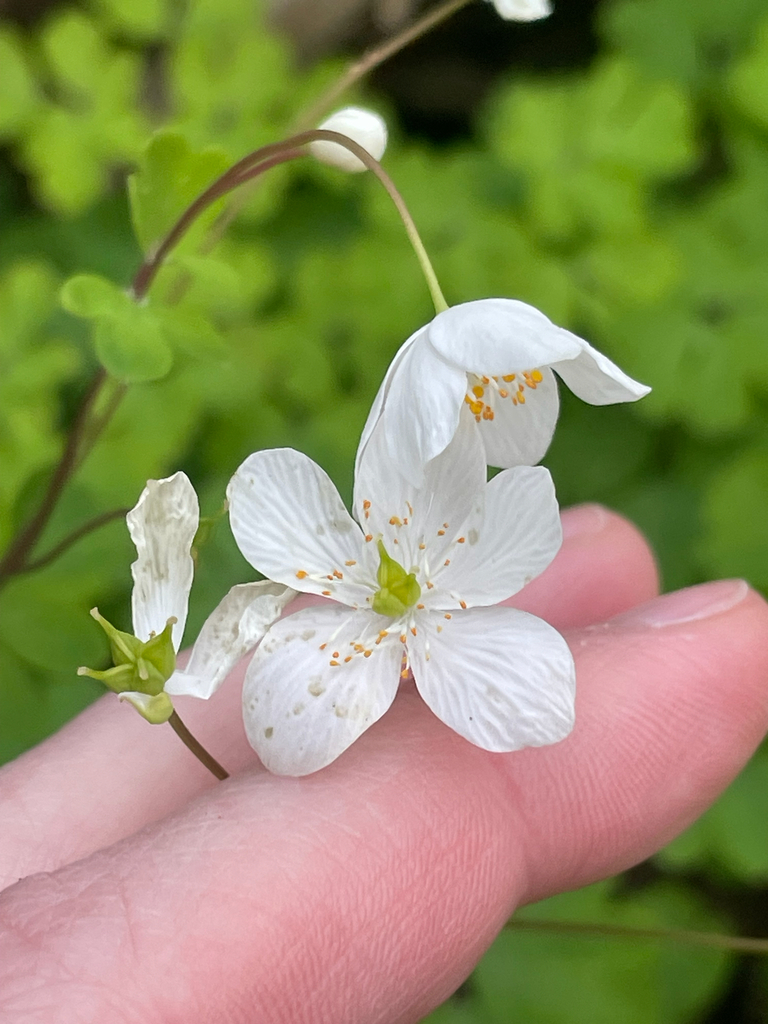
false rue anemone
Enemion biternatum
Enemion biternatum (syn. Isopyrum biternatum), commonly known as the false rue-anemone, is a spring ephemeral native to moist deciduous woodland in the eastern United States and extreme southern Ontario.
From the article Enemion biternatum on Wikipedia (CC BY-SA), quoted section by section
Description
Enemion biternatum is a perennial herb. The plant sends up evergreen basal leaves in the fall, and flower stems in the spring. It goes dormant in late spring and early summer after the seed ripens. Leaves are twice or thrice compound with groups of three leaflets. Leaflets are smooth-edged, irregularly and deeply lobed twice or thrice, often with one to three secondary shallow lobes. Basal leaves are held on long stalks, and there are leaves arranged alternately up the flowering stems, with shorter stalks. All stems are reddish and hairless. The root system is weakly rhizomatous and occasionally produces small tubers. Plants spread over time to form thick colonies. The flowering stems are 4 to 16 inches (10 to 40 cm) high. Flowers are produced singly or in leafy racemes of two to four flowers, which means that there are leaves arranged alternately up the stems and flowers are in stems that come out of leaf axils. On either side of the leaf axils are two rounded stipules. The flowers have five white petal-like sepals that are each 5.5–13.5 mm (3⁄16–9⁄16 in) long and 3.5–8.5 mm (1⁄8–5⁄16 in) wide, 25-50 stamens with yellow pollen on the anthers, and three to six green carpels. If a carpel is fertilized, it develops into a beaked pod (follicle). …
What it does
The flowers produce pollen but no nectar. Small insects such as sweat bees (Lasioglossum and Halictus), mining bees (Andrena), honeybees (Apis mellifera), and hoverflies visit the flowers to collect or feed on pollen. Some bees likely visit searching in vain for nectar.
Wikipedia: “Ecology”
Where it lives
Recorded sightings
—
geo-referenced records in GBIF, from museums, herbaria and field observers.
Drag the globe to turn it. Dots are where records exist, not a range map; darker means more records.
In the stacks
Searching the stacks…
Every page naming Enemion biternatum in the Biodiversity Heritage Library →
This page is assembled live from iNaturalist, GBIF, Wikipedia, the Source Library and the Internet Archive. It is not yet part of the hand-edited codex. iNaturalist taxon 81795.