- Plants
- ›Vascular Plants
- ›flowering plants
- ›monocots
- ›grasses, sedges, cattails, and allies
- ›grasses
- ›Pooideae
- ›Wheats, ryes, barleys and relatives
- ›barleys, ryes, and relatives
- ›Elymus
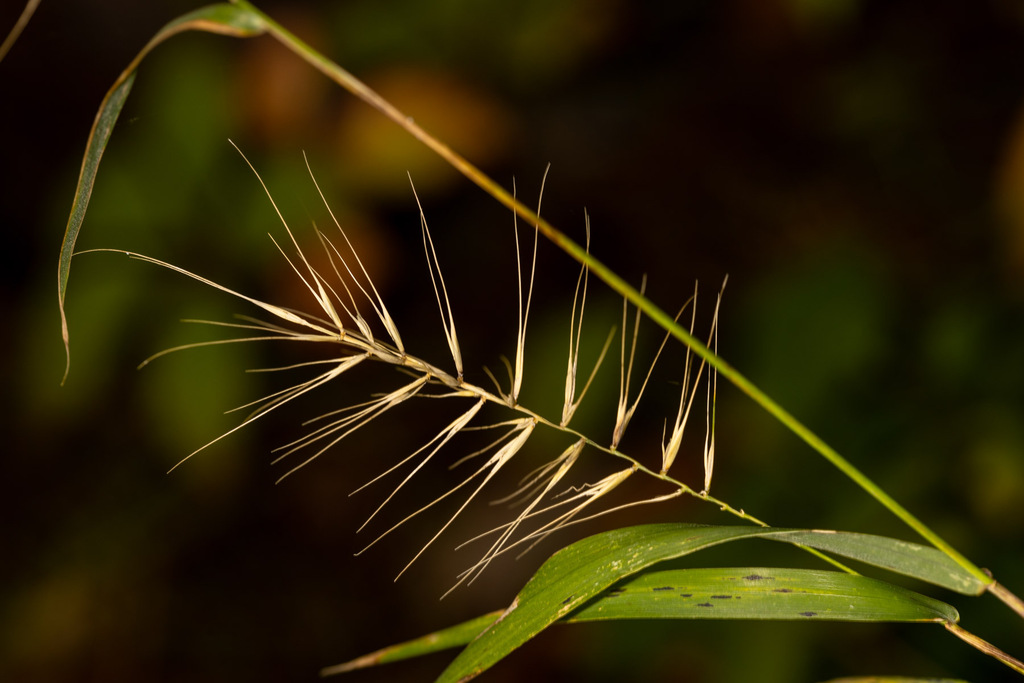
bottlebrush grass
Elymus hystrix
Elymus hystrix, known as eastern bottlebrush grass, or bottle-brush-grass, is a bunchgrass in the grass family, Poaceae. It is native to the Eastern United States and Eastern Canada.
From the article Elymus hystrix on Wikipedia (CC BY-SA), quoted section by section
Description
Elymus hystrix is a herbaceous plant with alternate, simple leaves, on erect stems. The flowers are white and bloom in spring. Elymus hystrix ranges from approximately two and a half to four and a half feet in height. There are usually two spikelets at each of the five to nine nodes of the plant. Unlike some similar native grasses, the blades of Elymus hystrix do not have glumes surrounding its spikelets. Elymus hystrix is self-compatible; that is, it can reproduce using its own pollen. Elymus hystrix is a perennial meaning it does not completely die at the end of each season, but comes back the next year. Elymus hystrix has four copies of its genome, exhibiting a type of polyploidy called tetraploidy.
Range & habitat
Elymus hystrix is found in the United States east of the Great Plains as well as in Eastern Canada. It is usually found in rocky, wet, and partially shaded habitat such as near rivers, creeks, or woods. Elymus hystrix does not grow well in heavily shaded areas and often inhabits the regions on the edge of shaded wooded areas such as forests. Growth of Elymus hystrix appears to be inhibited by excess shade, but is relatively resistant to soil compaction when compared to other herbaceous plant species.
Wikipedia: “Distribution and habitat”
At the table
Mus musculus, or mice, feed on Elymus seeds. It is reasonable that through domestication and enhancement of seed size and nutritional value seeds of Elymus hystrix could be useful for consumption by other vertebrates such as humans. Similar species of grasses are eaten by livestock throughout the United States. Other Elymus species have been found to be high in crude protein when compared to other native grasses, but research is needed to investigate whether specifically Elymus hystrix also exhibits this trait. It is also not immediately evident how nutritious the herbaceous grassy portion of the plant would be to humans, but potential for Elymus hystrix as a food source for livestock is also of interest.
Wikipedia: “Potential as a food crop”
Where it lives
Recorded sightings
—
geo-referenced records in GBIF, from museums, herbaria and field observers.
Drag the globe to turn it. Dots are where records exist, not a range map; darker means more records.
In the stacks
Searching the stacks…
Every page naming Elymus hystrix in the Biodiversity Heritage Library →
This page is assembled live from iNaturalist, GBIF, Wikipedia, the Source Library and the Internet Archive. It is not yet part of the hand-edited codex. iNaturalist taxon 81594.