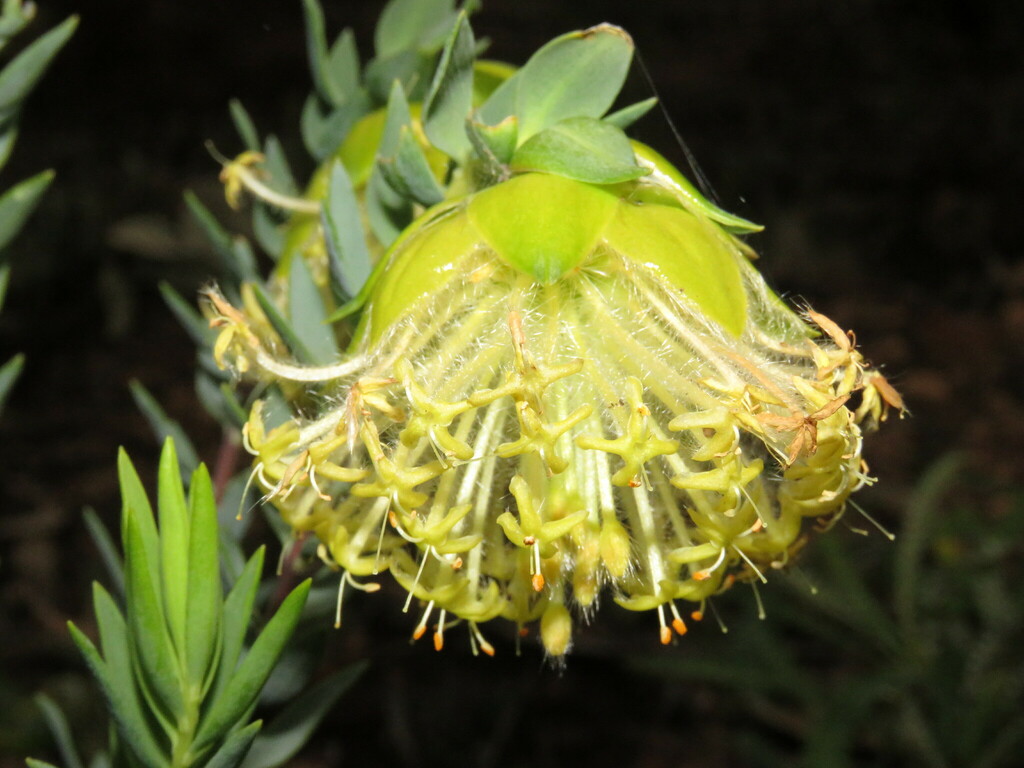
Scented Banjine
Pimelea suaveolens
Pimelea suaveolens, commonly known as the scented banjine or silky-yellow banjine is a slender shrub with large, rather hairy yellow inflorescences. It ranges in forest areas of the south-west of Western Australia from New Norcia to Albany.
From the article Pimelea suaveolens on Wikipedia (CC BY-SA), quoted section by section
Description
Pimelea suaveolens is an erect, spindly, often multi-stemmed shrub which grows to a height of 0.25–1.2 m (0.8–4 ft). The stems and leaves are glabrous and the leaves are arranged in opposite pairs, sword-shaped and 10–30 mm (0.4–1 in) long. The inflorescences are 30–40 mm (1–2 in) across and consist of many pale to deep yellow flowers surrounded by hairy, petal-like bracts and hang from the branches. Flowering occurs from June to October.
Range & habitat
Scented banjine grows on sand, sandy clay, gravel and laterite on undulating plains, flats, ridges and roadsides. It grows between New Norcia and Albany in the Coolgardie, Avon Wheatbelt, Esperance Plains, Geraldton Sandplains, Mallee, Swan Coastal Plain, Jarrah Forest and Warren biogeographic regions.
Wikipedia: “Distribution and habitat”
How it is grown
This species is not difficult to propagate from cuttings but is difficult to maintain in cultivation. "Good drainage and partial shade are important."
== References ==
Wikipedia: “Use in horticulture”
Where it lives
Recorded sightings
—
geo-referenced records in GBIF, from museums, herbaria and field observers.
Drag the globe to turn it. Dots are where records exist, not a range map; darker means more records.
In the stacks
Searching the stacks…
Every page naming Pimelea suaveolens in the Biodiversity Heritage Library →
This page is assembled live from iNaturalist, GBIF, Wikipedia, the Source Library and the Internet Archive. It is not yet part of the hand-edited codex. iNaturalist taxon 803217.