- Plants
- ›Vascular Plants
- ›flowering plants
- ›Dicots
- ›Heathers, Balsams, Primroses, and Allies
- ›heath family
- ›madrones, bearberries, and allies
- ›Xylococcus
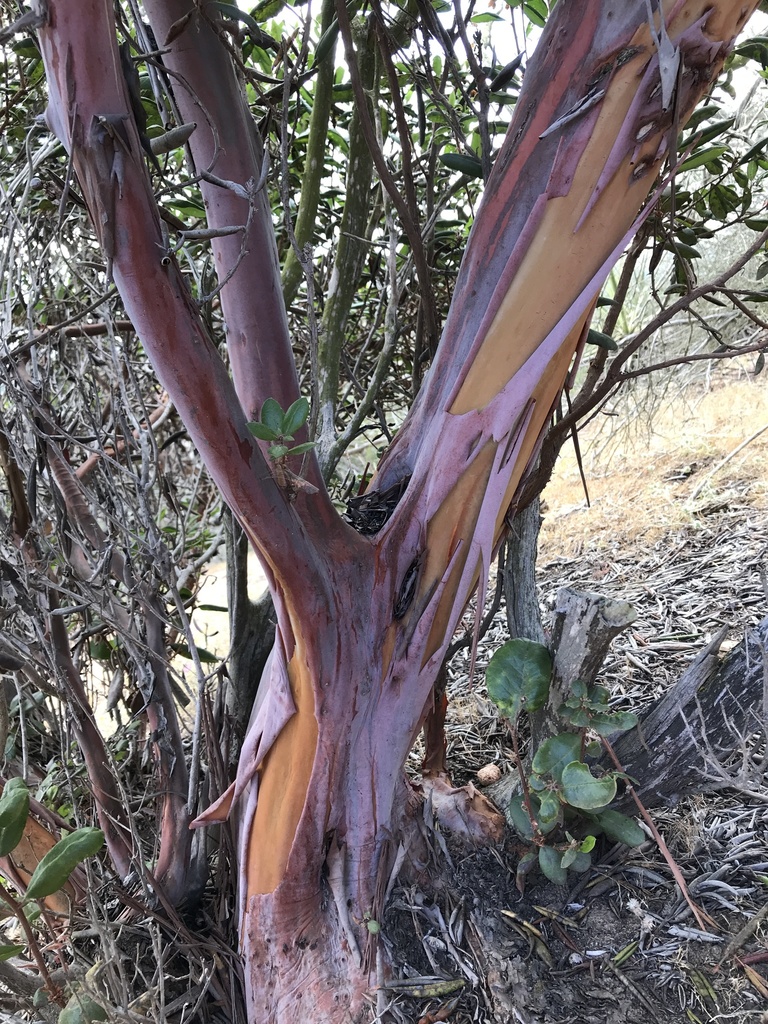
mission manzanita
Xylococcus bicolor
Xylococcus is a monotypic genus of flowering plants in the heather family which contains the single species Xylococcus bicolor, commonly known as the mission manzanita. It is a burl-forming, evergreen shrub with leathery leaves and smooth dark reddish bark. From December to February, white to pink urn-shaped flowers adorn the foliage, often attracting hummingbird pollinators. It is native to southern California and the Baja California Peninsula, south to the Sierra de la Giganta. There is growing concern over the future of this plant, referred to as the "queen of the elfin forest", as it may possibly lose up to 88% of its habitat and its wild seedlings are failing to survive more than a full year.
Known to and utilized by the indigenous peoples for centuries, this species was first described to Western science by Thomas Nuttall, who had found it on his journey to California. Nuttall named it Xylococcus, which is derived from the Greek word for "wood berry". Later botanists lumped this species into the true manzanitas (Arctostaphylos), but it has distinct features, such as the flowers and fruit, that support its generic placement. In light of its struggle in the wild, this plant is available from specialty nurseries focusing on California native plants, making it a distinctive and hardy shrub in the garden.
From the article Xylococcus bicolor on Wikipedia (CC BY-SA), quoted section by section
Description
Starting from the ground up, one will notice this evergreen shrub or tree has a burl, or lignotuber, an underground storage organ, which is topped by a smooth trunk with peeling red bark. The smooth red trunk is characteristic of other Arbutoideae in the region, like Arctostaphylos species, although this species has a darker tint to its bark. This species may rarely grow up to 6 metres (20 ft) in height. The stems are erect, generally less than 2.5 m (8.2 ft) in length, with canescent twigs. On the twigs are the alternately-arranged, leathery leaves, which have a lower surface that is densely covered with white to gray hairs. The margin of the leaves lack teeth and are rolled under. The leaves are up to 4.5 cm long. The dense inflorescence is a panicle, which hangs downward and is bracted. The pedicel is not jointed to the flower, with 2 bractlets. There are 5 sepals on the flower, along with 5 petals, which are fused to form an urn-shaped corolla. The white to pink corolla is covered in hairs. Within the flower, there are 10 stamens, with the filaments wooly in their lower half. The ovary is superior (attached to the receptacle above the attachment of other floral parts) and is hairy, with generally 5 chambers. Upon maturity, the flowers turn into a fruit around 9 mm (0.35 in) wide. The fruit is a dark-brown drupe, with 5 stones that are fused into a smooth unit.
Range & habitat
The plant's native range is very limited, to the Peninsular Ranges in Southern California (U.S.) and the Baja California Peninsula (México), the South Coast of California and Santa Catalina Island, and the northwestern Baja California coast and Cedros Island. Its populations are primarily in San Diego County, California and Baja California state. It is a member of the chaparral plant community, in the California chaparral and woodlands and California coastal sage and chaparral ecoregions. It grows at elevations below 3,500 feet (1,100 m), on dry, sunny slopes. In Baja California, the species also occurs outside of the chaparral plant community, particularly in sky islands of the central desert, and in the xeric scrub community of the Sierra de la Giganta mountain ranges in Baja California Sur.
Wikipedia: “Distribution and habitat”
What it does
Birds, including the California thrasher and California scrub jay, eat its seeds. Hummingbirds, especially the resident Anna's hummingbird, drink nectar from its flowers. Various birds nest in the plant, and many use it for cover. While some chaparral plant species require fire to germinate seeds and reproduce, Xylococcus bicolor does not, nor does it require openings left by wildfires. As a chaparral member species it must have a means of coping with wildfire, and it does so by resprouting from the base after its top has burned away. This mechanism works very well, unless a second fire follows closely after the first. If a plant has not had time to sufficiently regenerate, it will probably perish.
Reproductive crisis. There is growing concern that this species is unable to produce young individuals in the wild. Despite producing thousands of drupes annually, many intensive searches had failed to find seedlings, and it was believed that the species could no longer reproduce by seeds. Complicating this predicament, the seeds of Xylococcus are still perfectly viable, with 61% of stones having at least one seed filled with live endosperm. …
Wikipedia: “Ecology”
At the table
The Native American Luiseño people bruised ripe berries and soaked them overnight in cold water to produce a cider-like drink. Delfina Cuero, a member of the Kumeyaay people, corroborates a similar use of Xylococcus (known to her people as Haasill), soaking the ripe berries to use as a cool drink.
Cultivation. Xylococcus bicolor is cultivated as an ornamental plant by specialty plant nurseries, for planting in California native plant and wildlife gardens. It forms an interesting shrub with flowers that hummingbirds like. It prefers to have its leaves in full sun, but likes its roots in the shade. This species is tolerant of most soils, but requires excellent drainage. It needs fast draining soil of pH 6–7, in USDA zones 7–10. This plant is best suited on north-facing, dry rocky slopes. It grows at a moderate pace in a rounded shape, usually about 8 feet (2.4 m) high by 6 ft (1.8 m) wide. It prefers regular light watering over the first summer after planting. After establishment, this drought-tolerant shrub should survive the dry months with no supplemental water, though it can usually handle summer watering infrequently. It provides white and pink blooms over winter and spring, and is hardy down to 20 °F during these months.
Propagation. This species is notoriously difficult to propagate, and wild seedlings are seldom to survive past a year. …
Wikipedia: “Uses”
In human culture
The name Xylococcus derives from the Greek word for "wood berry", which refers to the rock-hard stone the seeds are encased within. The specific epithet, bicolor, refers to the leaves, which are a dark green on the top surface and a wooly-white on the bottom.
Wikipedia: “Etymology”
Where it lives
Recorded sightings
—
geo-referenced records in GBIF, from museums, herbaria and field observers.
Drag the globe to turn it. Dots are where records exist, not a range map; darker means more records.
In the stacks
Searching the stacks…
Every page naming Xylococcus bicolor in the Biodiversity Heritage Library →
This page is assembled live from iNaturalist, GBIF, Wikipedia, the Source Library and the Internet Archive. It is not yet part of the hand-edited codex. iNaturalist taxon 79543.