- Plants
- ›Vascular Plants
- ›flowering plants
- ›monocots
- ›lilies, supplejacks, and allies
- ›Herb-Paris, False Hellebores, Trilliums and allies
- ›Melanthieae
- ›Veratrum
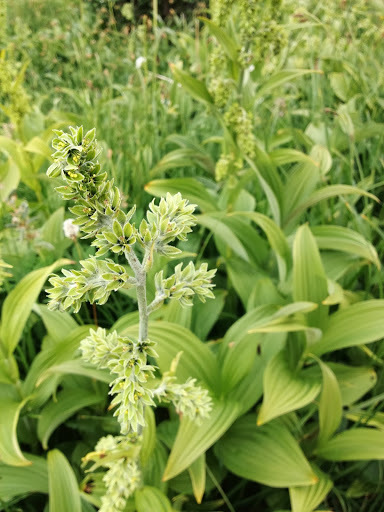
green false hellebore
Veratrum viride
Veratrum viride, known as Indian poke, corn-lily, Indian hellebore, false hellebore, green false hellebore, or giant false-helleborine, is a species of Veratrum native to eastern and western (but not central) North America. It is extremely toxic, and is considered a pest plant by farmers with livestock. The species has acquired a large number of other common names within its native range, including American false hellebore, American white hellebore, bear corn, big hellebore, corn lily, devil's bite, duck retten, itchweed, poor Annie, blue hellebore and tickleweed.
From the article Veratrum viride on Wikipedia (CC BY-SA), quoted section by section
Description
V. viride is a herbaceous perennial plant reaching 0.7 to 2 metres (2.3 to 6.6 ft) tall, with a solid green stem. The leaves are spirally arranged, 10 to 35 cm (4 to 14 in) long and 5 to 20 cm (2 to 8 in) broad, elliptic to broad lanceolate ending in a short point, heavily ribbed and hairy on the underside. The flowers are numerous, produced in a large branched inflorescence 30 to 70 cm (1.0 to 2.3 ft) tall; each flower is 5 to 12 mm (0.2 to 0.5 in) long, with six green to yellow-green tepals. The fruit is a capsule 1.5 to 3 cm (0.6 to 1.2 in) long, which splits into three sections at maturity to release the numerous flat 8 to 10 mm (0.3 to 0.4 in) diameter seeds. The plant reproduces through rhizome growth as well as seeds.
Range & habitat
In eastern North America, var. viride occurs from southwestern Labrador and southern Quebec south to northern Georgia. In the west, var. eschscholzianum occurs from Alaska and Northwest Territory south through Yukon, British Columbia, Alberta, Washington, Idaho, Montana, and Oregon to northwestern California (Del Norte, Siskiyou, Trinity, and Humboldt Counties). It is found in wet soils in meadows, sunny streambanks, and open forests, occurring from sea level in the north of its range up to 1,600 metres (5,200 ft) in the southeast and 2,500 metres (8,200 ft) in the southwest.
Wikipedia: “Distribution and habitat”
In medicine
The plant is highly toxic, causing nausea and vomiting. If the poison is not evacuated, cold sweat and vertigo appear. Respiration slows, while cardiac rhythm and blood pressure fall. The toxic effects of veratrum alkaloids are directly induced by antagonism of adrenergic receptors. It is used externally by several Native American nations. Although is rarely ever used in modern herbalism due to its concentration of various alkaloids, it has been used in the past against high blood pressure and rapid heartbeat; a standardized extract of V. viride alkaloids known as alkavervir was used in the 1950s and 1960s as an antihypertensive. The root contains even higher concentrations than the aerial parts.
Wikipedia: “Medicine”
Where it lives
Recorded sightings
—
geo-referenced records in GBIF, from museums, herbaria and field observers.
Drag the globe to turn it. Dots are where records exist, not a range map; darker means more records.
In the stacks
Searching the stacks…
Every page naming Veratrum viride in the Biodiversity Heritage Library →
This page is assembled live from iNaturalist, GBIF, Wikipedia, the Source Library and the Internet Archive. It is not yet part of the hand-edited codex. iNaturalist taxon 79484.