- Plants
- ›Vascular Plants
- ›flowering plants
- ›Dicots
- ›Roses, Elms, Figs, and Allies
- ›elm family
- ›Ulmus
- ›Ulmus
- ›Microptelea
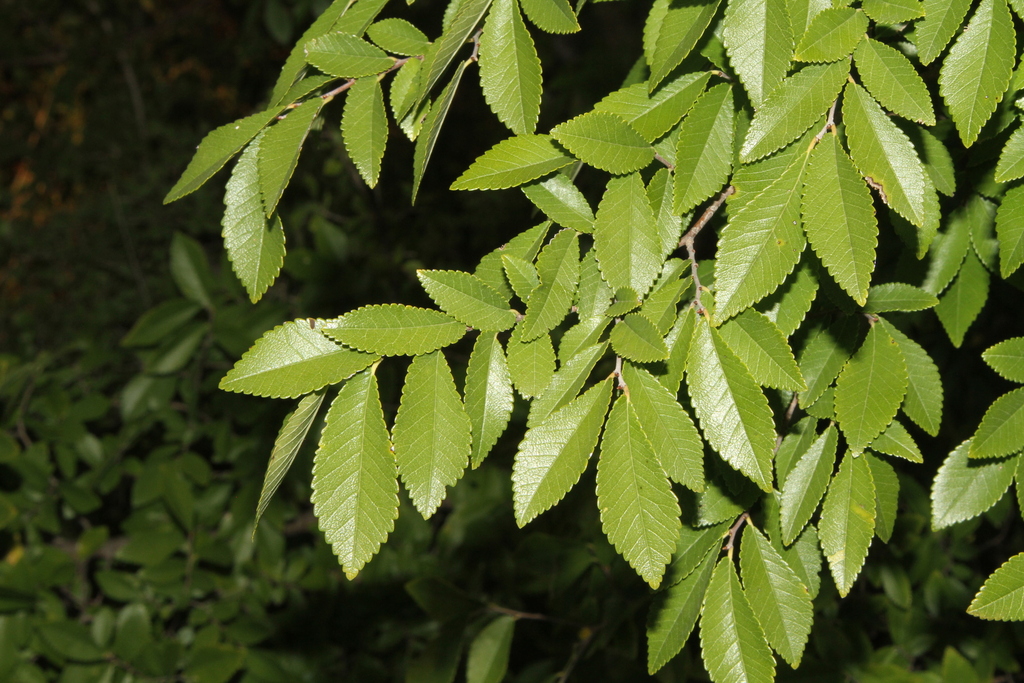
Chinese elm
Ulmus parvifolia
Ulmus parvifolia, commonly known as the Chinese elm or lacebark elm, is a species native to eastern Asia, including China, India, Japan, Korea, Vietnam, Siberia, and Kazakhstan. It has been described as "one of the most splendid elms, having the poise of a graceful Nothofagus".
From the article Ulmus parvifolia on Wikipedia (CC BY-SA), quoted section by section
Description
A small to medium deciduous or semideciduous (rarely semievergreen) tree, it grows to 10–18 m (33–59 ft) tall and 15–20 m (49–66 ft) wide, with a slender trunk and crown. The leathery, lustrous green, single-toothed leaves are small, 2–5 cm long by 1–3 cm broad, and often are retained as late as December or even January in Europe and North America. In some years, the leaves take on a purplish-red autumn colour. The apetalous, wind-pollinated, perfect flowers are produced in early autumn, small and inconspicuous. The fruit is a samara, elliptical to ovate-elliptical, 10–13 mm long by 6–8 mm broad. The samara is mostly glabrous, the seed at the centre or toward the apex, and is borne on a stalk 1–3 mm in length; it matures rapidly and disperses by late autumn. The trunk has a handsome, flaking bark of mottled greys with tans and reds, giving rise to its other common name, the lacebark elm, although scarring from major branch loss can lead to large, canker-like wounds. Ploidy: 2n = 28.
Many nurserymen and foresters mistakenly refer to Ulmus pumila, the rapidly growing, disease-ridden, relatively short-lived, weak-wooded Siberian elm, as "Chinese elm". This has given the true Chinese elm an undeserved bad reputation. The two elms are distinct species. The Siberian elm's bark becomes deeply ridged and furrowed with age, among other obvious differences. …
How it is grown
The Chinese elm is a tough landscape tree, hardy enough for use in harsh planting situations such as parking lots, small planters along streets, and plazas or patios. The tree is arguably the most ubiquitous elm, now found on all continents except Antarctica. It was introduced to Europe at the end of the 18th century as an ornamental, and is found in many botanical gardens and arboreta. The tree was introduced to the UK in 1794 by James Main, who collected in China for Gilbert Slater of Low Layton, Essex. It was also introduced to the United States in 1794, where, before the introduction of cold-hardy forms from the 1990s, it was mainly planted in southern States and in California. It has proved very popular in recent years as a replacement for American elms killed by Dutch elm disease. The tree was distributed in Victoria, Australia, from 1857. At the beginning of the 20th century, Searl's Garden Emporium, in Sydney, marketed it. Three U. parvifolia were supplied in 1902 by Späth to the Royal Botanic Garden Edinburgh. In New Zealand, it was found to be particularly suitable for windswept locations along the coast. The tree is commonly planted as an ornamental in Japan, notably around Osaka Castle. U. parvifolia is one of the cold-hardiest of the Chinese species. In artificial freezing tests at the Morton Arboretum. …
Wikipedia: “Cultivation”
In human culture
The name "lacebark elm", referring to the distinctive patchwork bark patterns, was suggested by E. W. Johnson of the Woodward, Oklahoma, USDA research station (who received U. parvifolia seed sent from the Far East by collector Frank Meyer around 1908), to reduce confusion with the Siberian elm, U. pumila, also called Chinese elm in the early days. Carl E. Whitcomb of Oklahoma State University, who raised the cultivar 'Prairie Shade', reintroduced the name "lacebark elm" in his Know It and Grow It: A Guide to the Identification and Use of Landscape Plants (1975).
Wikipedia: “Etymology”
Where it lives
Recorded sightings
—
geo-referenced records in GBIF, from museums, herbaria and field observers.
Drag the globe to turn it. Dots are where records exist, not a range map; darker means more records.
In the stacks
Searching the stacks…
Every page naming Ulmus parvifolia in the Biodiversity Heritage Library →
This page is assembled live from iNaturalist, GBIF, Wikipedia, the Source Library and the Internet Archive. It is not yet part of the hand-edited codex. iNaturalist taxon 79462.