- Plants
- ›Vascular Plants
- ›flowering plants
- ›monocots
- ›grasses, sedges, cattails, and allies
- ›grasses
- ›Paniceae, andropogoneae, paspaleae, and allies
- ›bristle, rosette, and barnyard grasses, and allies
- ›Cenchrinae
- ›Stenotaphrum
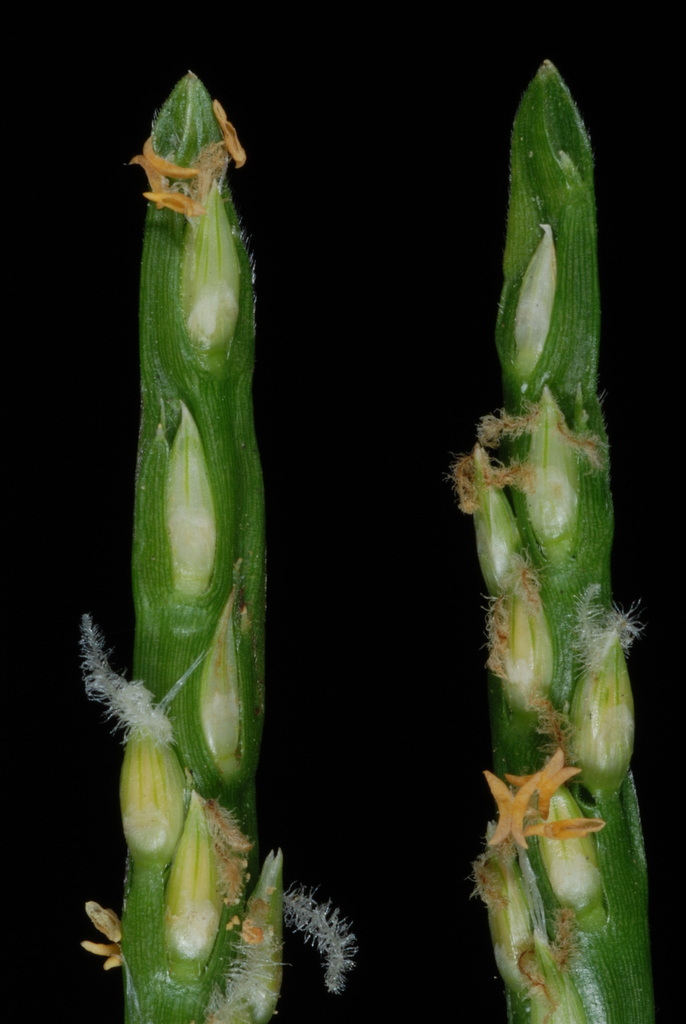
Saint Augustine grass
Stenotaphrum secundatum
St. Augustine grass (Stenotaphrum secundatum), also known as buffalo turf in Australia and buffalo grass in South Africa, is a species of grass in the family Poaceae. It is a warm-season lawn grass that is popular for cultivation in tropical and subtropical regions. It is a medium- to high-maintenance grass that forms a thick, carpetlike sod, crowding out most weeds and other grasses.
From the article St. Augustine grass on Wikipedia (CC BY-SA), quoted section by section
Description
St. Augustine is a dark green grass with broad, flat blades. It spreads by aboveground stolons, commonly known as "runners", and forms a dense layer. The grass occurs on both sides of the Atlantic Ocean, including much of the southeastern United States, Texas, Mexico, and Central and South America. It has escaped cultivation in California, Hawaii, many Pacific islands, South Africa and New Zealand. St. Augustine grass occurs in most Caribbean and Mediterranean areas. It grows best in tropical climates. It is often seen in lagoons and marshes, on shorelines, and wherever there is a good amount of moisture.
Wikipedia: “Characteristics”
At the table
St. Augustine grass is commonly used in pastures and on ranches. It is a popular lawn grass, rivalling bermudagrass, though St. Augustine is somewhat less drought-tolerant.
Wikipedia: “Uses”
How it is grown
Only recently has commercially valuable and viable seed for St. Augustine become available, so it has typically been propagated by plugs, sprigs, or sod. Once the grass is cultivated, it can propagate on its own. St. Augustine can grow in a wide range of soil types with a pH between 5.0 and 8.5. It usually blooms in spring and summer.
Wikipedia: “Planting and propagation”
Where it lives
Recorded sightings
—
geo-referenced records in GBIF, from museums, herbaria and field observers.
Drag the globe to turn it. Dots are where records exist, not a range map; darker means more records.
In the stacks
Searching the stacks…
Every page naming Stenotaphrum secundatum in the Biodiversity Heritage Library →
This page is assembled live from iNaturalist, GBIF, Wikipedia, the Source Library and the Internet Archive. It is not yet part of the hand-edited codex. iNaturalist taxon 79210.