- Plants
- ›Vascular Plants
- ›flowering plants
- ›Dicots
- ›nightshades, bindweeds, gooseweeds, and allies
- ›nightshade family
- ›nightshades and allies
- ›nightshades and jaltomatas
- ›Solanum
- ›Solanum nigrum
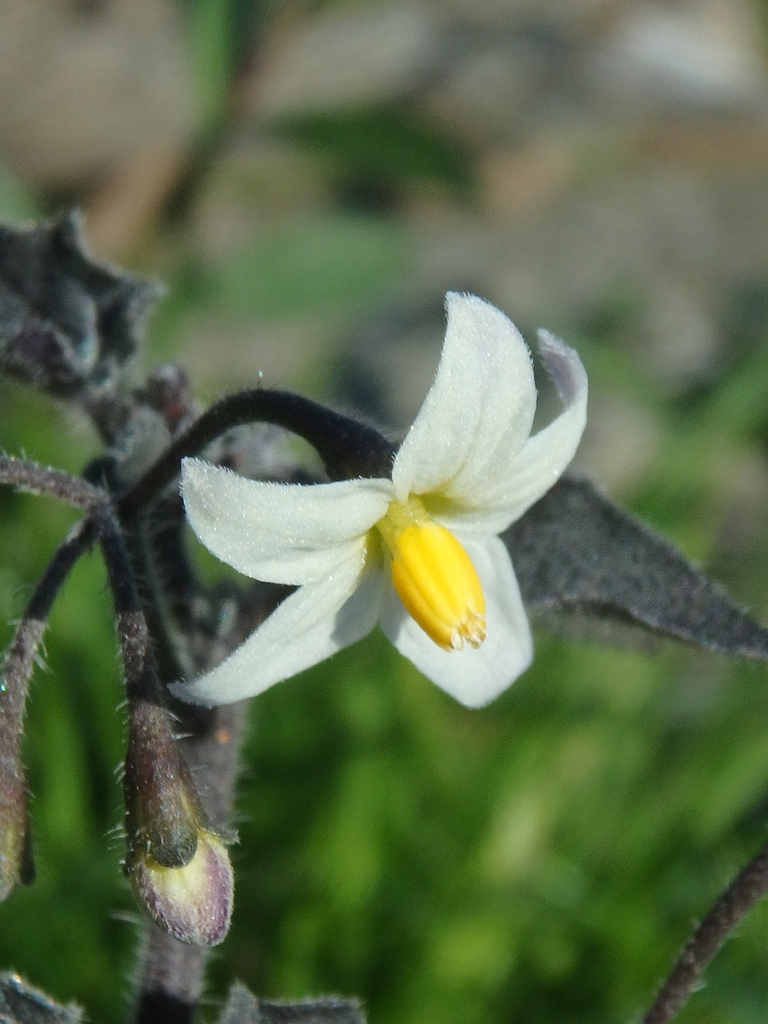
black nightshade
Solanum nigrum
Solanum nigrum, the European black nightshade or simply black nightshade or blackberry nightshade, is a species of flowering plant in the family Solanaceae, native to Eurasia and introduced in the Americas, Australasia, and South Africa. Ripe berries and cooked leaves of edible strains are used as food in some locales, and plant parts are used as a traditional medicine. Some other species may also be referred to as "black nightshade".
Solanum nigrum has been recorded from deposits of the Paleolithic and Mesolithic era of ancient Britain and it is suggested by the botanist and ecologist Edward Salisbury that it was part of the native flora there before Neolithic agriculture emerged. The plant was known and mentioned by ancient herbalists, including Dioscorides. In 1753, Carl Linnaeus described six varieties of Solanum nigrum in Species Plantarum.
From the article Solanum nigrum on Wikipedia (CC BY-SA), quoted section by section
Description
Black nightshade is a common herb or short-lived perennial shrub, found in many wooded areas, as well as disturbed habitats. It reaches a height of 30 to 120 cm (12 to 47 in), leaves 4.0 to 7.5 cm (1.6 to 3.0 in) long and 2 to 5 cm (1 to 2 in) wide; ovate to heart-shaped, with wavy or large-toothed edges; both surfaces hairy or hairless; petiole 1 to 3 cm (0.5 to 1 in) long with a winged upper portion. The flowers have petals greenish to whitish, recurved when aged and surround prominent bright yellow anthers. The berry is mostly 6 to 8 mm (0.24 to 0.31 in) in diameter, dull black or purple-black. In India, another strain is found with berries that turn red when ripe. Sometimes S. nigrum is confused for the more toxic deadly nightshade (Atropa belladonna), which is in a different genus within Solanaceae. A comparison of the fruit shows that the black nightshade berries grow in bunches, whereas the deadly nightshade berries grow individually. Another distinction is black nightshade flowers have white petals, whereas deadly nightshade flowers have purple petals.
Growth habit. The suited soil pH value of black nightshade is between 5.5 and 6.5. Preferring rich organic matter; being well watered and improved verility. However, in the lack of organic matter, poor ventilation (heavy) clay, its roots will be stunted, plant growth is weak and fruiting commodity is therefore poor. …
At the table
Some of the uses ascribed to S. nigrum in literature may actually apply to other black nightshade species within the same species complex, and proper species identification is essential for food and medicinal uses (see Taxonomy section).
Culinary use. S. nigrum has been widely used as a food since early times, and the fruit was recorded as a famine food in 15th-century China. Despite toxicity issues with some forms, the ripe berries and boiled leaves of edible strains are eaten. The thoroughly boiled leaves – although strong and slightly bitter flavours – are used like spinach as horta and in fataya pies and quiches. The ripe black berries are described as sweet and salty, with hints of liquorice and melon. In Kenya, among the Abagusii, S. nigrum (rinagu – singular; amanagu – plural) is a vegetable delicacy which when blanched and sauteed or boiled to soften and then salted or sauteed and eaten with Ugali (a corn meal dish). In the rest of Kenya, S. nigrum (managu) is eaten in a similar way. In Tanzania, S. nigrum (mnafu or mnamvu in Kiswahili) is a popular green vegetable. Sautéed with chicken or pork, eaten with Ugali, it is an expensive meal in most restaurants in urban areas. Traditionally, the Iraqw people in northern Tanzania have used S. …
Wikipedia: “Uses”
Toxicity
Solanine levels in S. nigrum have been tested, and the plant is rarely fatal. Solanine poisoning symptoms may occur when immature green fruit or mature leaves are ingested raw. There is typically a delay of 6 to 12 hours after ingestion for symptoms to occur. Initial symptoms of toxicity include fever, sweating, vomiting, abdominal pain, diarrhea, confusion, and drowsiness. Death from ingesting large amounts of the plant results from cardiac arrhythmias and respiratory failure. Livestock have also been poisoned from nitrate toxicity by grazing the mature leaves and green berries of S. nigrum. In central Spain, the great bustard (Otis tarda) may act as a seed disperser of European black nightshade (Solanum nigrum). Black nightshade is highly variable, and some advice says to avoid eating the berries unless they are a known edible strain. The toxin levels may also be affected by the plant's growing conditions. The toxins in S. nigrum are most concentrated in the unripe green berries, and immature fruit should be treated as toxic. Most cases of suspected poisoning are due to consumption of leaves or unripe fruit. There are ethnobotanical accounts of S. nigrum young leaves and shoots being boiled as a vegetable with the cooking water being discarded and replaced several times to remove toxins. …
How it is grown
Black nightshade is cultivated as a food crop on several continents, including Africa and North America. The leaves of cultivated strains are eaten after cooking. A garden form with fruit about 1.27 cm (0.50 in) diam. is occasionally cultivated.
Wikipedia: “Cultivation”
Where it lives
Recorded sightings
—
geo-referenced records in GBIF, from museums, herbaria and field observers.
Drag the globe to turn it. Dots are where records exist, not a range map; darker means more records.
In the old herbals & bestiaries

Notable Commentaries on the History of Plants
Leonhart Fuchs · 1542 · p.720

Notable Commentaries on the History of Plants
Leonhart Fuchs · 1549 · p.718

Commentaries on the Six Books of Dioscorides
Pietro Andrea Mattioli · 1560 · p.690

Compendium of Materia Medica
李時珍 · 1596 · p.18

Collected Illustrations of the Three Realms (Volume 104)
王圻, 王思義 · 1609 · p.18

Illustrated Compendium of Materia Medica (Vol. 14)
吳其濬 · 1848 · p.45

Herbarium Portatile, Oder Behendes Kräuter- und Gewächs-Buch: Darinn nicht allein 1363. so wol Einheimische als Außländndische Kräuter mit Lateinisch und Deutscher Benennung abgebildet, sondern auch die meisten, so in der Medicin gebräuchlich, kürtzlich erkläret werden
Panckow, Thomas · 1656 · p.162
In the stacks
Searching the stacks…
Every page naming Solanum nigrum in the Biodiversity Heritage Library →
This page is assembled live from iNaturalist, GBIF, Wikipedia, the Source Library and the Internet Archive. It is not yet part of the hand-edited codex. iNaturalist taxon 79141.