- Plants
- ›Vascular Plants
- ›flowering plants
- ›Dicots
- ›Mallows, Rock Roses, and Allies
- ›Mallow and Hibiscus Family
- ›Malvoideae
- ›Hibisceae
- ›Howittia
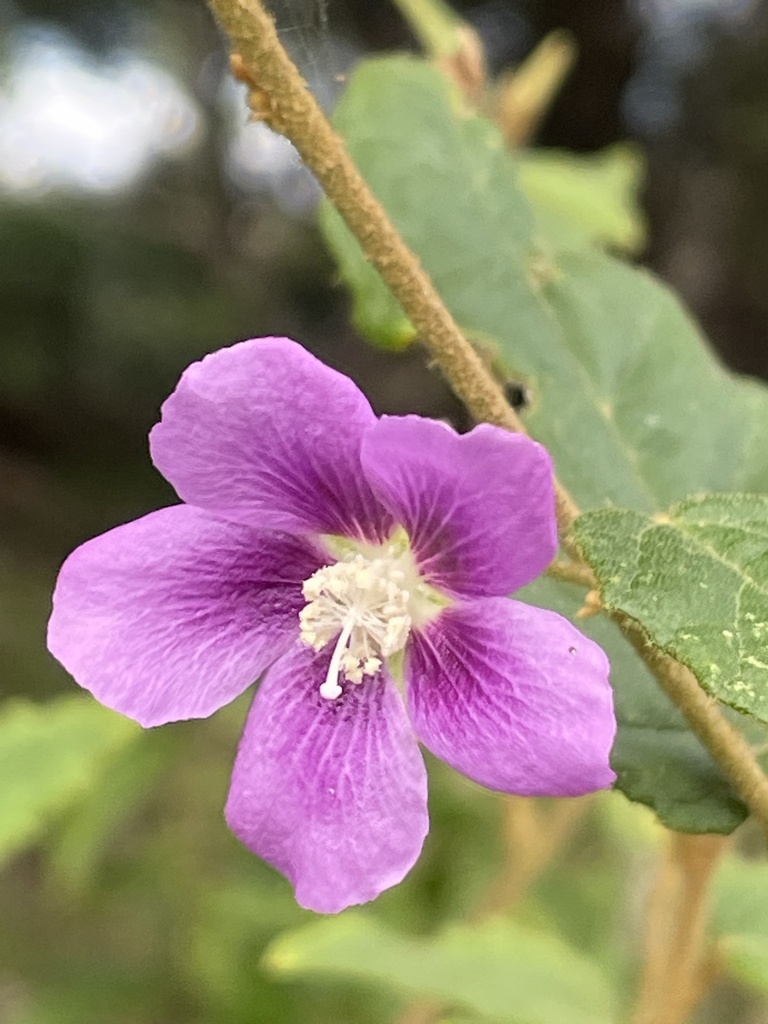
howittia
Howittia trilocularis
Howittia is a genus of plant containing the single species, Howittia trilocularis, commonly known as blue howittia, and is endemic to Australia. It is a tall shrub found growing in shaded valleys and on rainforest edges, it has hairy leaves and single, purple flowers.
From the article Howittia on Wikipedia (CC BY-SA), quoted section by section
Description
Howittia trilocularis is a spreading shrub up to 3 m (9.8 ft) high with oval to oblong-oval shaped leaves, 2.5–12 cm (0.98–4.72 in) long and 1.5–8 cm (0.59–3.15 in) wide, margins smooth, scalloped or slightly lobed. The under surface pale, white, yellow or brownish, irregularly covered with rusty or whitish star-shaped hairs, upper surface dark green. The whitish, lavender or deep mauve flowers are borne singly in the leaf axils, on a peduncle 3–4 cm (1.2–1.6 in) long and densely covered with long, matted hairs. The flowers have five petals, 1–2.5 cm (0.39–0.98 in) long on a pedicels 1.5–5 cm (0.59–1.97 in) long and yellow stamens. The calyx lobes are sharply pointed, 6–10 mm (0.24–0.39 in) long, rusty coloured with soft, star-shaped hairs. The seed capsule is rounded or indented globular shaped, 5–10 mm (0.20–0.39 in) in diameter and covered with soft, silky or star-shaped hairs. Flowering occurs from September to January.
Range & habitat
It is found growing in sheltered gullies, rainforest margins and eucalypt forests in New South Wales, Victoria and South Australia.
== References ==
Wikipedia: “Distribution”
Where it lives
Recorded sightings
—
geo-referenced records in GBIF, from museums, herbaria and field observers.
Drag the globe to turn it. Dots are where records exist, not a range map; darker means more records.
In the stacks
Searching the stacks…
Every page naming Howittia trilocularis in the Biodiversity Heritage Library →
This page is assembled live from iNaturalist, GBIF, Wikipedia, the Source Library and the Internet Archive. It is not yet part of the hand-edited codex. iNaturalist taxon 790876.