- Plants
- ›Vascular Plants
- ›flowering plants
- ›Dicots
- ›saxifrages, stonecrops, and allies
- ›stonecrop family
- ›Sempervivoideae
- ›Sedeae
- ›Sedum
- ›Gormania
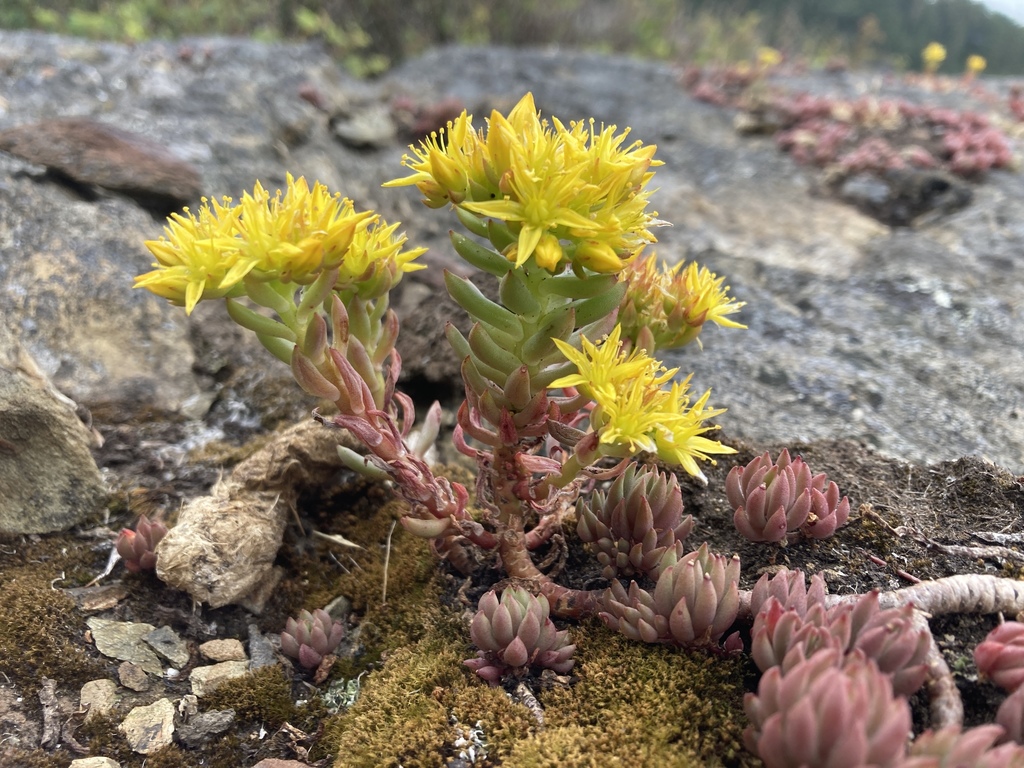
Lanceleaf Stonecrop
Sedum lanceolatum
Sedum lanceolatum is a species of flowering plant in the stonecrop family known by the common names lanceleaf stonecrop and spearleaf stonecrop.
It is native to western North America and occurs in western Canada and the United States. It is distributed from Alaska to Arizona and New Mexico and as far east as South Dakota and Nebraska. It grows in exposed, rocky mountainous habitats at moderate and high elevations, up to 4,048 meters (13,281 ft) in the Rocky Mountains. The plant persisted and evolved on sky islands and nunataks in these ranges during glaciation events during the Pleistocene epoch.
From the article Sedum lanceolatum on Wikipedia (CC BY-SA), quoted section by section
Description
Sedum lanceolatum is a very short succulent plant. Each plant will develop numerous branching sterile stems with tight clusters of leaves. The stems are both decumbent and ascending, growing along the surface of the ground or curving to grow upwards. Each stem will have a rosette of leaves at its end. The branchlets are easily broken apart. Each stem is biennial, but replaced by offsets. The leaves are not easily detached from the stems and are attached to the stems in a spiral. The shape of the leaves is subterete, nearly circular in cross section, with an outline that can be lanceolate, elliptic-lanceolate, or elliptic-ovate. They are also quite short, just 4.2 to 13 millimeters long, and 1.5–3.5 mm in width. The leaves vary in color with those exposed to strong, full sun conditions they are maroon while in less exposed situations they are dark gray-green and dull. The flowering stems are erect, growing straight upwards, to between 3 and 18 centimeters (1.2 and 7.1 in) in height. Leaves are attached alternately to flowering stems and often fall off by the time the flowers begin to bloom. The flowering head is a flat-topped cluster of yellow flowers. The number of flowers on each stem may be as few as three or as many as twenty-five. …
Range & habitat
Lanceleaf stonecrop has a native range across much of western North America from Alaska to New Mexico. In Canada it is reported from the Yukon Territory, British Columbia, Alberta, and Saskatchewan. In the Pacific Northwest, it grows in much of Washington, Oregon, and Idaho. Eastward across the Rocky Mountains it is only reported from three counties in Montana. It grows in five counties in the Black Hills of southwest South Dakota while only found Sioux County at the western edge of Nebraska. It grows in all but two counties of Wyoming and the western two-thirds of Colorado. It only grows in the northwestern part of New Mexico. In the Southwestern United States it grows throughout all of Utah, the northeastern part of Arizona, many parts of Nevada, and in the high Sierra Nevada ranges, the Klamath Ranges, and high Cascade Mountains in California. The exact extent of its range is uncertain, but is estimated at between 20,000 and 2,500,000 square kilometers (8,000 and 965,000 sq mi). It grows on stony outcrops, dry rocky slopes, and areas of lithosol, places with very thin and poorly developed soils. It is associated with a wide range of stones including limestone, sandstone, marble, andesite, basalt, granodiorite, and granite. However, the botanist Charles Uhl reports that it is not often found or may be absent from basaltic rocks and lava outcroppings. …
Wikipedia: “Range and habitat”
What it does
Sedum lanceolatum is almost the sole host plant of the Rocky Mountain apollo butterfly (Parnassius smintheus) in large parts of its range. The plant produces a deterrent cyanoglycoside, sarmentosin, so that herbivores do not feed on it. This butterfly's larvae sequester sarmentosin from the plant for their own defense. However, it has been found that if the plant becomes physically damaged by mechanical means, the larvae feeding on it have reduced growth rates, possibly due to an induced defense by the plant itself. Consequently, the larvae often hurry to feed, then switch to another plant within the time window offering the highest nutritional quality. Larvae will typically feed and leave a plant in less than half an hour. From November to February, the leaves of their foodplant are fatally toxic to the larvae, but for the rest of the year, the larvae feed and develop normally. If the snow melts before March, the eggs hatch while the larval foodplant is still toxic, and the larvae perish.
Wikipedia: “Ecology”
At the table
Lanceleaf stonecrop is a drought tolerant species that is planted in rock gardens. However, it is a rare species in the plant trade and usually only available from specialist sources in Europe. It can be slow to spread and difficult to grow in areas of high rainfall.
Wikipedia: “Uses”
Where it lives
Recorded sightings
—
geo-referenced records in GBIF, from museums, herbaria and field observers.
Drag the globe to turn it. Dots are where records exist, not a range map; darker means more records.
In the stacks
Searching the stacks…
Every page naming Sedum lanceolatum in the Biodiversity Heritage Library →
This page is assembled live from iNaturalist, GBIF, Wikipedia, the Source Library and the Internet Archive. It is not yet part of the hand-edited codex. iNaturalist taxon 79026.