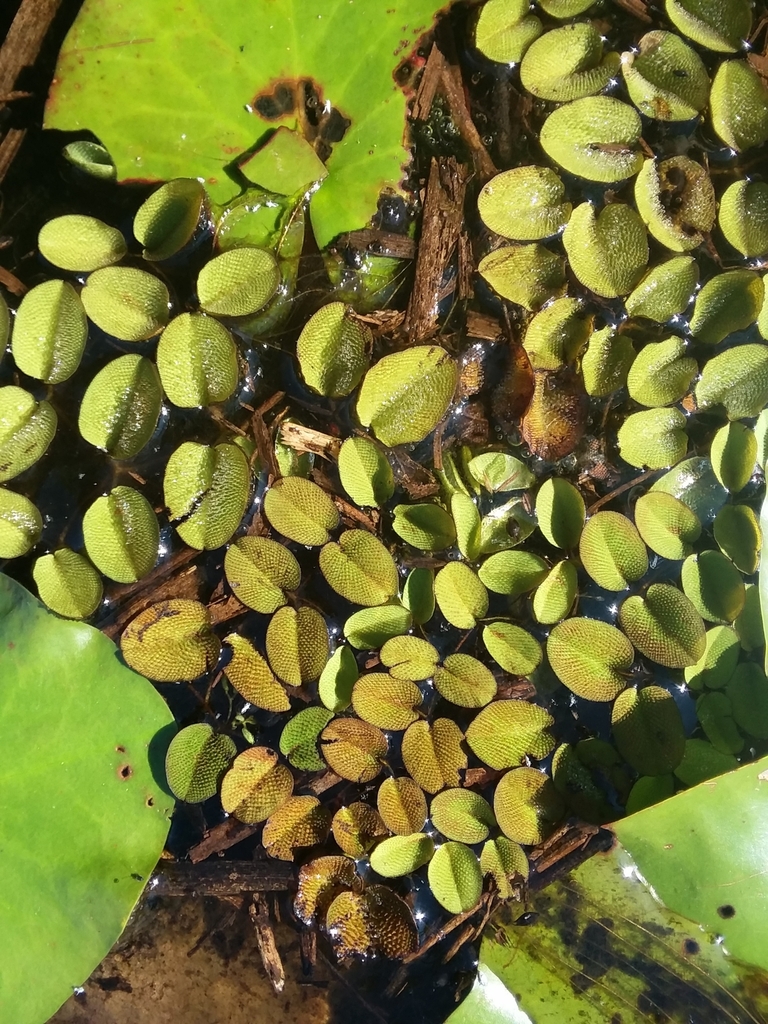
Giant Salvinia
Salvinia molesta
Salvinia molesta, commonly known as giant salvinia, is a free-floating aquatic fern native to southeastern Brazil. It is invasive in many parts of the world, especially southern Africa, where it is commonly known as Kariba weed due to its infestation of Lake Kariba, a large artificial lake situated between Zambia and Zimbabwe. The fern is notable for its long and broad fronds and bristly, waterproof surfaces. The fronds are produced in pairs, with a third modified root-like frond that hangs in the water.
S. molesta has been accidentally introduced to several lakes throughout the world. Since 2019, it has been included in the European Union's list of invasive alien species of Union concern. The species cannot be legally imported, cultivated, transported, commercialized, planted, or intentionally released into the environment in the European Union. In the United States, it has been introduced into Caddo Lake in Texas, where it has caused significant eutrophication.
From the article Salvinia molesta on Wikipedia (CC BY-SA), quoted section by section
Description
S. molesta belongs to a complex of closely-related water fern species that are only visually distinguishable by their unique sporocarps. The fern was originally grown as an ornamental plant, but has since escaped its native habitat and become a pest in many regions worldwide. S. molesta exhibits multiple growth forms; its primary invasive form has small, flat leaves, while its tertiary form has larger leaves that are crowded and folded. Under favorable conditions, the plants can form a dense mat up to two feet in thickness; such mats are often large enough to interfere with recreational activities on lakes and waterways. S. molesta extracts nutrients and pollutants from the water. When it is dried out, it can be used as mulch. Several organic and chemical compounds have been isolated from S. molesta, including 6'-O-(3,4-dihydroxy benzoyl)-beta-D-glucopyranosyl ester, 4-O-beta-d-glucopyranoside-3-hydroxy methyl benzoate, methyl benzoate, hypogallic acid, caffeic acid, paeoniflorin, and pikuroside.
Range & habitat
S. molesta is native to Brazil, but is now widely distributed in global tropical and subtropical climate zones. It is known for taking over large bodies of slow-moving fresh water. S. molesta has been naturalized in Texas and Louisiana, and has also been observed and reported in Alabama, Mississippi, Florida, and Georgia. It can also be found where the lower Colorado River borders Arizona and California. The regions of Texas where S. molesta is naturalized contain a total of 14 drainage basins with infested water bodies; these basins are used as impoundments on tributaries that flow near federally protected wetlands. In October 2020, the Texas Parks and Wildlife Department detected specimens of S. molesta in the Lone Star Lake within the city of Marshall while surveying fish populations.
Invasion. S. molesta originated in southeast Brazil, and was exported from its native habitat to be used as an ornamental plant in aquariums and garden ponds. From these environments, it escaped or was deliberately released into the wild. Specimens of the fern may also have been exported along with fresh and iced fish. Once in a waterway, it can be transported to adjacent bodies of water by boats, which not only spread it to new areas, but also break up the plant, allowing it to propagate quickly. S. molesta has been spread by contaminated aquatic plant stocks, boats, and other watercraft. S. …
Wikipedia: “Distribution”
How it is grown
S. molesta reproduces by asexual reproduction. It is capable of growing extremely quickly, starting from small fragments and doubling in dry weight every 2.2–2.5 days. The fern can grow from fragments or dormant buds that have been detached from the main plant. Each node can produce up to five buds, allowing the plant to spread rapidly under favorable conditions. The plant also generates genetically defective spores that do not produce viable offspring. S. molesta prefers to grow in areas of slow-moving water, such as those found in lakes, ponds, oxbow lakes, streams, ditches, marshes, and rivers. It prefers nutrient-rich waters, and thrives in bodies of water that are eutrophic or polluted by wastewater. The fern usually does not grow in brackish or salty water, but its presence has been reported in streams with a tidal flow in southeast Texas. It can tolerate dewatering, as well as exposure to low or very high temperatures, although it prefers to grow in moderate temperatures. The United States Geological Service has highlighted zones 7a, 8, 9, and 10 of the USDA Plant Hardiness Map as possible regions of growth for the fern. The survivability of individual S. molesta specimens is heavily dependent on environmental conditions. It can survive on a mud bank for a short period of time, but will eventually wither and die due to the dry conditions. …
Wikipedia: “Growing conditions”
Where it lives
Recorded sightings
—
geo-referenced records in GBIF, from museums, herbaria and field observers.
Drag the globe to turn it. Dots are where records exist, not a range map; darker means more records.
In the stacks
Searching the stacks…
Every page naming Salvinia molesta in the Biodiversity Heritage Library →
This page is assembled live from iNaturalist, GBIF, Wikipedia, the Source Library and the Internet Archive. It is not yet part of the hand-edited codex. iNaturalist taxon 78976.