- Plants
- ›Vascular Plants
- ›flowering plants
- ›Dicots
- ›pinks, cactuses, and allies
- ›knotweed family
- ›Polygonoideae
- ›Docks, Sorrels and Rhubarbs
- ›Rumex
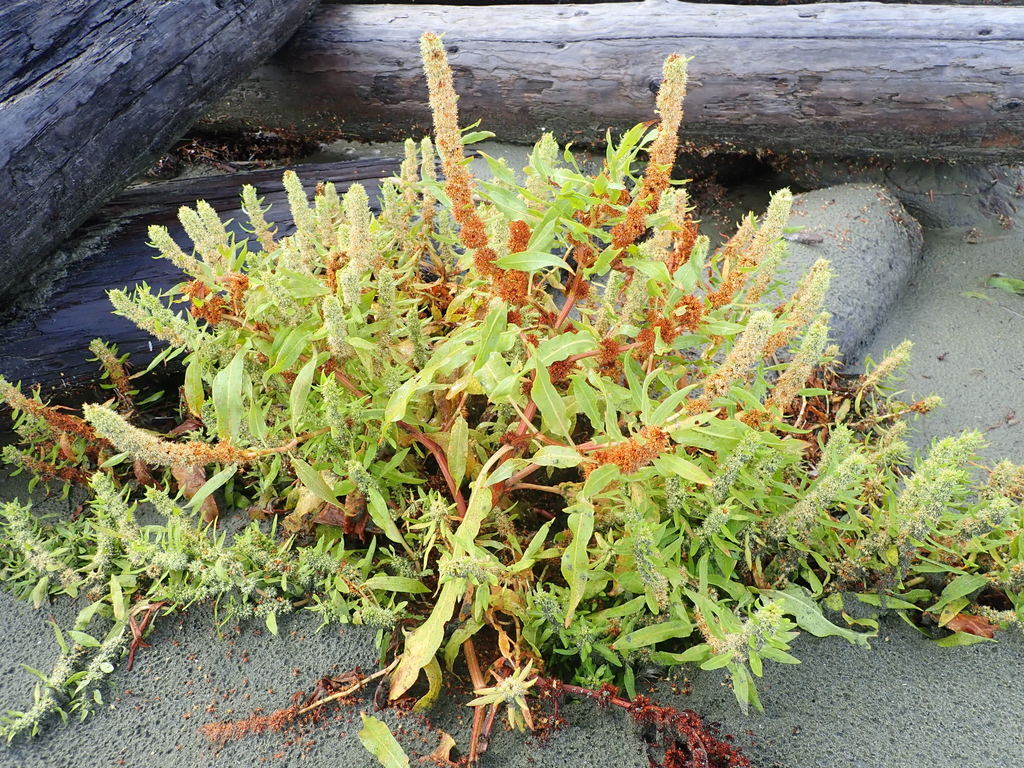
pacific golden dock
Rumex persicarioides
Rumex persicarioides is a species of flowering plant in the family Polygonaceae, native to western Canada and the US (British Columbia, Oregon and California) and eastern Canada and the northeastern US (New Brunswick, Nova Scotia, Prince Edward Island, Quebec, Connecticut, Massachusetts and New York State).
From the article Rumex persicarioides on Wikipedia (CC BY-SA), quoted section by section
Description
R. persicarioides stands erect at about 15–75 cm in height. The plant contains papillose and pubescent protrusions in its inflorescence and on the abaxial leaf blade. The stem is mostly inflorescent, with branching mostly starting a third of the way up from the base. Shorter plants start inflorescence at the base of the stem. Flowers of R. persicarioides are straw-colored and densely whorled at the distal most end of the inflorescence. The flowers consist of triangular tepals with tooth-like margins and brown fruiting achenes. The pedicels are threadlike and weakly visible, being 3-7mm in length. The leaves of R. persicarioides are long, thin lanceolate or oblong-lanceolate blades ranging from 5–25 cm in length with vaguely undulated or entire margins. Leaf blades are either truncate or cordate at the base and acute at the tip.
Range & habitat
R. persicarioides thrives in wet and saline ecosystems, typically being found in coastal regions and salt marshes. It is native to western Canada and the US (British Columbia, Oregon and California) and eastern Canada and the northeastern US (New Brunswick, Nova Scotia, Prince Edward Island, Quebec, Connecticut, Massachusetts and New York State).
== References ==
Wikipedia: “Distribution”
Where it lives
Recorded sightings
—
geo-referenced records in GBIF, from museums, herbaria and field observers.
Drag the globe to turn it. Dots are where records exist, not a range map; darker means more records.
In the stacks
Searching the stacks…
Every page naming Rumex persicarioides in the Biodiversity Heritage Library →
This page is assembled live from iNaturalist, GBIF, Wikipedia, the Source Library and the Internet Archive. It is not yet part of the hand-edited codex. iNaturalist taxon 78908.