- Plants
- ›Vascular Plants
- ›flowering plants
- ›Dicots
- ›pinks, cactuses, and allies
- ›knotweed family
- ›Polygonoideae
- ›Polygoneae
- ›Polygoninae
- ›Duma
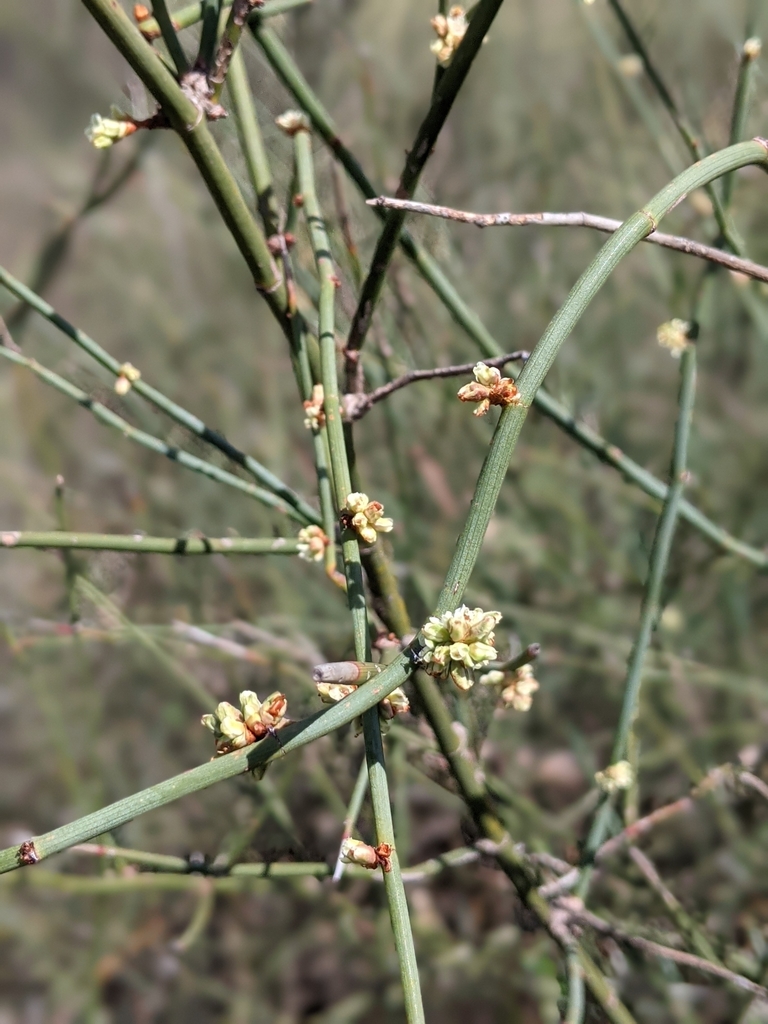
Tangled Lignum
Duma florulenta
Duma florulenta (synonym Muehlenbeckia florulenta), commonly known as tangled lignum or often simply lignum, is a plant native to inland Australia. It is associated with wetland habitats, especially those in arid and semiarid regions subject to cycles of intermittent flooding and drying out. The Wiradjuri name for the plant is gweeargal, and the Walmajarri name is Kirinykiriny, or Kurinykuriny.
From the article Duma florulenta on Wikipedia (CC BY-SA), quoted section by section
Description
Lignum is a perennial, dioecious shrub, growing to 2.5 m in height, with its multitude of thin, intertwined and tangled branches and branchlets forming dense thickets to the exclusion of other species. Its thin, narrow leaves are 15–70 mm long and 2–10 mm wide. The grey-green stems often end in a sharp point. The flowers are small and cream to yellowish, solitary or clustered along the branchlets and occurring through most of the year. The fruit is top-shaped, dry, and about 5 mm long.
Lignum often appears leafless as the leaves are produced on younger growth but soon die off, especially in dry conditions. New leaves and shoots are rapidly produced in response to rainfall or flooding. The plant has a very deep root system, penetrating the soil to at least 3 m in depth. It is highly tolerant of salinity and drought and may be used as an indicator of dryland soil salinity. Because of its densely tangled growth habit, it provides protected breeding habitat for native wildlife such as waterbirds, though it can also provide refuge for pest species such as feral pigs, foxes and rabbits.
Range & habitat
Lignum occurs in all of Australia's mainland states, as well as the Northern Territory. The plant's preferred habitats include floodplains, swamps, gilgais and other intermittently flooded areas. In southern Australia it is often associated with stands of river red gum and black box.
Wikipedia: “Distribution and habitat”
At the table
During the long period when the Australian government took children from their aboriginal parents (see Stolen generations), the Walmajarri people hid themselves and their children within the dense tangle of these plants so that the police could not find them.
== References ==
Wikipedia: “Aboriginal uses”
Where it lives
Recorded sightings
—
geo-referenced records in GBIF, from museums, herbaria and field observers.
Drag the globe to turn it. Dots are where records exist, not a range map; darker means more records.
In the stacks
Searching the stacks…
Every page naming Duma florulenta in the Biodiversity Heritage Library →
This page is assembled live from iNaturalist, GBIF, Wikipedia, the Source Library and the Internet Archive. It is not yet part of the hand-edited codex. iNaturalist taxon 786095.