- Plants
- ›Vascular Plants
- ›flowering plants
- ›Dicots
- ›carrots, ivies, and allies
- ›cheesewood family
- ›Pittosporum
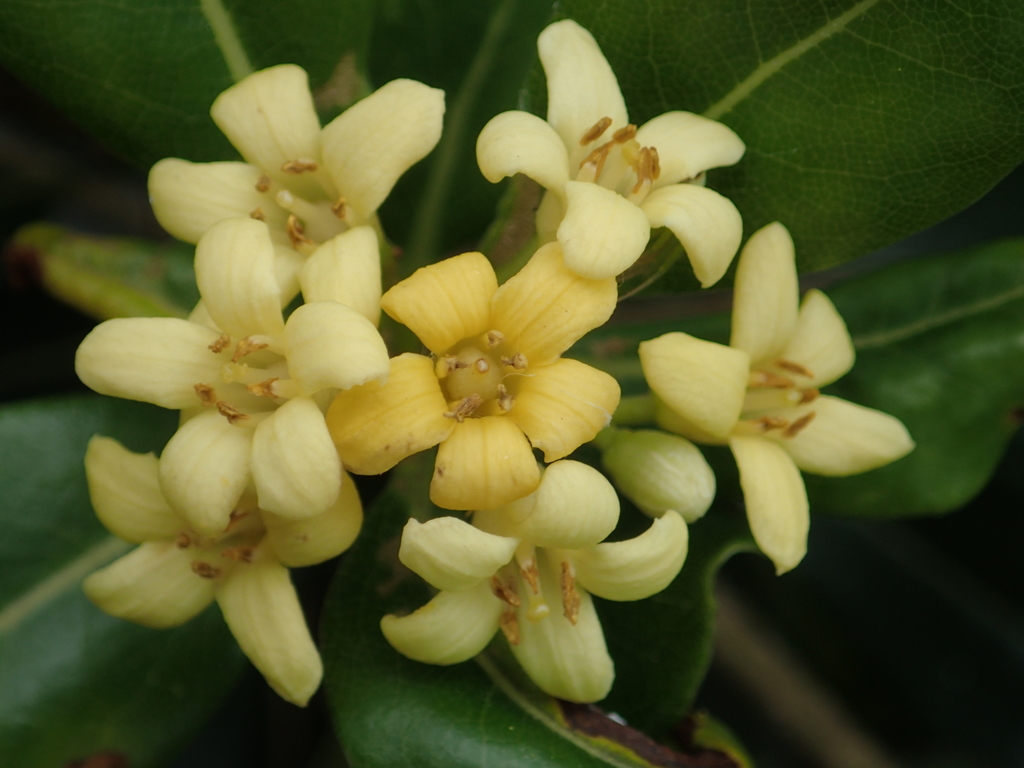
Japanese cheesewood
Pittosporum tobira
Pittosporum tobira is a species of sweet-smelling flowering plant in the pittosporum family Pittosporaceae known by several common names, including Australian laurel, Japanese pittosporum, mock orange and Japanese cheesewood. It is native to Japan (south of Kanto), China, Taiwan, and Korea, but it is used throughout the world as an ornamental plant in landscaping and as cut foliage.
From the article Pittosporum tobira on Wikipedia (CC BY-SA), quoted section by section
Description
It is an evergreen shrub which can reach 10 m (33 ft) tall by 3 m (10 ft) broad, and can become treelike. It can also be trimmed into a hedge. The leaves are oval in shape with edges that curl under and measure up to 10 cm (4 in) in length. They are leathery, hairless, darker, and shinier on the upper surfaces. The inflorescence is a cluster of fragrant flowers occurring at the ends of branches. The flower has five white petals each about a centimetre long. The fruit is a hairy, woody capsule about 1 cm wide divided into three valves. Inside are black seeds in a bed of resinous pulp.
Distribution. It is native to parts of Eastern Asia but has been introduced as an ornamental plant in many parts of the world. In China, it is found in the Fujian province and has been introduced in several others. In Japan, it is found in Honshu and the islands of Kyushu, Shikoku, as well as the Ryukyu Islands. It is also found in South Korea and northern Taiwan. It has been introduced to parts of the United States, and may be found in California, North Carolina, Georgia, and Florida. It grows in forests, limestone areas, slopes, sandy seashores, and roadsides, usually to 1,800 m (5,900 ft) above sea level.
Taxonomy and phylogeny. P. tobira is one of over 200 species of the genus Pittosporum which also includes kōhūhū and tarata. Phylogenetic research suggests P. japonicum , P. glabratum , P. …
What it does
Common pests of this plant include various aphids, mites, and leafhoppers, the cotton cushiony scale (Icerya purchasi), and root-knot nematodes (Meloidogyne spp.). It can be attacked by the pit-making pittosporum scale (Planchonia arabidis). It is vulnerable to the fungal plant pathogen Erythricium salmonicolor, which causes galls and the dieback disease known as pink limb blight. The pathogenic plant fungus Rhizoctonia solani forms white, web-like basidial fructifications on the lower sides of infected leaves of Pittosporum tobira. The fruits of the plant are not poisonous but not edible. However, they are eaten by bulbuls and other birds in Japan. The sticky substance around the seeds allow them to stick to the beaks of birds and be carried over long distances. The stench given off when broken is thought to have evolved to repel predation from foraging animals but it is a favorite of the sika deer.
Wikipedia: “Ecology and interactions”
At the table
This shrub is a common, drought-tolerant and fairly hardy landscaping plant. Many cultivars have been developed, including dwarf forms (such as Wheeler's dwarf) and the popular 'Variegata', which has variegated leaves. It is used for hedges, living privacy screens, and indoor and outdoor planter boxes. The stems, leaves, and dried fruits are used in flower arrangements. P. tobira is suitable for a Mediterranean climate, but may be more sensitive than other common ornamental plants to drought-induced stress. In 2014, a study comparing the effects of drought stress of five common ornamental plants found P. tobira to be the only plant whose total dry biomass was significantly affected (noting a 19% decrease in biomass). The plant may also be useful for fire-resistant landscaping due to its high gross heat of combustion. This plant may also be associated with more damage to other plant species when it is nonnative. A 2016 analysis of 49 plant species in green spaces in Madrid found P. tobira to be among the most likely shrubs to be associated with damage to native plant species. The species and the cultivar 'Variegatum' have both gained the Royal Horticultural Society's Award of Garden Merit.
Wikipedia: “Cultivation and uses”
In human culture
The binomial qualifier tobira derives from the Japanese name for the plant. The genus name Pittosporum derives from the Greek substantives pitta (meaning "pitch") and sporos (meaning "seed") in reference to the resinous substance that surrounds the seed. In Japan and China, where it is native, it is known as tobera (トベラ) and hǎitóng huā (海桐花) respectively. Its Japanese name, tobera, comes from "tobira no ki" which roughly translates to "door tree". This is because the plant emits a foul odour when leaves or branches are cut and so it was hung up in doorways during Setsubun along with the heads of sardines. In English, it is known as Japanese pittosporum, mock orange, Australian-laurel, and Japanese cheesewood. In German it is also known as chinesischer Klebsame ("Chinese sticky seed") or Pechsame (Pech, "pitch, tar"; Same, "seed"). In Swedish it is called glansbuske ("glossy shrubs"). In Brazilian Portuguese, it is known as lágrima-sabéia ("teardrop"), pau-de-incenso ("incense stick"), or pitósporo-japonês.
Wikipedia: “Names and etymology”
Where it lives
Recorded sightings
—
geo-referenced records in GBIF, from museums, herbaria and field observers.
Drag the globe to turn it. Dots are where records exist, not a range map; darker means more records.
In the stacks
Searching the stacks…
Every page naming Pittosporum tobira in the Biodiversity Heritage Library →
This page is assembled live from iNaturalist, GBIF, Wikipedia, the Source Library and the Internet Archive. It is not yet part of the hand-edited codex. iNaturalist taxon 78592.