- Plants
- ›Vascular Plants
- ›flowering plants
- ›Dicots
- ›carrots, ivies, and allies
- ›cheesewood family
- ›Pittosporum
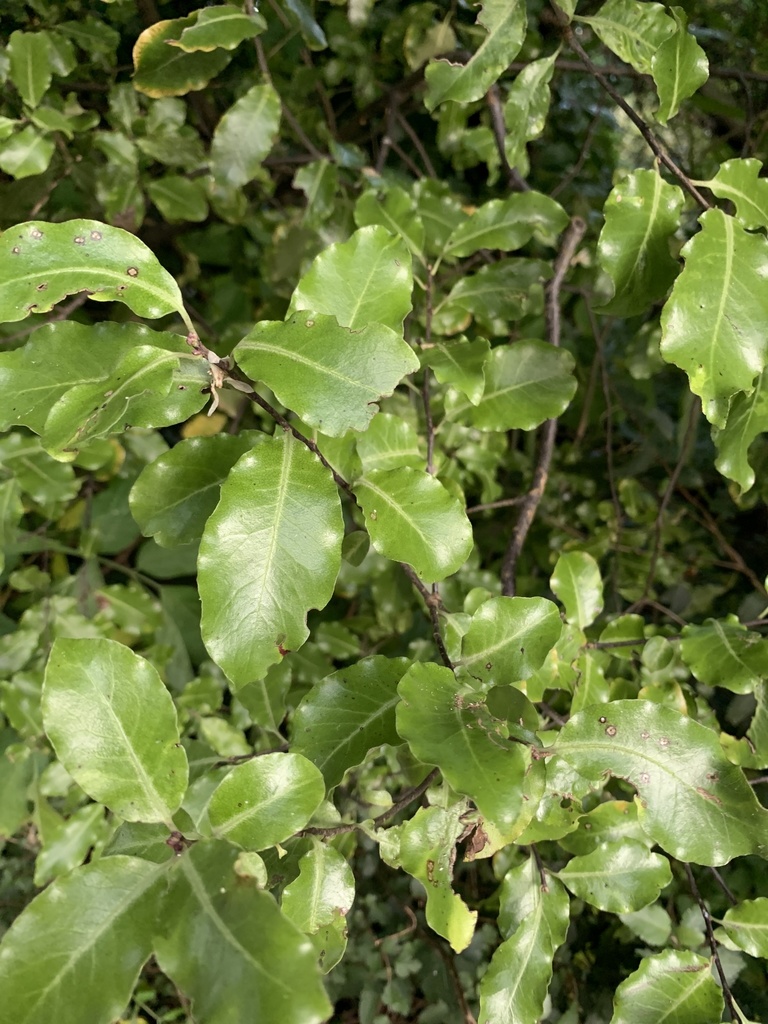
Kōhūhū
Pittosporum tenuifolium
Pittosporum tenuifolium is a small evergreen tree, up to 10 m (33 ft), native to New Zealand, commonly known as kōhūhū and black matipo, and by other Māori names kohukohu and tawhiwhi. It is sometimes grown under the cultivar name 'Nigricans', so called because of its black stems. In horticulture it is valued for its coloured foliage (cultivated variations include purple, "silver" and variegated leaves), and for its tolerance of some horticulturally difficult growing conditions, including dry soils...
From the article Pittosporum tenuifolium on Wikipedia (CC BY-SA), quoted section by section
Description
Pittosporum translates to tarry – pittos – seed – sporum, a reference to the sticky fluid that encases the seeds and tenuifolium means thin – tenui – leaf – folium. Kōhūhū is a bush or small tree that grows up to around 8–10 metres tall. The trunk is slender (30–40 cm diameter) with a mottled dark grey bark color that progressively turns black towards the tips of the branches. The leaf coverage is compact in kōhūhū; the leaves are arranged alternately on the stem and the petiole is short. The leaves themselves are usually small – 2–4 cm long by 1–2 cm wide – but can grow up to 7 cm long. The edges are undulated and the leaf shape can range from oval to almost circular. Young leaves are covered in a layer of fine hairs that gets shed as the leaves grow. Adult leaves have a smooth, glossy texture. The colouration of the foliage is a silvery green, darker on the upper side and lighter underneath. The midrib of the leaf and its smaller lateral veins are whiteish and quite visible on the upper side of the leaf. Kōhūhū has small – around 1 cm in diameter – dark coloured flowers. The colour ranges from dark-red to dark-purple turning almost black as the flowers age. On rare occasions, the colour can be red or yellow. …
Range & habitat
Kōhūhū is well spread all over New Zealand, being absent only to the west of the Southern Alps and Stewart Island.
Wikipedia: “New Zealand range”
What it does
Most of the plants in the genus Pittosporum are easily propagated from seed, but germination may be slow. In horticultural production, the sticky substance coating the seeds is removed before sowing, as it acts as a germination inhibitor. The seeds are treated to simulate natural conditions for six weeks in order to improve germination rates. Kōhūhū is a relatively fast growing plant growing from 0.5 metres to 3 metres within five years. The root system is shallow and spread out. These characteristics make it ideal – when used in conjunction with another plants – for use in stream stabilisation and erosion control. Flowering happens in late spring, from October to November, and the maturation of the fruit happens between mid-summer and autumn, from January to March. The seedlings of kōhūhū are unusual, as in some cases they have three or four seed leaves instead of the usual two.
Wikipedia: “Life cycle/Phenology”
Where it lives
Recorded sightings
—
geo-referenced records in GBIF, from museums, herbaria and field observers.
Drag the globe to turn it. Dots are where records exist, not a range map; darker means more records.
In the stacks
Searching the stacks…
Every page naming Pittosporum tenuifolium in the Biodiversity Heritage Library →
This page is assembled live from iNaturalist, GBIF, Wikipedia, the Source Library and the Internet Archive. It is not yet part of the hand-edited codex. iNaturalist taxon 78591.