- Plants
- ›Vascular Plants
- ›flowering plants
- ›Dicots
- ›carrots, ivies, and allies
- ›cheesewood family
- ›Pittosporum
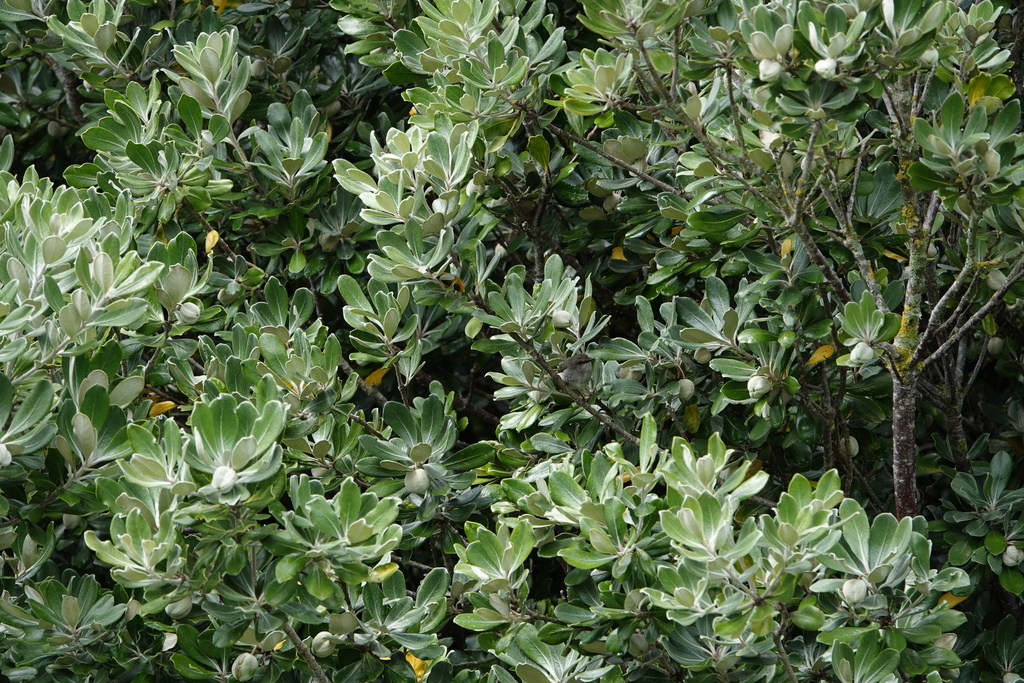
Karo
Pittosporum crassifolium
Pittosporum crassifolium, commonly called Karo, is a small tree or shrub native to New Zealand. Karo's original distribution was generally the top half of the North Island, although now it has naturalised throughout New Zealand and overseas in Norfolk Island and Hawaii. P. crassifolium occurs in lowland and coastal forests. Mature trees grow to about 5 metres (16 ft) in height. Other common names include stiffleaf cheesewood, and in Māori, kaikaro and kīhihi.
From the article Pittosporum crassifolium on Wikipedia (CC BY-SA), quoted section by section
Description
The leaves on this species are approximately 5-10x2-3cm and are oval shaped, dark green and leathery with grey tomentum (fine hairs) on the undersides of the leaves including the petioles and inflorescences. This tomentum provides protection against coastal winds by preventing salt damage and moisture loss.The leaves are simple and are alternately arranged and are very dense at the furthest point away from the stem. The leaf margins are recurved, thick and leathery (hence the name crassifolium which translates from Latin to "thick leaf") and they often show signs of insect damage. The apex of the leaf can vary from being obtuse (blunt and rounded) to acute (sharp and tapered) The petioles are the stalk between the leaf and the stem, and they measure approximately 4-14x1-3mm. When in ideal growing conditions, karo can grow into small trees (up to 5 metres (16 ft)) with multiple trunks. The bark on karo is dark brown and black and has distinct lenticels which allow for breathing. Juvenile plants often appear different from the adult form as the branchlets are covered with tomentum until they mature and become darker. During the spring to early summer, karo produce fragrant burgundy red flowers that are around 10cm long with long stalks and are borne in terminal umbels meaning that they grow in clusters, similar to the shape of an umbrella. …
Range & habitat
Karo's original distribution was generally the top half of the North Island, although now it has naturalised throughout New Zealand and overseas in Norfolk Island, Hawaii and the Isles of Scilly. This species has been recorded on iNaturalist in many other countries. The Integrated Taxonomic Information System has compiled a list of these countries which includes South Africa, Portugal, England and America. These areas where it has been found are all coastal, which has allowed this species to handle the conditions due to the natural adaptations it has. Karo is endemic to the north part of the North Island and is found from North Cape to Poverty Bay and in the Kermadec and Chatham Islands. This species has naturally spread through bird dispersal throughout New Zealand and is now a reasonably common species in the South Island, Chatham and Stewart Islands. Because this species wasn’t endemic to the South Island it is now considered an urban weed. It has been widely dispersed by exotic and indigenous birds.
Wikipedia: “Range”
What it does
The karo produces dark red flowers with a fragrant smell from August to October. Towards the end of the flowering period, this species produces green capsules which develop into seedpods with black seeds within. In September, when the fruit is ripe, the capsule splits into three or four valves which have an orange colouring on the inside. These fruits are then consumed by many different species including rats and possums. The ripe seed is on the shrub for approximately six months and ripens in winter which allows plenty of time for dispersal via birds and other animals. During spring, this species produces pale green leaves with white tomentum, which creates contrast against the old foliage with the dark leaves and red flowers.
Wikipedia: “Life cycle and phenology”
Where it lives
Recorded sightings
—
geo-referenced records in GBIF, from museums, herbaria and field observers.
Drag the globe to turn it. Dots are where records exist, not a range map; darker means more records.
In the stacks
Searching the stacks…
Every page naming Pittosporum crassifolium in the Biodiversity Heritage Library →
This page is assembled live from iNaturalist, GBIF, Wikipedia, the Source Library and the Internet Archive. It is not yet part of the hand-edited codex. iNaturalist taxon 78590.