- Plants
- ›Vascular Plants
- ›flowering plants
- ›monocots
- ›Aroids, Water Plantains, Seagrass, and allies
- ›Arum Family
- ›Aroideae
- ›Pistieae
- ›Pistia
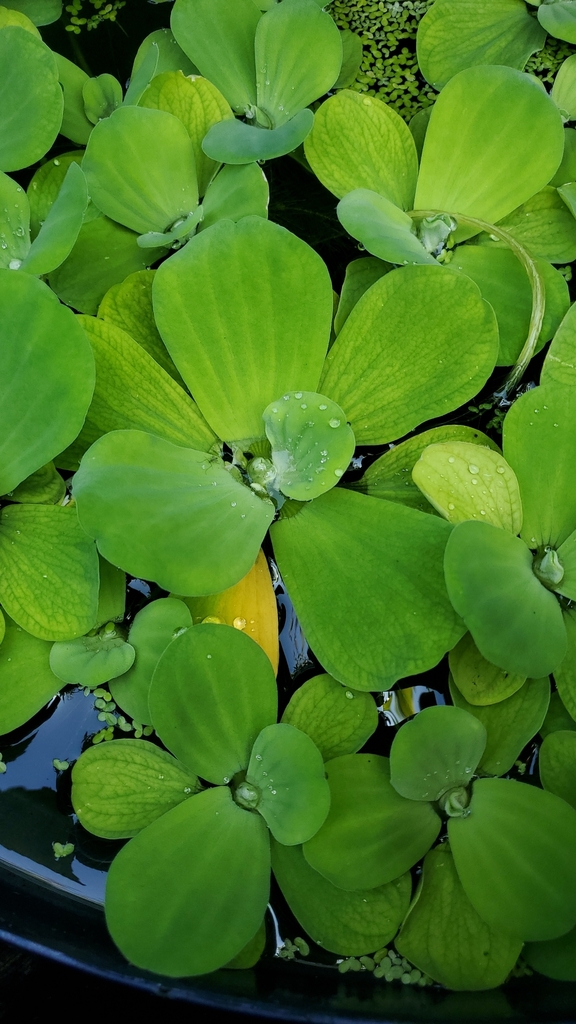
Water Lettuce
Pistia stratiotes
Pistia is a genus of aquatic plants in the arum family, Araceae. It is the sole genus in the tribe Pistieae which reflects its systematic isolation within the family. The single species it comprises, Pistia stratiotes, is often called water cabbage, water lettuce, Nile cabbage, or shellflower. Its native distribution is uncertain but is probably pantropical; it was first scientifically described from plants found on the Nile near Lake Victoria in Africa. It is now present, either naturally or through human introduction, in nearly all tropical and subtropical fresh waterways and is considered an invasive species as well as a mosquito breeding habitat. The specific epithet is derived from a Greek word, στρατιώτης, meaning "soldier", which references the sword-shaped leaves of some plants in the genus Stratiotes.
From the article Pistia on Wikipedia (CC BY-SA), quoted section by section
Description
Pistia stratiotes is a perennial monocotyledon with thick, soft leaves that form a rosette. It floats on the surface of the water, its roots hanging submersed beneath floating leaves. The leaves can measure 2–15 cm (0.8–5.9 in) long and are light green, with parallel venations and wavy margins. The surface of the leaves is covered in short, white hairs which form basket-like structures that can trap air bubbles and increase the plant's buoyancy. The spongy parenchyma with large intercellular spaces in the leaves also aids the plant in floating.
The flowers are dioecious, lack petals, and are hidden in the middle of the plant amongst the leaves. Pistia stratiotes has a spadix inflorescence, containing one pistillate flower with one ovary and 2–8 staminate flowers with two stamens. The pistillate and carpellate flowers are separated by folds in the spathe, where the male flowers are located above the female flowers. Oval, green berries with ovoid seeds form after successful fertilization. The plant undergoes asexual reproduction by propagating through stolons, yet evidence of sexual reproduction has also been observed in the ponds of Southern Brazil. Pistia stratiotes are found in slow-moving rivers, lakes, and ponds. The species displays optimal growth in the temperature range of 22–30 °C (72–86 °F), but can endure extreme temperatures up to 35 °C (95 °F). …
Range & habitat
The center of origin of Pistia stratiotes has long been a source of debate. Nativity to northern Africa is indicated by Egyptian hieroglyphics and reports of plants meeting the description of Pistia by Greek botanists, Dioscorides and Theophrastus in the Nile River. In addition, the co-evolution of Pistia stratiotes with various insects native to Brazil and Argentina, such as the water lettuce weevil, indicates a long-term native tenure in South America. Fossil specimens dating back to the late Pleistocene (~12,000 BP) and early Holocene (~3,500 BP) period are reported from Florida, indicating a native presence in the southeastern United States. Recent genetic evidence also suggests that Pistia is not actually a monotypic genus, as had been long assumed. Instead, Pistia appears to be composed of at least three genetically distinct, but morphologically and ecologically similar, species at a global scale.
Temperate occurrences. Though Pistia stratiotes is intolerant of cold temperatures, it has been recorded growing at least temporarily in temperate areas of North America and Europe. In the United States north of the Gulf of Mexico it has been found growing in Colorado, Connecticut, Delaware, Illinois, Kansas, Maryland, Michigan, Minnesota, Missouri, New York, North Carolina, Ohio, Rhode Island, South Carolina, and Wisconsin. …
Wikipedia: “Range”
In medicine
There are various medical uses of Pistia stratiotes throughout regions in Asia and Africa. In Nigeria, the dried leaves are prepared into a powder form and are applied to wounds and sores for disinfection. A similar use is present in Indian traditional medicine, where the powdered leaf is applied to syphilitic eruptions and skin infections. In Nigeria and Gambia, the leaf is infused in water to create an eyewash to treat allergic conjunctivitis. The eyewash is known to have a cooling and analgesic effect. Therefore, the plant is commonly called 'eye-pity' in Africa. In addition, the leaves of Pistia stratiotes can be burned into ash, and in Indian and Nigerian traditional medicine, the ash is used in treating ringworm infections of the scalp.
Medicinal properties. Anti-inflammatory properties: Extractions of the leaves of P. stratiotes reduces mast infiltration and degranulation in allergic reactions and presents anti-inflammatory properties. The ethanolic extracts have also been positively correlated with a reduction in inflammatory disorders, such as arthritis and fevers. Antifungal properties: With the popular use of Pistia stratiotes as a traditional treatment for ringworms, researchers have tested P. stratiotes methanolic extracts on dermatophyte fungi. The results of the studies depicted significant fungicidal activity on T. rubrum, T. mentagrophytes, and E. floccosum.
Wikipedia: “Medical treatment”
Where it lives
Recorded sightings
—
geo-referenced records in GBIF, from museums, herbaria and field observers.
Drag the globe to turn it. Dots are where records exist, not a range map; darker means more records.
In the old herbals & bestiaries

In the stacks
Searching the stacks…
Every page naming Pistia stratiotes in the Biodiversity Heritage Library →
This page is assembled live from iNaturalist, GBIF, Wikipedia, the Source Library and the Internet Archive. It is not yet part of the hand-edited codex. iNaturalist taxon 78589.