- Plants
- ›Vascular Plants
- ›flowering plants
- ›Dicots
- ›nightshades, bindweeds, gooseweeds, and allies
- ›nightshade family
- ›nightshades and allies
- ›groundcherries, lanterns, and allies
- ›Physalis
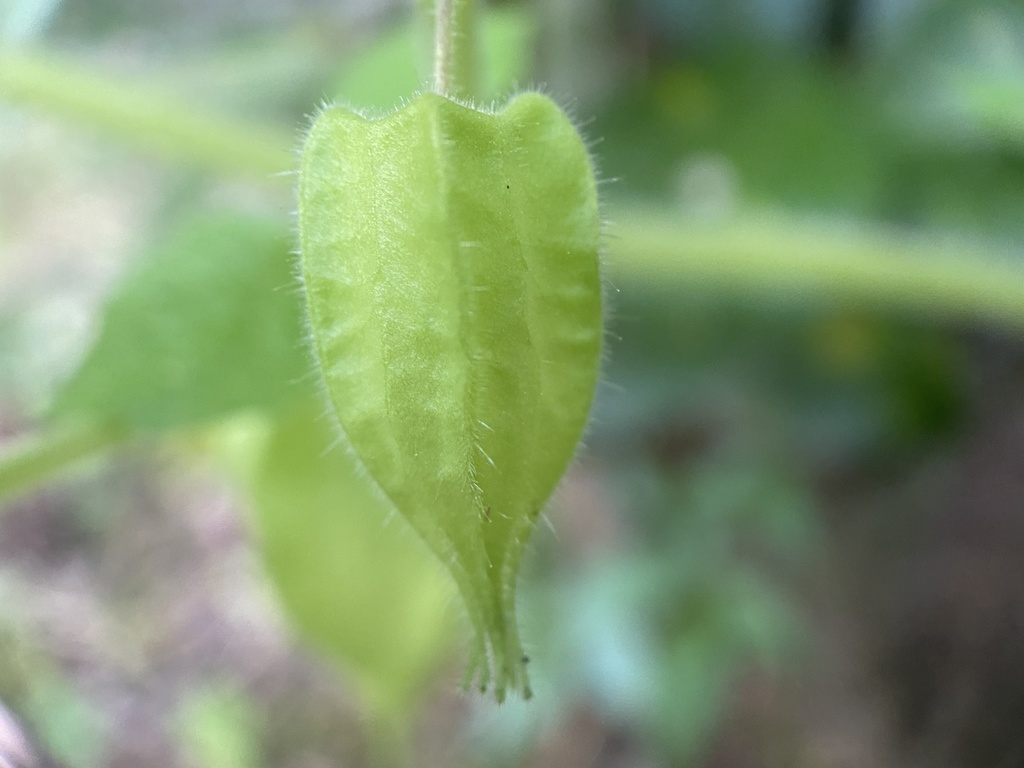
hairy groundcherry
Physalis pubescens
Physalis pubescens is a species of flowering plant in the nightshade family known by many common names, including husk tomato, low ground-cherry and hairy groundcherry in English, and muyaca and capulí in Spanish. It is native from Brazil, but also found in southern half of the United States, Mexico, Central and much of South America. It can be found elsewhere as an introduced species and sometimes a weed. It can grow in many types of habitat, including disturbed areas. This is an annual herb producing a glandular, densely hairy stem up to about 60 cm (24 in) in maximum height from a taproot. The oval or heart-shaped leaves are 3–9 cm (1.2–3.5 in) long and have smooth or toothed edges. The flowers blooming from the leaf axils are bell-shaped and about a centimeter long. They are yellow with five dark spots in the throats, and have five stamens tipped with blue anthers. The five-lobed calyx of sepals at the base of the flower enlarges as the fruit develops, becoming an inflated, ribbed, lanternlike structure 2–4 cm (0.79–1.57 in) long which contains the berry.
From the article Physalis pubescens on Wikipedia (CC BY-SA), quoted section by section
How it is grown
The fruits can be harvested and ripened for a few weeks to be made into pie or jelly; unripe fruits and green parts of the plant are somewhat poisonous. Members of the Toba-Pilagá culture of Gran Chaco consume the fruit raw. Toba-Pilagá children burst the fruits of Physalis pubescens var. hygrophila (Mart.) Dunal (a synonym of Physalis pubescens) when they are covered by the inflated calyx by placing it on the palm of the hand and striking it with the other hand in order to make noises as part of games.
Wikipedia: “Cultivation and use”
Where it lives
Recorded sightings
—
geo-referenced records in GBIF, from museums, herbaria and field observers.
Drag the globe to turn it. Dots are where records exist, not a range map; darker means more records.
In the stacks
Searching the stacks…
Every page naming Physalis pubescens in the Biodiversity Heritage Library →
This page is assembled live from iNaturalist, GBIF, Wikipedia, the Source Library and the Internet Archive. It is not yet part of the hand-edited codex. iNaturalist taxon 78570.