Sand Food
Pholisma sonorae
Pholisma sonorae, commonly known as sandfood, is a rare and unusual species of flowering plant endemic to the Sonoran Deserts to the west of Yuma, Arizona in the California Yuha, Mojave Desert and Colorado Desert, and south in the Yuma Desert, where it is known from only a few locations.
From the article Pholisma sonorae on Wikipedia (CC BY-SA), quoted section by section
Description
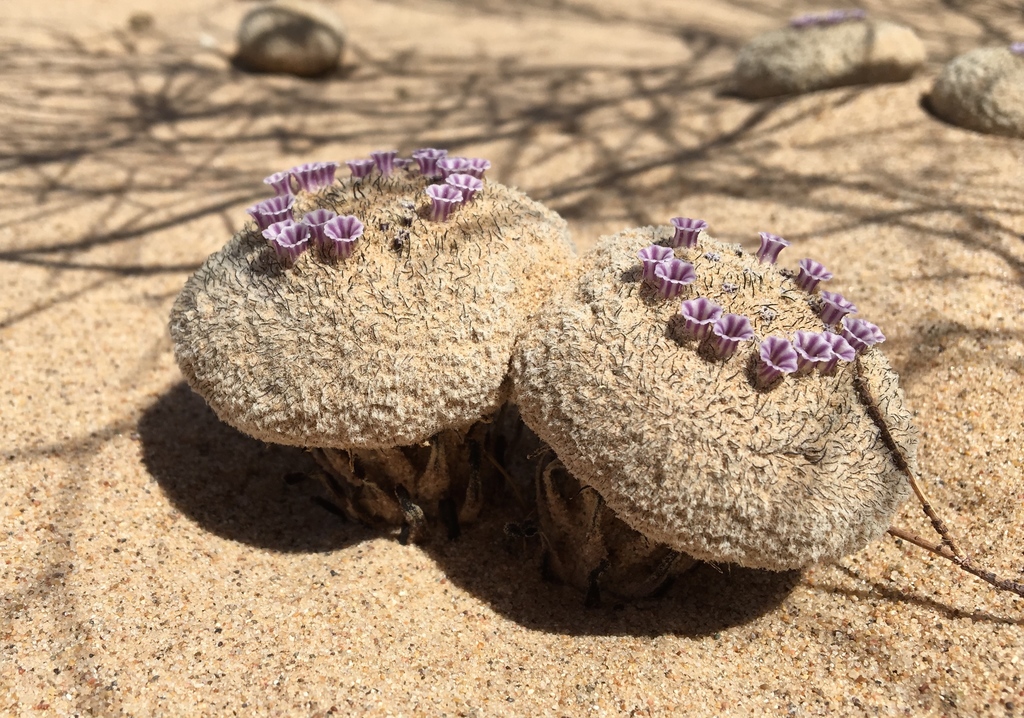
Pholisma sonorae is a perennial herb which grows in sand dunes, its fleshy stem extending down to two meters (six feet) below the surface and emerging above as a small rounded or ovate form. It may be somewhat mushroom-shaped if enough sand blows away to reveal the top of the stem. It is a parasitic plant which attaches to the roots of various desert shrubs such as wild buckwheats, ragweeds, plucheas, and Tiquilia plicata and T. palmeri to obtain nutrients. As a heterotroph, the Pholisma sonorae plant lacks chlorophyll and is grayish, whitish, or brown in color. It has glandular scale-like leaves along its surface. It is speculated that the plant obtains water, not from its host plants, but through stomata in its leaves. The plant blooms in centimeter-wide flowers which are pink to purple in color with white margins.
At the table
This was an important food item for certain desert-dwelling Native American peoples, including the Cocopah and the Hia C-eḍ O'odham.
Wikipedia: “Uses”
Where it lives
Recorded sightings
—
geo-referenced records in GBIF, from museums, herbaria and field observers.
Drag the globe to turn it. Dots are where records exist, not a range map; darker means more records.
In the stacks
Searching the stacks…
Every page naming Pholisma sonorae in the Biodiversity Heritage Library →
This page is assembled live from iNaturalist, GBIF, Wikipedia, the Source Library and the Internet Archive. It is not yet part of the hand-edited codex. iNaturalist taxon 78557.