- Plants
- ›Vascular Plants
- ›flowering plants
- ›Dicots
- ›pinks, cactuses, and allies
- ›knotweed family
- ›Polygonoideae
- ›Persicarieae
- ›Persicariinae
- ›Persicaria
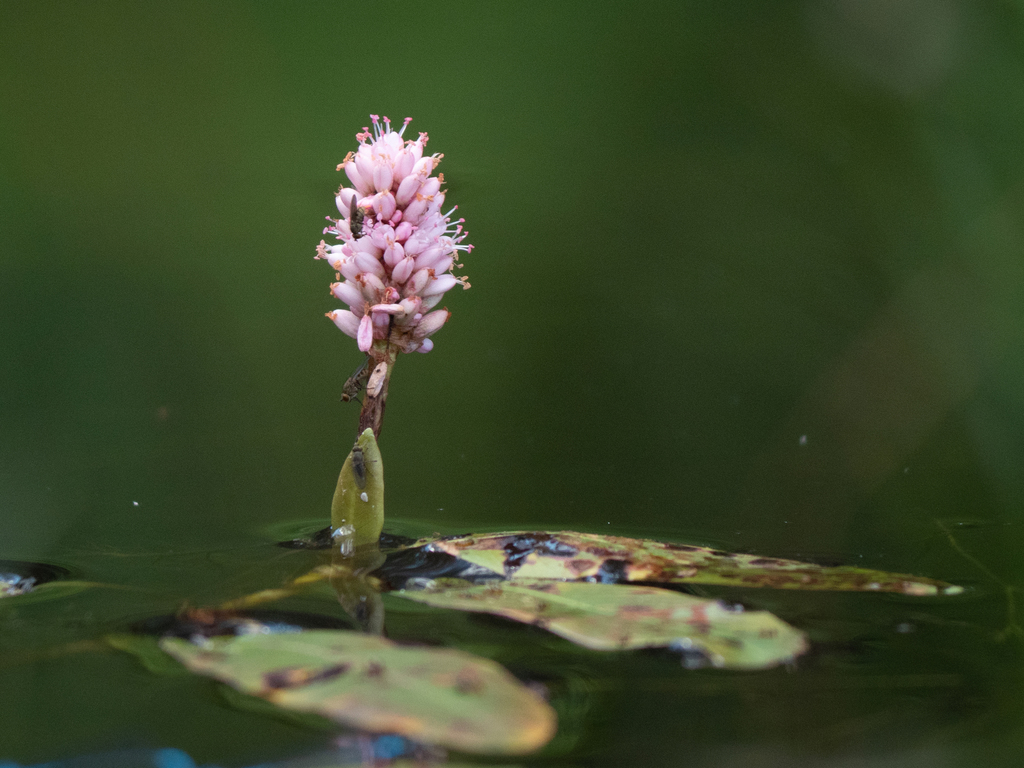
water smartweed
Persicaria amphibia
Persicaria amphibia (syn. Polygonum amphibium) is a species of flowering plant in the knotweed family known by several common names, including longroot smartweed, water knotweed, water smartweed, and amphibious bistort. It is native to much of North America, Asia, Europe, and parts of Africa, and it is known elsewhere as an introduced species and sometimes a noxious weed.
From the article Persicaria amphibia on Wikipedia (CC BY-SA), quoted section by section
Description
Persicaria amphibia produces a thick stem from its rhizome. The stem may creep, float, or grow erect, rooting at stem nodes that come in contact with moist substrate. Stems are known to reach 3 meters (10 feet) long in aquatic individuals. The stems are ribbed and may be hairless to quite hairy in texture. Leaves are lance-shaped or take various other shapes and are borne on petioles. They may be over 30 centimeters (1 foot) in length. The inflorescence is a dense terminal cluster of many five-lobed pink flowers. Plants may have bisexual or unisexual flowers, with some plants bearing only male or only female flowers. The fruit is a shiny brown rounded achene around 3 mm (0.12 in) long.
Range & habitat
Persicaria amphibia is native to a large area across the northern hemisphere, including Europe, Asia, North America, and parts of Africa. It has been introduced elsewhere, such as South America and other parts of Africa. It grows in many types of wet habitat, such as ponds, streams, and marshes. It is a rhizomatous perennial herb which takes a variety of forms and is quite variable in morphology. It may be an aquatic plant, growing submerged or floating in water bodies, it may grow in muddy and wet areas which are periodically inundated, and it may grow in moist spots on land, such as in meadows. Dry-land and fully aquatic plants are sometimes considered different named varieties of the species.
Wikipedia: “Distribution and habitat”
At the table
Various parts of this plant were used by several Native American groups as medicinal remedies and sometimes as food.
== References ==
Wikipedia: “Uses”
Where it lives
Recorded sightings
—
geo-referenced records in GBIF, from museums, herbaria and field observers.
Drag the globe to turn it. Dots are where records exist, not a range map; darker means more records.
In the old herbals & bestiaries

In the stacks
Searching the stacks…
Every page naming Persicaria amphibia in the Biodiversity Heritage Library →
This page is assembled live from iNaturalist, GBIF, Wikipedia, the Source Library and the Internet Archive. It is not yet part of the hand-edited codex. iNaturalist taxon 78450.