- Plants
- ›Vascular Plants
- ›flowering plants
- ›Dicots
- ›Mints, Plantains, Olives, and Allies
- ›Plantain Family
- ›Penstemon and allies
- ›Penstemon
- ›Penstemon
- ›Penstemon
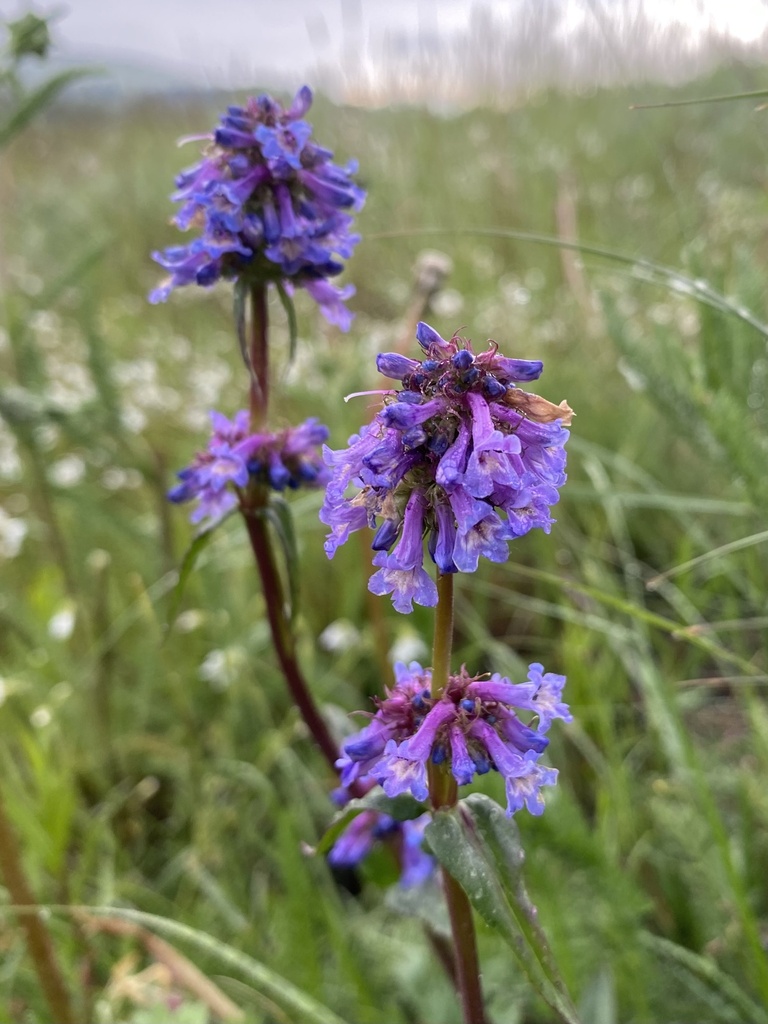
Small-flower Beardtongue
Penstemon procerus
Penstemon procerus is a species of penstemon known by the common name littleflower penstemon. It is native to western North America from Alaska to California to Colorado, as far east in Canada as Manitoba, where it grows in mountain habitat such as meadows, often in alpine climates. This herbaceous perennial forms mats of herbage with some erect stems reaching about 40 centimeters in maximum height. There are several varieties which vary in morphology, some more decumbent than others, some of which are known commonly as pincushion penstemons for their matted forms. In general, the leaves are lance-shaped to oval, plentiful around the base of the plant with smaller ones arranged in opposite pairs along the stem. The inflorescence is made up of one or more clusters of tubular flowers with lipped, lobed mouths. Each flower is no more than one centimeter in length and is purple to blue in color, often with a white throat. The outside of the flower is generally hairless, while the inside may be lined with white or yellowish hairs.
From the article Penstemon procerus on Wikipedia (CC BY-SA), quoted section by section
Description
Littleflower penstemons have a wide range of heights when mature, typically 3 to 40 centimeters (1–16 in), but occasionally as tall as 70 cm (28 in). Its stems can be hairless or be more or less covered in backwards pointing stiff hairs, but are never glaucous. The flowering stems can either grow straight upwards or lean outwards from the base of the plant before growing upwards, occasionally they may grow along the ground. The non-flowering stems are often numerous enough for form a mat at the base of the plant. Plants can have both basal leaves, springing directly from the base of the plant, and leaves attached to the stems, but in some plants the basal leaves are not well developed. They might have a somewhat leathery texture and can have rough backwards pointing hairs, be simply hairy, or hairless. Basal leaves and the ones lowest on the stems range from 0.9 to 9 cm long, only occasionally reaching 11.5 cm.
How it is grown
In cultivation in the UK the cultivar 'Roy Davidson' has won the Royal Horticultural Society's Award of Garden Merit. It copes with a range of situations, but requires a well-drained medium in full or partial sun.
Wikipedia: “Cultivation”
Where it lives
Recorded sightings
—
geo-referenced records in GBIF, from museums, herbaria and field observers.
Drag the globe to turn it. Dots are where records exist, not a range map; darker means more records.
In the stacks
Searching the stacks…
Every page naming Penstemon procerus in the Biodiversity Heritage Library →
This page is assembled live from iNaturalist, GBIF, Wikipedia, the Source Library and the Internet Archive. It is not yet part of the hand-edited codex. iNaturalist taxon 78414.