- Plants
- ›Vascular Plants
- ›flowering plants
- ›Dicots
- ›Buttercups, Poppies, and Allies
- ›Poppy Family
- ›Poppy Subfamily
- ›Papavereae
- ›Papaver
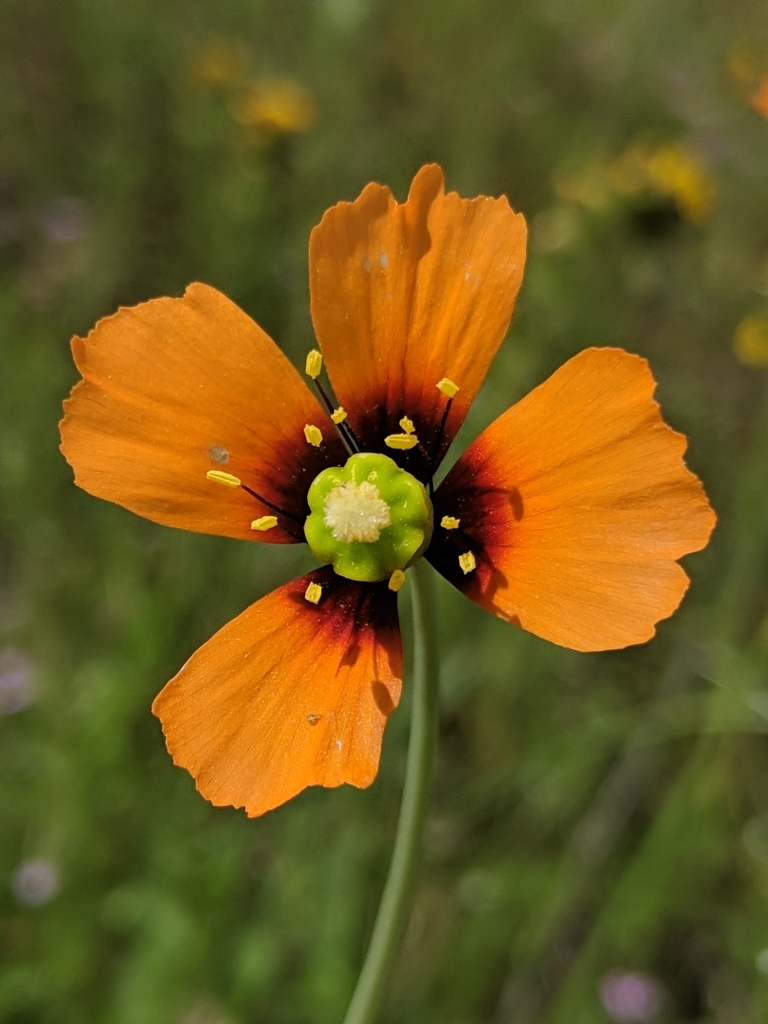
wind poppy
Papaver heterophyllum
Papaver heterophyllum, previously known as Stylomecon heterophylla, and better known as the wind poppy, is a winter annual herbaceous plant. It is endemic to the western California Floristic Province and known to grow in the area starting from the San Francisco Bay Area of Central Western California southwards to northwestern Baja California, Mexico. Its main habitat is often described as mesic and shady, with loamy soils such as soft sandy loam, clay loam, and leaf mold loam.
It is a member of the family Papaveraceae, the poppy family of flowering plants mostly found in the Northern Hemisphere. The name poppy originates from Early Old English popeġ, popaeġ, popæġ, or popei and is suspected to have previously come from Late Latin papavum, popauer.
From the article Papaver heterophyllum on Wikipedia (CC BY-SA), quoted section by section
Description
The wind poppy consists of radially symmetrical flowers supported by long, thin, and wiry stems with lobed leaves. The flower has bright orange petals and a purple-black central disk. The central disk is a deep red which distally fades at the petal bases, while the staminal filaments are dark red to black. It is a relatively short lived annual herb with a blooming period that can occur from February to late May, with the peak occurring in March and April. The wind poppy is a polyploid, with reports on chromosome number for the species concluding it as being octoploid. It is also self compatible and autonomously self-pollinating. Papaver heterophyllum can be compared to Papaver californicum because of the close species relationship delineated by similar vegetative and reproductive traits. It was stated by Ernst in 1962 that the “seedling stages are identical, and even the adult plants are so similar that determinations cannot be made without the gynoecia.” The species are more easily distinguishable through leaf, flower, and fruit morphology. Kadereit & Baldwin describe the gynoecium of Papaver heterophyllum to have a flat ovary roof with capsules that split apart through pores under it. The seeds of Papaver heterophyllum have a mean length of 803 μm, with a coarser seed surface when compared to the smaller seeds of P. californicum. …
Wikipedia: “Morphology”
Range & habitat
Papaver heterophyllum is native to the coastal mountains of central California down to Baja where it grows on the sides of slopes below altitudes of 4000 feet (1200 m). They are often found in chaparral, grasslands and oak woodlands. They prefer an environment with low moisture and well-drained soil in part shade and are uncommon even within their range. They seem to survive a relatively broad range of environmental conditions, at least compared to P. californicum.
Wikipedia: “Habitat”
Where it lives
Recorded sightings
—
geo-referenced records in GBIF, from museums, herbaria and field observers.
Drag the globe to turn it. Dots are where records exist, not a range map; darker means more records.
In the stacks
Searching the stacks…
Every page naming Papaver heterophyllum in the Biodiversity Heritage Library →
This page is assembled live from iNaturalist, GBIF, Wikipedia, the Source Library and the Internet Archive. It is not yet part of the hand-edited codex. iNaturalist taxon 78344.