- Plants
- ›Vascular Plants
- ›flowering plants
- ›monocots
- ›Agaves, Orchids, Irises, and Allies
- ›amaryllis, onions, and allies
- ›amaryllis subfamily
- ›Pancratieae
- ›Pancratium
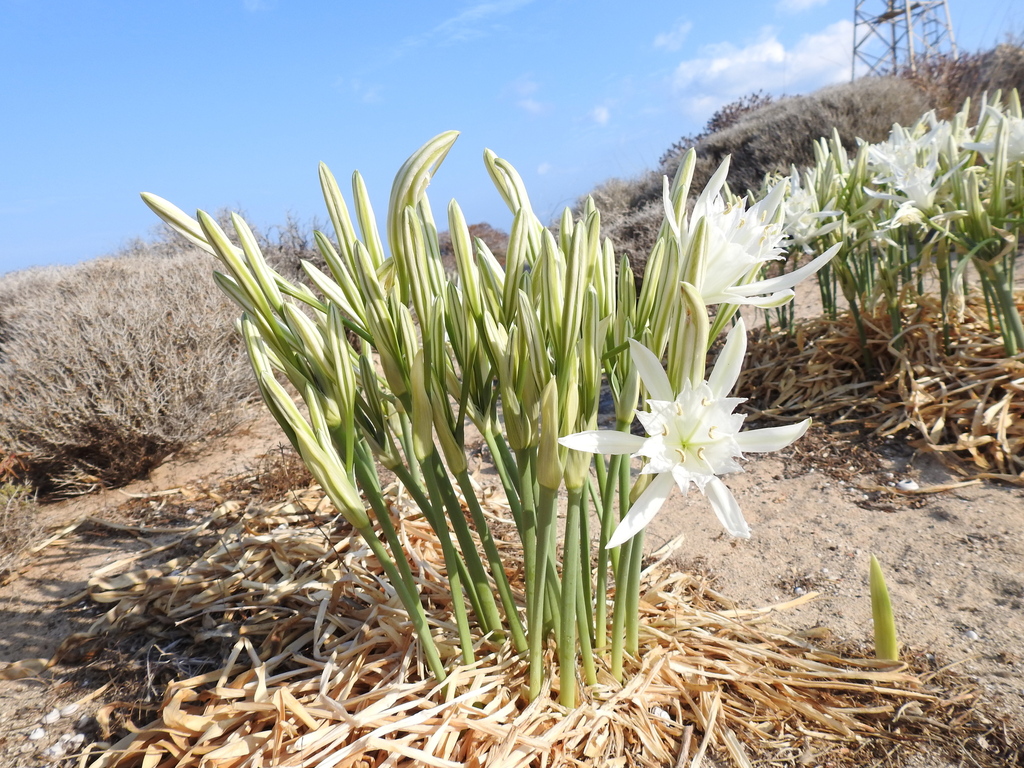
Sea Daffodil
Pancratium maritimum
Pancratium maritimum, or sea daffodil, is a species of bulbous plant native to both sides of the Mediterranean region and the Black Sea, from the Canary Islands, Portugal, Morocco, and Cyprus, and east to Turkey, Syria, Israel and the Caucasus. Its range on the coasts of the Black Sea includes southern Bulgaria, northern Turkey and Georgia. The species is naturalized in Southern California.
Pancratium maritimum grows on beaches and coastal sand dunes, often with much of the leaves and scapes buried in the sand. Other vernacular names are sea lily, sand daffodil, sand lily and lily of St. Nicholas, (although it is not a true lily). The specific epithet maritimum means "of the sea".
From the article Pancratium maritimum on Wikipedia (CC BY-SA), quoted section by section
Description
Pancratium maritimum is a bulbous perennial with a long neck and glaucous, broadly linear leaves, evergreen, but the leaves often die back during hot summers. Scape to 40 centimetres (16 in). Flowers 3–15 in an umbel, up to 15 cm (6 in) long, white. Corona two-thirds as long as the tepals. The flowers have a pleasing, exotic and very subtle lily scent, which only becomes apparent during still, windless summer nights that allow the delicate fragrance to become perceptible. Flowering is from August to October.
Chemistry. 4'-Hydroxy-5,7-dimethoxy-8-methylflavan is a flavan found in P. maritimum.
What it does
Pancratium maritimum is pollinated by a hawk-moth named Agrius convolvuli. These insects visit the flower only when the speed of the wind is under 2 metres per second (6.6 ft/s). Even if the species is pollinated in an artificial way during windy weather the pollination is not effective. Pancratium maritimum is not receptive to its own pollen and must be cross-pollinated.
Wikipedia: “Ecology”
How it is grown
Easily grown but requires a very sunny position and a very well drained, sandy soil. Needs hot summers to induce flowering and is often a shy bloomer in cooler climates. Hardy to USDA zone 8. Tolerates temperatures down to about −5 °C (23 °F). Propagation by seeds or division after flowering. Seedlings may flower in their third or fourth year.
Wikipedia: “Cultivation”
In human culture
The Hebrew name for the flower is חבצלת החוף (khavatselet ha-Khof), closely related to the rose of Sharon (khavatselet ha-Sharon – חבצלת השרון) mentioned in the Song of Solomon. Since the plant grows on the Sharon plain of the coast of the Mediterranean Sea, it is suggested the biblical passage may refer to this flower.
Wikipedia: “Culture”
Where it lives
Recorded sightings
—
geo-referenced records in GBIF, from museums, herbaria and field observers.
Drag the globe to turn it. Dots are where records exist, not a range map; darker means more records.
In the old herbals & bestiaries


In the stacks
Searching the stacks…
Every page naming Pancratium maritimum in the Biodiversity Heritage Library →
This page is assembled live from iNaturalist, GBIF, Wikipedia, the Source Library and the Internet Archive. It is not yet part of the hand-edited codex. iNaturalist taxon 78334.