- Plants
- ›Vascular Plants
- ›flowering plants
- ›Dicots
- ›myrtles, evening primroses, and allies
- ›evening primrose family
- ›Oenothera
- ›Oenothera
- ›Oenothera
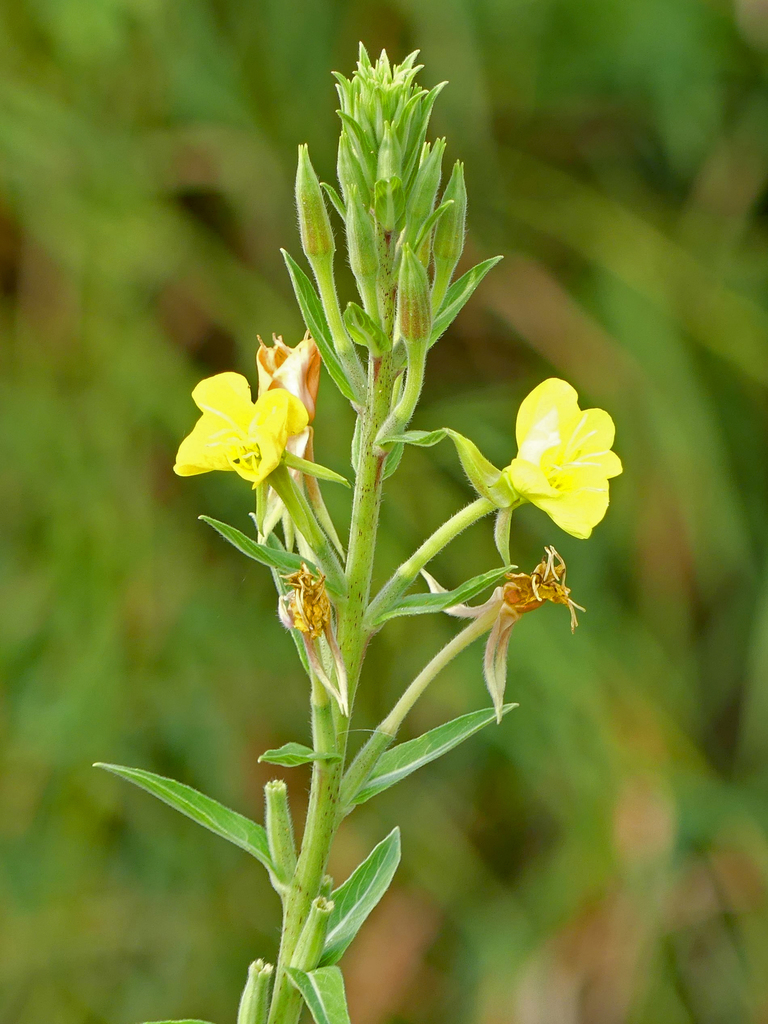
hairy evening primrose
Oenothera villosa
Oenothera villosa, the hairy evening primrose, is a species of flowering plant in the family Onagraceae. It is native to nearly all of the United States (except Hawaii, Alaska, Louisiana, Florida, and South Carolina), and to all Canadian provinces and the Northwest Territories. It has been introduced to cool and cold-temperate regions worldwide. An erect biennial reaching 3–6 feet (0.91–1.83 m), it is typically found in open areas and disturbed situations.
From the article Oenothera villosa on Wikipedia (CC BY-SA), quoted section by section
Description
This plant is a taproot dicotyledon (two stem leaves) biennial that has a red stem and is strigillose. This term means hairy. In this Scenario, the plant is covered in trichome hairs. The hairs are considered erect. This means that they stick straight out from the stem, not in a curled manner. The leaves are usually green in color and can have fully denticulate margins or part entire (smooth edges), part denticulate margins. in rarer scenarios the leaves can have moderate dentate margins. This all means that the leaves usually have small teeth on their edges, or have parts of their leaves of small-toothed edges. Also the rare moderate dentate margins means that sometimes a plant can be found with somewhat larger teeth on its leaf borders. The flowers inflorescent head, or the whole flower part of the plant is in the open position. The shoot growing structure called the apex is of the obtuse type. The plant has fruit capsules that do not measure any longer than the plants shoot internodes. This means that the fruit capsules are not longer than the spacings between the plants leaf nodes. The plants campanuate (bell shaped) yellow flowers have red stripes on the outer part of the flowers, so if someone views the flowers from the sides, not staring into the flowers, they appear as yellow, and painted with red stripes. The inside of the flowers are all yellow. …
At the table
This plant is not as common for use as some other garden or culinary plants, but it has some notable ones. A few people have planted Oenothera Villosa in gardens. This plant can be used to attract butterflies (lepidopterans) and other pollinating insects/birds. The plant has a chemical compound omega fatty-acid called Gamma Linolenic Acid (GLA) that is found in the oil called Evening Primrose Oil (EPO). This oil from a few of the closely related primrose plants including the hairy evening primrose is thought to be an ingredient that is active in some therapeutic medicine. This oil is found in the seeds of this primrose plant. The oil is being used to treat some conditions/disorders that can be targeted by using these helpful omega fatty acids found in the oil. However, the accuracy and efficacy of this oil actually relieving and treating some of these conditions is still being debated among medical people as of 2007. Some treatment uses of EPO are in Assistive Reproductive health Technologies (ART) and medicine. This oil is being used to treat certain reproductive diseases/conditions such as female breast inflammation, Euteral diabetes, other inflammation, and menopause/menstrual disorders. …
Wikipedia: “Uses”
Where it lives
Recorded sightings
—
geo-referenced records in GBIF, from museums, herbaria and field observers.
Drag the globe to turn it. Dots are where records exist, not a range map; darker means more records.
In the stacks
Searching the stacks…
Every page naming Oenothera villosa in the Biodiversity Heritage Library →
This page is assembled live from iNaturalist, GBIF, Wikipedia, the Source Library and the Internet Archive. It is not yet part of the hand-edited codex. iNaturalist taxon 78251.