- Plants
- ›Vascular Plants
- ›flowering plants
- ›Dicots
- ›Waterlilies, Fanworts, and Allies
- ›Waterlily Family
- ›Nuphar
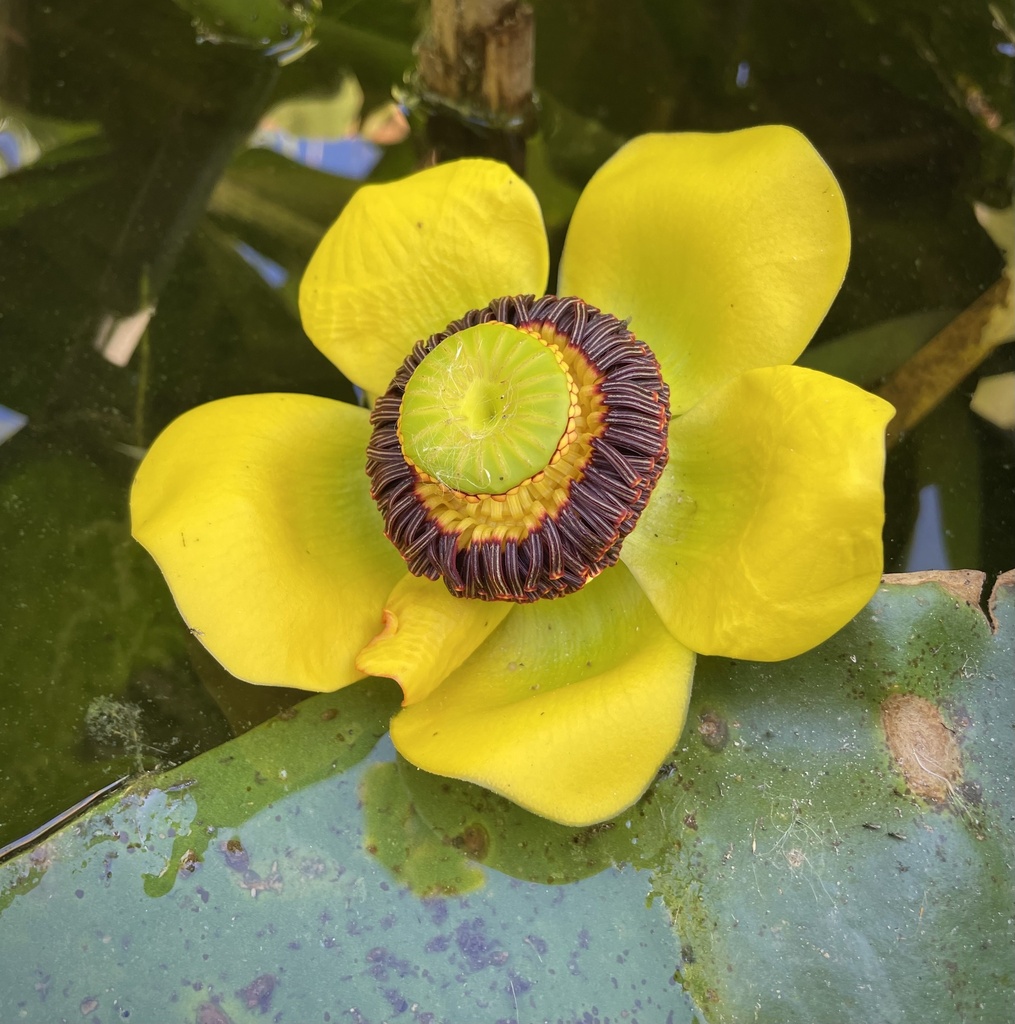
western yellow pond-lily
Nuphar polysepala
Nuphar polysepala (the great yellow pond-lily or wokas; syn. Nuphar polysepalum orth. err., Nuphar lutea subsp. polysepala (Engelm.) E.O.Beal) is a species of Nuphar native to western North America. The name Nuphar is Greek for "water-lily" and polysepala means many sepals. It is commonly found in shallow muddy ponds from northern Alaska and Yukon southward to central California and northern New Mexico, and can be recognized easily by its large floating leaves and bright yellow blossoms.
From the article Nuphar polysepala on Wikipedia (CC BY-SA), quoted section by section
Description
Nuphar polysepala is a perennial, rhizomatous, aquatic herb with an extensive root system. The rhizomes are up to 5 metres (16 ft) long and 3–8 centimetres (1+1⁄4–3+1⁄4 in) wide, spongy, creeping, and branching. The leaves are submerged or floating. The ovate to oblong leaf is 10–45 cm (4–17+1⁄2 in) long and 7–30 cm (3–12 in) wide. The terete petiole is up to 2 m (6+1⁄2 ft) long. The flowers are solitary, pedunculate, bisexual, and 5–10 cm wide. They float on the water surface or extend beyond it. They have (6–)9(–12) green to bright yellow sepals, which occasionally have a red base. The 10–20 green to yellow, thick petals are hidden by the stamens. The fruit is ovoid to cylindric, strongly ribbed, 4–6(–9) cm long, and 3.5–6 cm wide. It bears seeds 4 millimetres (1⁄8 in) in length. The chromosome count is 2n = 34.
Range & habitat
It is native to western North America. It is commonly found in shallow muddy ponds from northern Alaska and Yukon southward to central California and northern New Mexico, and can be recognized easily by its large floating leaves and bright yellow blossoms. It occurs in slowly flowing streams, ponds, and lakes in up to 2,4 m deep water.
Wikipedia: “Distribution and habitat”
At the table
The seeds are edible; they pop like popcorn, and can be steamed as a vegetable, dried and ground for flour, or can be cooked like oatmeal. Historically they have been a significant source of carbohydrates for the Klamath and Modoc peoples who inhabit the area near Oregon's Upper Klamath Lake. The leaves and rootstocks have traditionally been used for ulcerous skin conditions and swelling. The rootstock infusion is used as a traditional gargle for mouth, sore throats and douche for vaginal inflammation. One cup of boiling water is used for two tablespoons of chopped rhizome.
== References ==
Wikipedia: “Uses”
Where it lives
Recorded sightings
—
geo-referenced records in GBIF, from museums, herbaria and field observers.
Drag the globe to turn it. Dots are where records exist, not a range map; darker means more records.
In the stacks
Searching the stacks…
Every page naming Nuphar polysepala in the Biodiversity Heritage Library →
This page is assembled live from iNaturalist, GBIF, Wikipedia, the Source Library and the Internet Archive. It is not yet part of the hand-edited codex. iNaturalist taxon 78234.