- Plants
- ›Vascular Plants
- ›flowering plants
- ›Dicots
- ›nightshades, bindweeds, gooseweeds, and allies
- ›nightshade family
- ›nightshades and allies
- ›shoo-fly plant and allies
- ›Nicandra
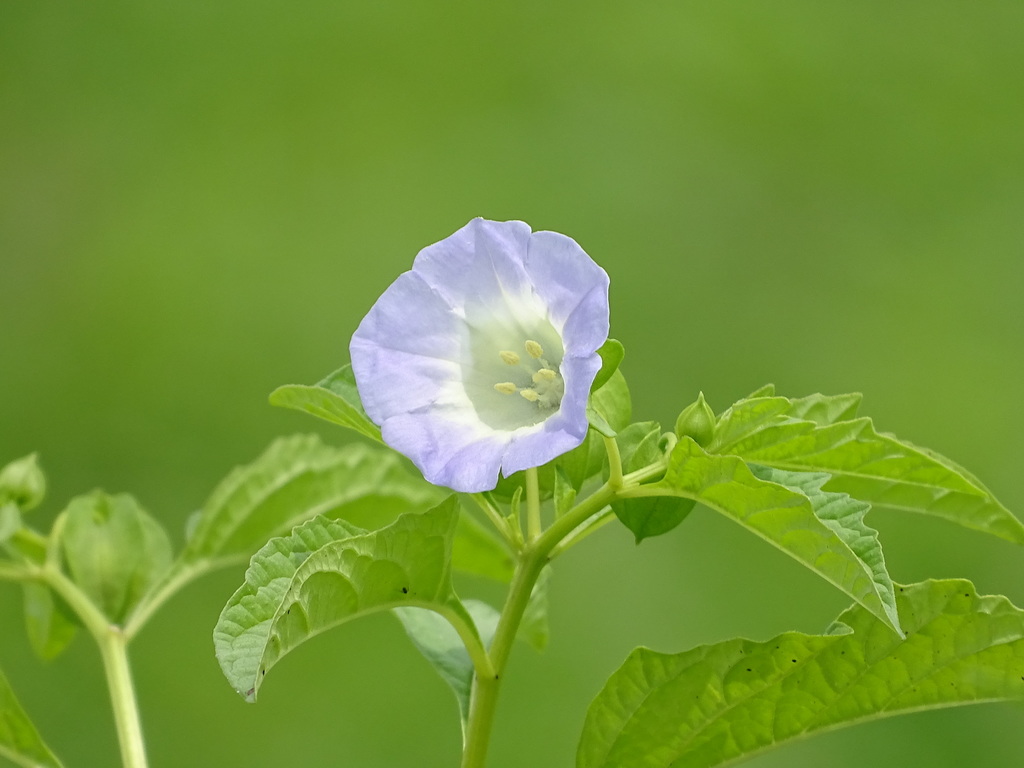
apple-of-Peru
Nicandra physalodes
Nicandra physalodes is a species of flowering plant in subfamily Solanoideae of the nightshade family. It is known by the common names apple-of-Peru and shoo-fly plant. It is thought originally to have been native to western South America, including Peru, and is known elsewhere as an introduced and ruderal species – sometimes as a weed – in tropical, subtropical and, to a lesser extent, temperate areas all over the world. It has also long been cultivated as an ornamental plant for its attractive flowers and curious fruits (the latter sometimes dried for use in floral design) and has been adopted into the traditional medicine of countries far-removed from its original home.
From the article Nicandra physalodes on Wikipedia (CC BY-SA), quoted section by section
Description
Nicandra physalodes is an annual species growing to 1 metre tall with spreading branches and ovate, mid-green, toothed and waved leaves. The flowers are bell-shaped and 5 centimeters or more across, pale violet with white throats (occasionally pure white), opening only for a few hours in the day. The flower becomes lantern-like towards the end of its blooming period, the inflated calyces somewhat resembling those of certain Physalis spp., although in Nicandra (unlike in Physalis) the fruiting calyx is deeply lobed, (the sepals cordate) and not a single, undivided, bladder-like structure. The plant is thought to have insect repellent properties, particularly in relation to whitefly. N. physalodes seeds have a relatively thick testa (seed coat) and exhibit strong dormancy, which may, however be broken by a combination of warm and cold stratification, involving temperature fluctuation between 15 and 25 °C (59 and 77 °F).
Range & habitat
Nicandra physalodes is native to western South America – Northwest Argentina, Bolivia, North and Central Chile and Peru. It has been introduced in many tropical and temperate regions worldwide. It is a weed of arable land nearly worldwide. In the British Isles, the plant is a frequent casual, found in bare or sparsely grassy places, including cultivated ground, waste places and rubbish tips. Its occurrence is often traceable to the presence of its seeds in commercial brands of bird seed.
Wikipedia: “Distribution”
At the table
The literature on the plant features somewhat conflicting accounts of use, as a species both edible and toxic/medicinal, pointing to the conclusion that it should be regarded as suspect and treated with caution. The whole plant is said to be toxic (even, according to some sources, very toxic) and to be used medicinally as a diuretic, sedative and cough medicine. The tender leaves have, on occasion, been cooked as a leaf vegetable or pot herb (e.g. in the cuisine of Tanzania), yet the decoction of the leaves has been used as an insecticide to treat head lice; while the juice of the fresh leaves has been used to treat amoebiasis. Unspecified medicinal uses of the leaves have also been recorded in the folk medicine of Brazil and Madagascar. The rather dry, brown berries within the papery calyces have an odour reminiscent of cooking oil and, although described in at least one source as being poisonous, are eaten by the Raji people of Nepal. …
Wikipedia: “Uses”
Toxicity
Nicandra physalodes is suspected of having poisonous properties similar to those possessed by certain Physalis species implicated in the poisoning of sheep. Some conflicting evidence in respect of these suspicions has emerged from Australia (where the plant is sometimes known as wild gooseberry), in which the plant has been suspected, on rather vague evidence, of poisoning stock at various times, although a feeding test carried out in New South Wales using a sheep and a goat gave negative results. A case was reported from New South Wales in 1970 in which two crossbred ewes died, apparently as a result of consuming this plant. The animals had been left to graze in a paddock of Wimmera ryegrass heavily infested with Nicandra physalodes plants of around 60 cm (24 in) in height, such that they overtopped the grass. Both ewes died, with symptoms of bloat within 12 hours. At necropsy there were extensive hemorrhages in heart and lungs, but no other apparent abnormalities. The paunches of the ewes were observed to contain large amounts of Nicandra.
Wikipedia: “Stock poison”
Where it lives
Recorded sightings
—
geo-referenced records in GBIF, from museums, herbaria and field observers.
Drag the globe to turn it. Dots are where records exist, not a range map; darker means more records.
In the stacks
Searching the stacks…
Every page naming Nicandra physalodes in the Biodiversity Heritage Library →
This page is assembled live from iNaturalist, GBIF, Wikipedia, the Source Library and the Internet Archive. It is not yet part of the hand-edited codex. iNaturalist taxon 78217.