- Plants
- ›Vascular Plants
- ›flowering plants
- ›Dicots
- ›myrtles, evening primroses, and allies
- ›myrtle family
- ›Myrtoideae
- ›Myrteae
- ›Myrtinae
- ›Myrtus
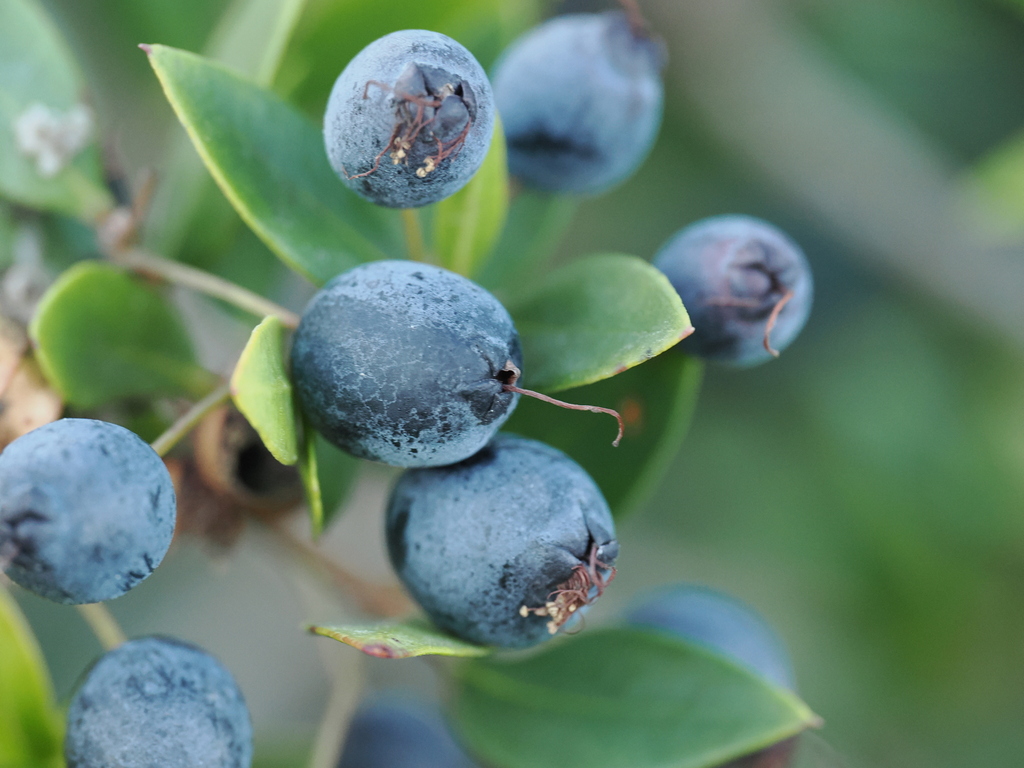
myrtle
Myrtus communis
Myrtus communis, the common myrtle, is a species of flowering plant in the myrtle family Myrtaceae. It is an evergreen shrub native to southern Europe, north Africa, western Asia, Macaronesia, and the Indian Subcontinent, and also cultivated.
From the article Myrtus communis on Wikipedia (CC BY-SA), quoted section by section
Description
The plant is an evergreen shrub or small tree, growing to 5 metres (16 feet) tall. The leaves are 2–5 centimetres (1–2 in) long, with a fragrant essential oil. The flowers are white or tinged with pink, with five petals and many stamens that protrude from the flower. The fruit is an edible berry that is blue-black when ripe.
Range & habitat
The species is native to southern Europe, North Africa, Western Asia, Macaronesia, and the Indian subcontinent.
Wikipedia: “Distribution and habitat”
At the table
The essential oils derived from this plant have anti-proliferative and anti-quorum sensing properties, helping against food spoilage. The berries are also macerated in alcohol to make Mirto liqueur.
== References ==
Wikipedia: “Uses”
How it is grown
This species and the more compact M. communis subsp. tarentina have won the Royal Horticultural Society's Award of Garden Merit. They are hardy but prefer a sheltered position in full sun. The plant can be propagated with seeds stratified for 3 months. Also, one can use a cutting with a short heel (small part of the bark), keeping it in moistened rooting mix.
Wikipedia: “Cultivation”
Where it lives
Recorded sightings
—
geo-referenced records in GBIF, from museums, herbaria and field observers.
Drag the globe to turn it. Dots are where records exist, not a range map; darker means more records.
In the old herbals & bestiaries

Jan Moninckx; Maria Moninckx — Moninckx Atlas, vol. 7 (1686)
Jan Moninckx; Maria Moninckx · 1686 · p.39

The Natural History of Carolina, Florida and the Bahama Islands, Vol. 1
Mark Catesby · 1777 · p.224

The Dialogue of Creatures
Anonymous · 1509 · p.47

The Natural History of Carolina, Florida and the Bahama Islands, Vol. 1
Mark Catesby · 1777 · p.56

A voyage to the islands Madera Barbados Jamaica Vol. 1
Hans Sloane · 1707 · p.556

Garden of Health
Jacob Meydenbach · 1491 · p.277

Garden of Health
1507 · p.223

The Great Herbary with all the figures of the herbs
1532 · p.214

Commentaries on the Six Books of Dioscorides
Pietro Andrea Mattioli · 1560 · p.249

Commentaries on the Six Books of Dioscorides
Pietro Andrea Mattioli · 1560 · p.265

Commentaries on the Six Books of Dioscorides on Medical Matter
Pietro Andrea Mattioli · 1563 · p.708

Commentaries on the Six Books of Dioscorides on Medical Matter
Pietro Andrea Mattioli · 1563 · p.249
In the stacks
Searching the stacks…
Every page naming Myrtus communis in the Biodiversity Heritage Library →
This page is assembled live from iNaturalist, GBIF, Wikipedia, the Source Library and the Internet Archive. It is not yet part of the hand-edited codex. iNaturalist taxon 78159.