- Plants
- ›Vascular Plants
- ›flowering plants
- ›Dicots
- ›Mallows, Rock Roses, and Allies
- ›Mallow and Hibiscus Family
- ›Malvoideae
- ›Malveae
- ›Malva
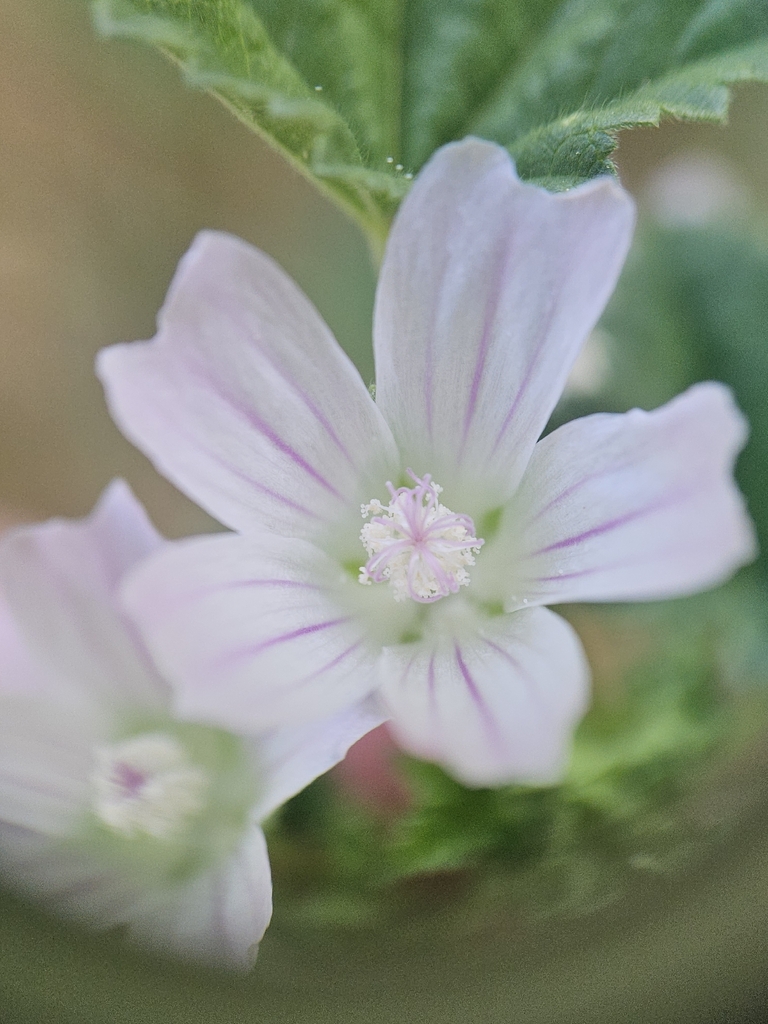
dwarf mallow
Malva neglecta
Malva neglecta is a species of plant of the family Malvaceae, native to most of the Old World except sub-Saharan Africa. It is an annual growing to 0.6 m (2 ft). It is known as common mallow in the United States and also as buttonweed, cheeseplant, cheeseweed, dwarf mallow, and roundleaf mallow.
This plant is often consumed as a food, with its leaves, stalks and seed all being considered edible. This is especially true of the seeds, which contain 21% protein and 15.2% fat.
From the article Malva neglecta on Wikipedia (CC BY-SA), quoted section by section
Description
Dwarf mallow is a prostrate, downy, herbaceous plant, growing to approximately 60 cm (24 in). The leaves are alternate with long, strongly channeled petioles, up to 12 cm (4.7 in), and narrowly triangular stipules. It is a broadleaf winter annual that also persists through a biennial or perennial life cycle if environmental conditions are favorable. Each leaf is reniform or with 5–7 shallow lobes, the basal leaves are 3–7 cm (1.2–2.8 in). It grows a tough taproot. The flowers are single-stalked and occur in clusters of 2–5 in the leaf axils. The flower stalks are shorter than the leaf stalks, with the leaves partially obscuring the flowers. The fruits are schizocarps, which split into 10–12 mericarps (nutlets) and are smooth and hairy. In addition to daily phototropic movements, leaves show epinasty, geotropism and sleeping behaviors. Leaves joined to the stem on the east side of the plant bend abaxially and leaves on the west side of the plant bend adaxially, while leaves on the north and south sides turn sideways. Overnight, leaves were observed returning to their morning position.
After introduction into Canada, common mallow was found to be freezing tolerant, retaining the capacity for photosynthesis and respiration after long periods of exposure to subfreezing temperatures.
Range & habitat
Native Palearctic: Macaronesia: Canary Islands Northern Africa: Algeria, Morocco Arabian Peninsula: Saudi Arabia Western Asia: Afghanistan, Cyprus, Sinai, Iran, Iraq, Jordan, Lebanon, Historic Palestine, Syria, Turkey Caucasus: Armenia, Azerbaijan, Georgia Soviet Middle Asia: Kazakhstan, Kyrgyzstan, Tajikistan, Turkmenistan, Uzbekistan Mongolia: Mongolia China: Xinjiang Indian Subcontinent: India, Pakistan Northern Europe: Denmark, Ireland, Norway, Sweden, United Kingdom Middle Europe: Austria, Belgium, Czech Republic, Germany, Hungary, Netherlands, Poland, Slovakia, Switzerland Southeastern Europe: Albania, Bosnia and Herzegovina, Bulgaria, Croatia, Greece, Italy, Montenegro, North Macedonia, Sardinia, Serbia, Slovenia, Romania, Southwestern Europe: France, Portugal, Spain Source:
Wikipedia: “Distribution”
What it does
Malva neglecta exhibits six age states: seedlings, juveniles, immatures, virginals, young generatives, and middle-aged generatives. Seedling leaf blades are pubescent below and along the edge. Juvenile plants have a solitary shoot and rounded leaves with wavy toothed edges. Immature plants show kidney-shaped leaves with jagged edges. Virginile plants present rosettes of 3-5 rounded heart-shaped leaves. Young generative plants develop solitary white or light pink flowers. Branching of the generative shoot is observed in Middle-aged plants. While young leaves and stems are green, mature leaves and lower stems vary from green to purple in color.
Wikipedia: “Life cycle”
At the table
The plant has 1-octacosanol, ascorbic acid, choline, alkaloids, and saponin (the plant has a certain antioxidant content). It has a high nitrate content, similar to that of arugula. The flowers contain tannins.
Therapeutic. A common traditionally used medicinal plant, used for catarrh, enteritis, sore throat, hoarse voice, and as an expectorant. A lab study has shown that the plant is good for stomach ulcers
Seeds. The seeds can be eaten raw or cooked and have a nutty flavor. Mature seeds can be cooked like rice or grains. In the past, seeds were ground into flour in times of need.
Root. The root can be ground and used as a meringue substitute by boiling in water, simmering until thickened, and then whisked like egg whites.
Leaves. Leaves are useful in salads, can be eaten raw, and contain Vitamin C, significant protein and mineral content. In culinary applications, it is cooked similar to spinach, or used for thickening soups, as the leaves release a thickening agent similar to okra which is also in the mallow family. In Morocco leaves are known as Bakola or Khobiza, braised as a side dish (called salad, but cooked) or used as a sauce over couscous. In Jewish and Egyptian cooking, leaves are made into a stew called Mulukhiyah.
Wikipedia: “Uses”
Where it lives
Recorded sightings
—
geo-referenced records in GBIF, from museums, herbaria and field observers.
Drag the globe to turn it. Dots are where records exist, not a range map; darker means more records.
In the old herbals & bestiaries


In the stacks
Searching the stacks…
Every page naming Malva neglecta in the Biodiversity Heritage Library →
This page is assembled live from iNaturalist, GBIF, Wikipedia, the Source Library and the Internet Archive. It is not yet part of the hand-edited codex. iNaturalist taxon 77952.