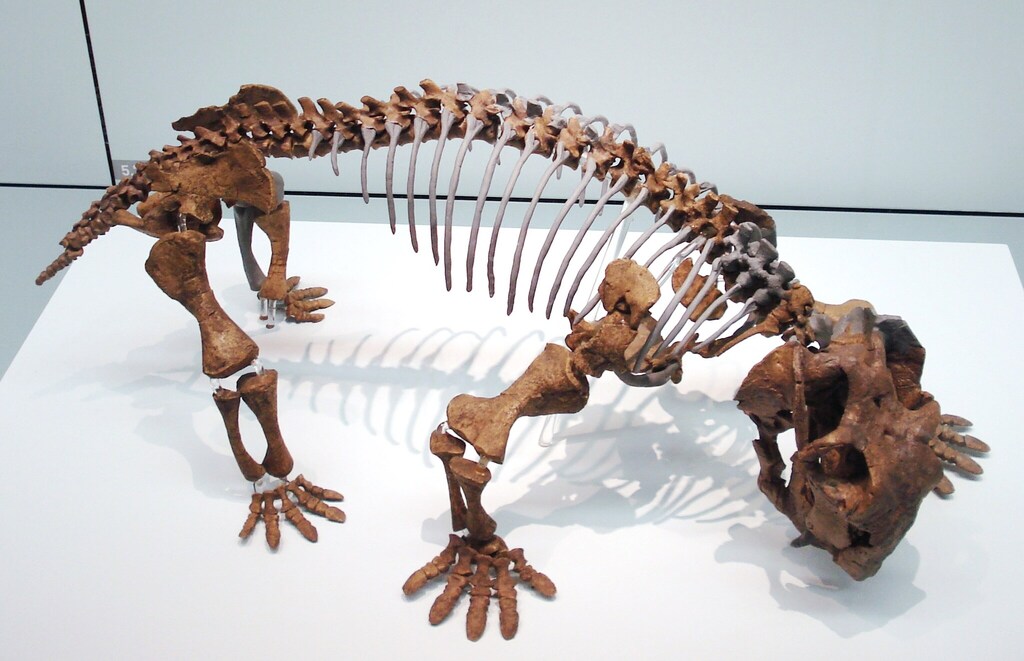
Lystrosaurus
Lystrosaurus (; 'shovel lizard'; from Ancient Greek λίστρον lístron 'tool for leveling or smoothing, shovel, spade, hoe') is an extinct genus of herbivorous dicynodont therapsids from the late Permian and Early Triassic epochs (around 248 million years ago). It had a widespread distribution across Pangaea, with fossils having been found in what is now Antarctica, India, China, Mongolia, European Russia, South Africa, and possibly Australia and Mozambique. Four to six species are currently recognized, but from the 1930s to 1970s the number of species was thought to be much higher.
As a dicynodont, Lystrosaurus had only two teeth (a pair of tusk-like canines), and is thought to have had a horny beak that was used for biting off pieces of vegetation. It was a heavily built, herbivorous animal. The structure of its shoulders and hip joints suggests that it moved with a semi-sprawling gait. Its forelimbs were even more robust than its hindlimbs, and it is thought to have been a powerful digger that nested in burrows.
0 branches of this genus, most-observed first
See this branch on the Wheel of Life →Where it lives
Recorded sightings
—
geo-referenced records in GBIF, from museums, herbaria and field observers.
Drag the globe to turn it. Dots are where records exist, not a range map; darker means more records.
In the stacks
Searching the stacks…
Every page naming Lystrosaurus in the Biodiversity Heritage Library →
This page is assembled live from iNaturalist, GBIF, Wikipedia, the Source Library and the Internet Archive. It is not yet part of the hand-edited codex. iNaturalist taxon 778562.