- Plants
- ›Vascular Plants
- ›flowering plants
- ›Dicots
- ›honeysuckles, moschatels, and allies
- ›honeysuckle family
- ›honeysuckle subfamily
- ›Lonicera
- ›Chamaecerasus
- ›Nintooa
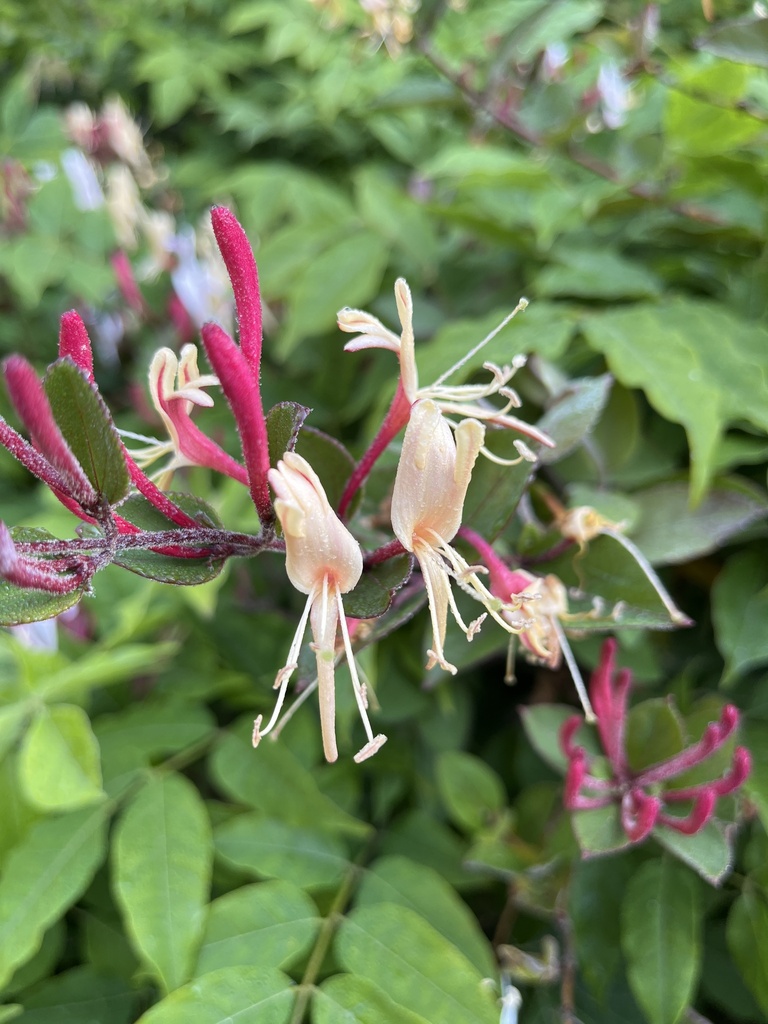
Japanese honeysuckle
Lonicera japonica
Lonicera japonica, known as Japanese honeysuckle and golden-and-silver honeysuckle, is a species of honeysuckle native to East Asia, including many parts of China. It is often grown as an ornamental plant, but has become an invasive species in a number of countries. It is used in traditional Chinese medicine.
From the article Lonicera japonica on Wikipedia (CC BY-SA), quoted section by section
Description
Lonicera japonica is a twining vine able to climb up to 10 m (33 ft) high or more in trees, with opposite, simple oval leaves 3–8 cm (1+1⁄4–3+1⁄4 in) long and 2–3 cm (3⁄4–1+1⁄4 in) broad. When its stems are young, they are slightly red in color and may be fuzzy. Older stems are brown with peeling bark, and are often hollow on the inside. The flowers are double-tongued, opening white and fading to yellow, and sweetly vanilla scented. The fruit, which is produced in fall, is a black spherical berry 3–4 mm (1⁄8–3⁄16 in) diameter containing a few seeds.
Chemistry. Lonicera japonica leaves contain methyl caffeate, 3,4-di-O-caffeoylquinic acid, methyl 3,4-di-O-caffeoylquinic acid, protocatechuic acid, methyl chlorogenic acid, and luteolin. Other polyphenols present in the plant are hyperoside and caffeic acid. The two secoiridoid glycosides, loniceracetalides A and B, can be isolated, together with 10 known iridoid glycosides, from the flower buds.
What it does
The flowers can also be a significant source of food for deer, rabbits, hummingbirds, and other wildlife.
As an invasive species. Japanese honeysuckle has become naturalized in Argentina, Australia, Brazil, Mexico, New Zealand, and much of the United States, including Hawaii, as well as a number of Pacific and Caribbean islands. It is classified as a noxious weed in 46 states, being prohibited to be bought and sold in Connecticut, Illinois, Massachusetts, and Vermont, and banned in Indiana and New Hampshire. It is on the New Hampshire invasive species list. Lonicera japonica was initially brought to the U.S. from Japan in the early 1800s as an ornamental plant. It is still deliberately planted in the U.S. for reasons such as erosion control or forage for deer, but has become invasive in many areas. It prefers to invade areas that have been disturbed, such as roadsides or floodplains. It will generally only invade forests when the canopy has been opened by logging or fallen trees, as it grows less vigorously in the shade. Once it has invaded an area, Lonicera japonica grows rapidly and outcompetes native plants for sunlight and nutrients. It proliferates using both sexual and vegetative reproduction, producing seeds that are spread by animals and expanding locally via rhizomes. …
Wikipedia: “Ecology”
At the table
Japanese honeysuckle flowers are edible to humans and appreciated for their sweet-tasting nectar.
Herbal medicine. In traditional Chinese medicine, Lonicera japonica is called rěn dōng téng (忍冬藤); literally "winter enduring vine") or jīn yín huā (Chinese: 金銀花; literally "gold-silver flower", in reference to the presence of flowers of different age on the same plant as each flower changes from white (silver) to yellow (gold)). Alternative Chinese names include er hua (二花) and shuang hua (雙花), meaning double-[color] flowers.
== References ==
Wikipedia: “Uses”
Toxicity
All parts of the plant other than the flower nectar have the potential to be toxic if consumed in a very large quantity for its saponin.
How it is grown
Even though it is a highly invasive and destructive plant, this species is often sold by American nurseries as the cultivar 'Hall's Prolific' (Lonicera japonica var. halliana), and in the UK as the cultivar 'Halliana'. The cultivar is also known as Hall's Japanese honeysuckle. It is an effective groundcover and has strong-smelling flowers. It can be cultivated by seed, cuttings, or layering. In addition, it will spread itself via shoots if given enough space to grow. The variety L. japonica var. repens has gained the Royal Horticultural Society's Award of Garden Merit.
Wikipedia: “Cultivation”
Where it lives
Recorded sightings
—
geo-referenced records in GBIF, from museums, herbaria and field observers.
Drag the globe to turn it. Dots are where records exist, not a range map; darker means more records.
In the old herbals & bestiaries


In the stacks
Searching the stacks…
Every page naming Lonicera japonica in the Biodiversity Heritage Library →
This page is assembled live from iNaturalist, GBIF, Wikipedia, the Source Library and the Internet Archive. It is not yet part of the hand-edited codex. iNaturalist taxon 77835.