- Plants
- ›Vascular Plants
- ›flowering plants
- ›Dicots
- ›honeysuckles, moschatels, and allies
- ›honeysuckle family
- ›honeysuckle subfamily
- ›Lonicera
- ›Lonicera
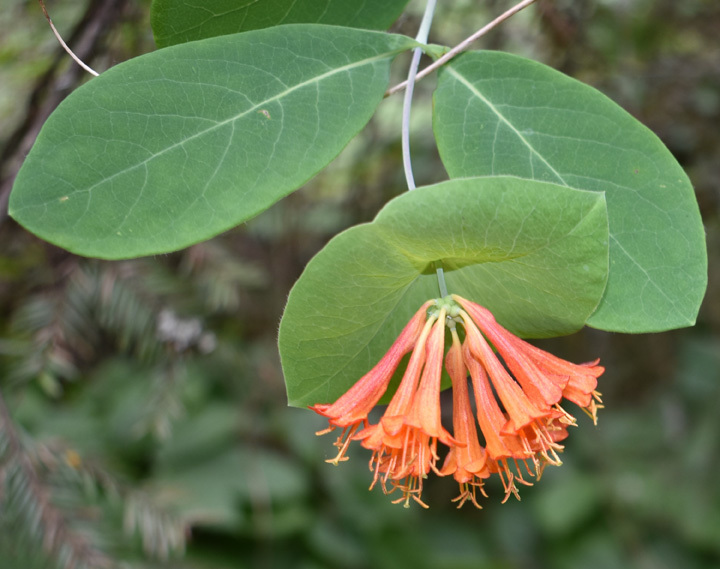
orange honeysuckle
Lonicera ciliosa
Lonicera ciliosa, the orange honeysuckle or western trumpet honeysuckle is a honeysuckle native to forests of western North America. A deciduous shrub growing to 6 m (20 ft) tall with hollow twigs, the leaves are opposite, oval, 4–10 cm (1.6–3.9 in) long with the last pair on each twig merged to form a disk. The flowers are orange-yellow, 2–4 cm (0.79–1.57 in) long, with five lobes and trumpet shaped; they are produced in whorls above the disk-leaf on the ends of shoots....
From the article Lonicera ciliosa on Wikipedia (CC BY-SA), quoted section by section
Description
A deciduous shrub growing to 6 metres (20 ft) tall with hollow twigs, the leaves are opposite, oval, 4–10 centimetres (1+1⁄2–4 in) long with the last pair on each twig merged to form a disk. The flowers are orange-yellow, 2–4 cm (3⁄4–1+1⁄2 in) long, with five lobes and trumpet shaped; they are produced in whorls above the disk-leaf on the ends of shoots. The fruit is a translucent orange-red berry less than 1 cm (3⁄8 in) diameter.
At the table
The fruits have traditionally been eaten by some Native American groups. However, modern sources caution that the berries may be mildly toxic and their edibility is not well established.
Wikipedia: “Edibility”
In medicine
The orange honeysuckle was used as cold medicine, a contraceptive, a sedative and even as a tuberculosis remedy.
Wikipedia: “Medicinal uses”
In human culture
The species was one of the many florae recorded during Lewis and Clark's expeditions beginning in 1804.
Wikipedia: “In culture”
Where it lives
Recorded sightings
—
geo-referenced records in GBIF, from museums, herbaria and field observers.
Drag the globe to turn it. Dots are where records exist, not a range map; darker means more records.
In the stacks
Searching the stacks…
Every page naming Lonicera ciliosa in the Biodiversity Heritage Library →
This page is assembled live from iNaturalist, GBIF, Wikipedia, the Source Library and the Internet Archive. It is not yet part of the hand-edited codex. iNaturalist taxon 77832.