- Plants
- ›Vascular Plants
- ›flowering plants
- ›Dicots
- ›carrots, ivies, and allies
- ›carrot family
- ›Apioideae
- ›Selineae
- ›Lomatium
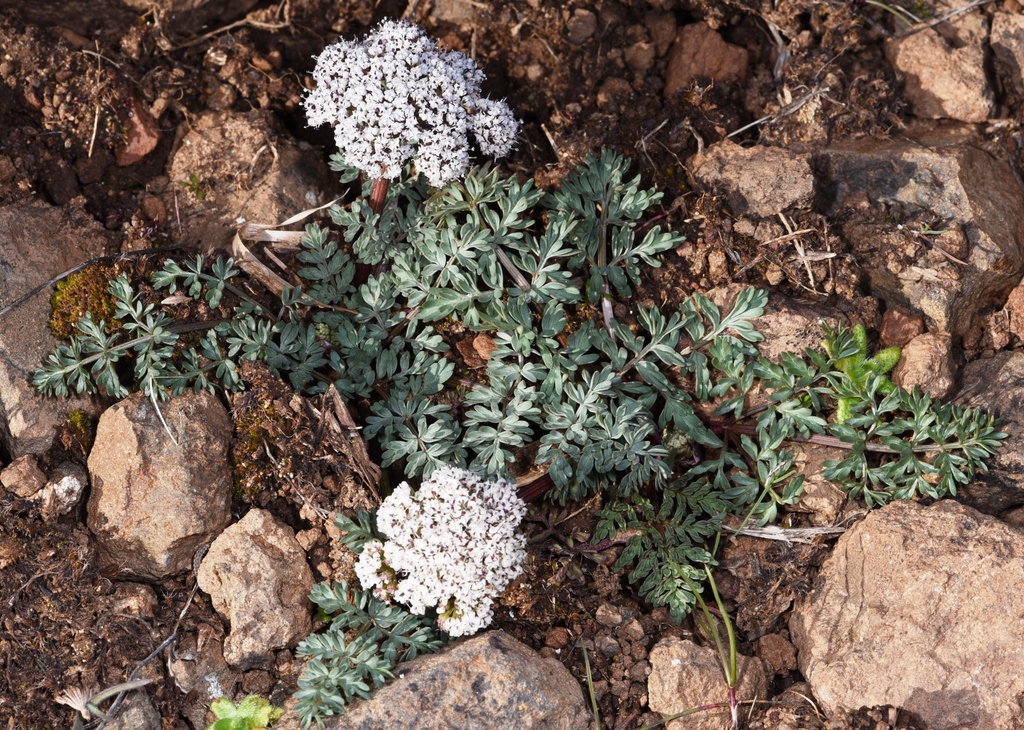
canby's lomatium
Lomatium canbyi
Lomatium canbyi is a species of flowering plant in the carrot family known by the common name Canby's biscuitroot (lúukš in the Sahaptin language and qeqíit in the Nez Perce language). It is native to the Pacific Northwest of the United States and northeast California, where it grows east of the Cascade ridge in sagebrush-covered plateau habitat and barren flats.
From the article Lomatium canbyi on Wikipedia (CC BY-SA), quoted section by section
Description
Lomatium canbyi is a perennial herb with flower stalks up to about 25 centimeters tall. It lacks a stem, producing compound leaves and inflorescences from ground level. The hairless leaves are up to 15 centimeters long and divided into many highly divided leaflets usually with a glaucous or slightly bluish color. The leaves are often held parallel to and close to the ground. The inflorescence is stout and is topped with a dense compound umbel up to 6 cm wide, composed of many small white flowers with dark anthers. The primary umbel (involucre) has no bracts and the secondary umbel (involucel) has narrow bractlets that wither to become inconspicuous as the flower ages.
Where it lives
Recorded sightings
—
geo-referenced records in GBIF, from museums, herbaria and field observers.
Drag the globe to turn it. Dots are where records exist, not a range map; darker means more records.
In the stacks
Searching the stacks…
Every page naming Lomatium canbyi in the Biodiversity Heritage Library →
This page is assembled live from iNaturalist, GBIF, Wikipedia, the Source Library and the Internet Archive. It is not yet part of the hand-edited codex. iNaturalist taxon 77802.