- Plants
- ›Vascular Plants
- ›flowering plants
- ›Dicots
- ›Sunflowers, Bellflowers, Fanflowers, and Allies
- ›bellflower family
- ›Lobelia subfamily
- ›Lobelia
- ›Stenotium
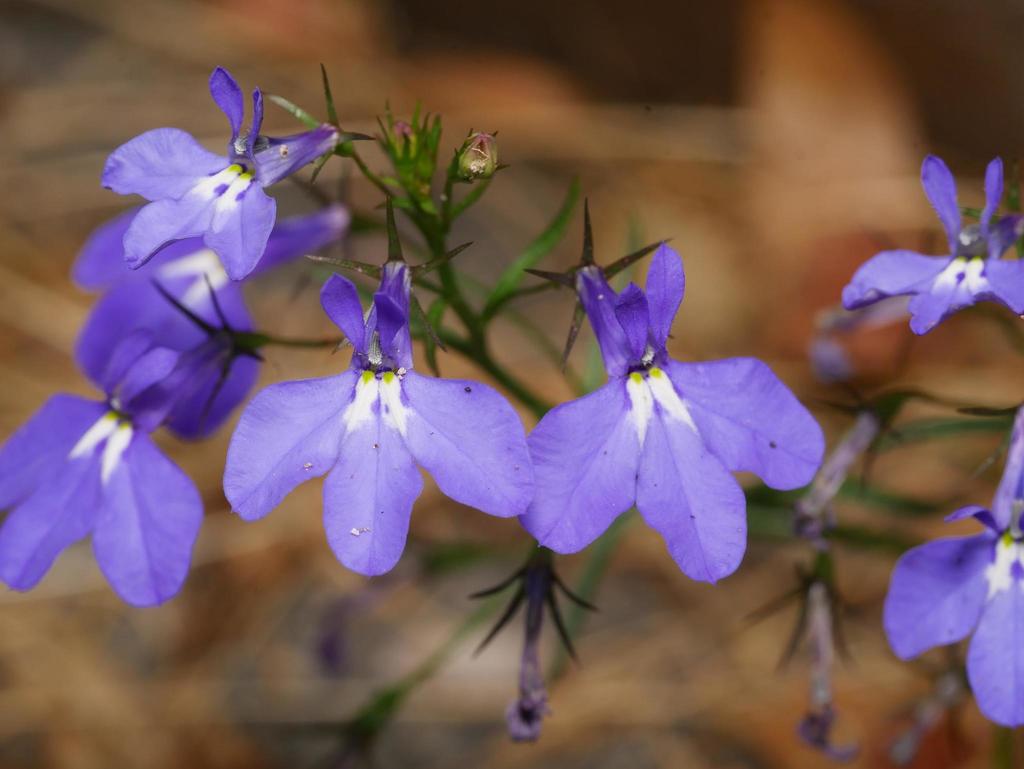
Garden Lobelia
Lobelia erinus
Lobelia erinus (edging lobelia, garden lobelia or trailing lobelia) is a species of flowering plant in the bellflower family Campanulaceae, native to southern Africa.
From the article Lobelia erinus on Wikipedia (CC BY-SA), quoted section by section
Description
It is a low growing, prostrate or scrambling herbaceous perennial plant growing to 8–15 cm tall. The basal leaves are oval, 10 mm long and 4–8 mm broad, with a toothed margin; leaves higher on the stems are slender and sometimes untoothed. The flowers are blue to violet in wild plants, with a five-lobed corolla 8–20 mm across; they are produced in loose panicles. About 0.5 to 4.5 inches long inflorescence stems are about 5 inches long, loose racemose inflorescences with many flowers. The hermaphrodite flower is zygomorphic with a length of up to 1 centimeter and quinate with double perianth. The five sepals are fused. The fan-shaped lower lip is trilobed. The color of the crown varies depending on the variety between white, blue, purple, pink or red and the center is yellow or white. The five stamens are 3 to 7 millimeters long. The fruit is a 5–8 mm capsule containing numerous small seeds.
Range & habitat
The distribution area lies in southern Africa and extends from Malawi, Mozambique, Zambia and Zimbabwe to the south to Botswana, Namibia, Eswatini, Lesotho and the South African provinces. L. erinus also occurs as a weed where it has escaped from cultivation.
Wikipedia: “Range”
At the table
Lobelia erinus is a very popular edging plant in gardens, especially for hanging baskets and window boxes. In temperate zones it is grown as a half-hardy annual, i.e. sown under glass with some heat in spring, then planted out when all danger of frost has passed. Alternatively plants can be purchased from garden centres as young "plug" plants, to be transferred outside in May or June.
Cultivars. Numerous cultivars have been selected, either with a bushy or a trailing habit, in a wide range of flower colours, including white, pink, magenta ("red"), pale to dark blue, and purple, often with a prominent white eye. Some of the better known cultivars include 'Blue Moon', 'Gracilis', 'Crystal Palace', 'Sapphire', 'Rosamund' and 'Riviera Rose'. In the United Kingdom the following cultivars have gained the Royal Horticultural Society's Award of Garden Merit:
Wikipedia: “Cultivation and uses”
Where it lives
Recorded sightings
—
geo-referenced records in GBIF, from museums, herbaria and field observers.
Drag the globe to turn it. Dots are where records exist, not a range map; darker means more records.
In the stacks
Searching the stacks…
Every page naming Lobelia erinus in the Biodiversity Heritage Library →
This page is assembled live from iNaturalist, GBIF, Wikipedia, the Source Library and the Internet Archive. It is not yet part of the hand-edited codex. iNaturalist taxon 77797.