- Plants
- ›Vascular Plants
- ›flowering plants
- ›Dicots
- ›Mints, Plantains, Olives, and Allies
- ›Plantain Family
- ›Toadflaxes and Allies
- ›Linaria
- ›Speciosae
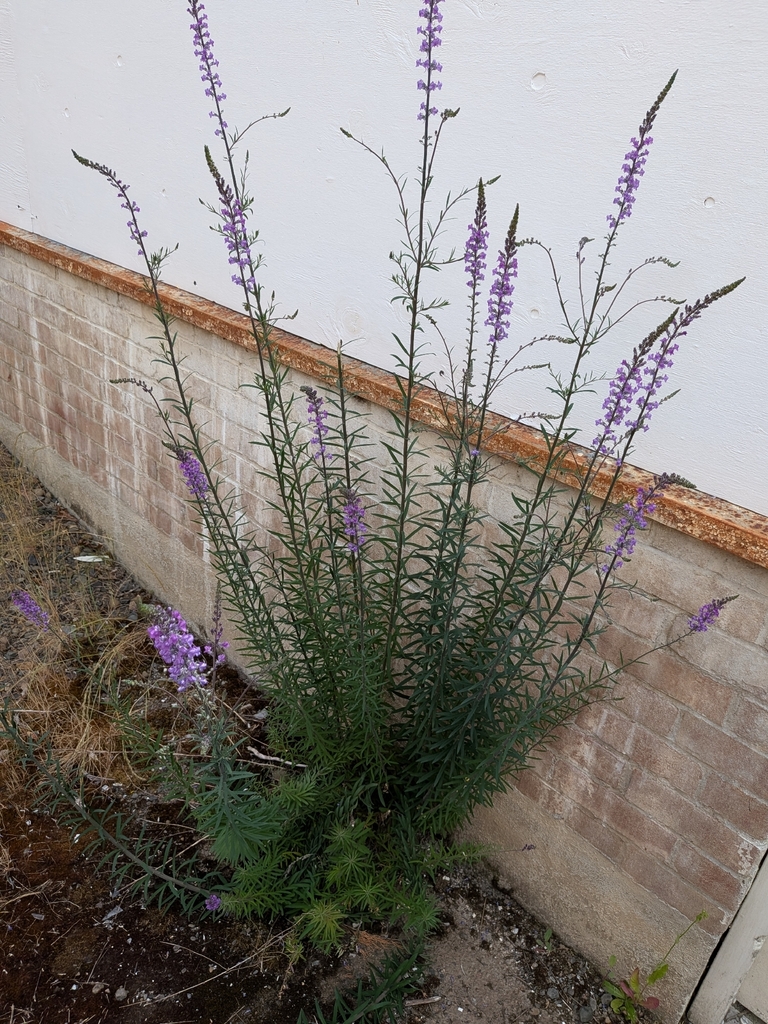
Purple Toadflax
Linaria purpurea
Linaria purpurea is a species of flowering plant in the plantain family known by the common name purple toadflax. It is native to Italy, but it can be found growing wild as an introduced species in parts of western North America, including California, western Washington, and British Columbia, and it is cultivated as an ornamental plant. It is a perennial herb growing 30 to 70 centimeters tall with linear leaves 2 to 5 centimeters in length....
From the article Linaria purpurea on Wikipedia (CC BY-SA), quoted section by section
Description
It is a perennial herbaceous plant growing 1 metre (3 ft 3 in) tall (rarely to 1.2 m) with erect stems bearing glabrous, glaucous grey-green linear leaves 2–4.5 cm long and 2–3 mm broad. The inflorescence is a raceme of flowers occupying the top of the stem. The flower is between 8–13 mm long with five lobes arranged into two lips with a 3–6 mm spur at the end. The flower is usually dark purple or violet, rarely pale or even white. The flowering season is long, from April to October. The fruit is a capsule. Plants at high altitude have broader leaves, up to 10 mm wide; these have been described as L. purpurea var. montana Caruel, but as the variation is continuous, this is not accepted as a valid taxon.
Range & habitat
It is endemic to central and southern Italy, in Abruzzo, Basilicata, Calabria, Campania, Emilia-Romagna, Lazio, Marche, Molise, Puglia, Sicily, Toscana, and Umbria. It occurs naturally in cliffs, scree, woodland edges, and on uncultivated land. It has a wide environmental range, growing from sea level up to 1,900 m, and up to 2,500 m on Gran Sasso d'Italia.
Non-native range. It is naturalised in Europe north of its native range in Italy in Veneto, and in Germany, Great Britain, and Ireland, in western North America from California north to British Columbia, in South America in Argentina, and in New Zealand. It is widely cultivated as an ornamental plant. In Britain it is sometimes regarded as a weed, spreading readily on stony waste ground and walls, although it is tolerated for its attractive, long-lasting flowers which are very attractive to bees. There is a pale pink cultivar named 'Canon Went'.
Wikipedia: “Range”
Toxicity
This plant is poisonous to livestock, though ruminants may tend to avoid consuming it. The larvae of some species of Lepidoptera (butterflies) use this plant as a food source. In a recent study conducted in Italy the plant was found to contain a compound exhibiting antifungal activity, which drastically reduced the production of aflatoxin B1 in Aspergillus flavus Link., making it a potential natural and 'green' anti-aflatoxin B1 agent suitable for use in the food industry.
Wikipedia: “Toxicity and chemistry”
In human culture
Because of its wide range in Italy and status as an Italian endemic species, combined with its beauty, it has been suggested as a floral emblem for the country.
Wikipedia: “Cultural value”
Where it lives
Recorded sightings
—
geo-referenced records in GBIF, from museums, herbaria and field observers.
Drag the globe to turn it. Dots are where records exist, not a range map; darker means more records.
In the stacks
Searching the stacks…
Every page naming Linaria purpurea in the Biodiversity Heritage Library →
This page is assembled live from iNaturalist, GBIF, Wikipedia, the Source Library and the Internet Archive. It is not yet part of the hand-edited codex. iNaturalist taxon 77778.