- Plants
- ›Vascular Plants
- ›flowering plants
- ›Dicots
- ›Mustards, Capers, and Allies
- ›mustard family
- ›Brassicoideae
- ›Camelinodae
- ›Lepidieae
- ›Lepidium
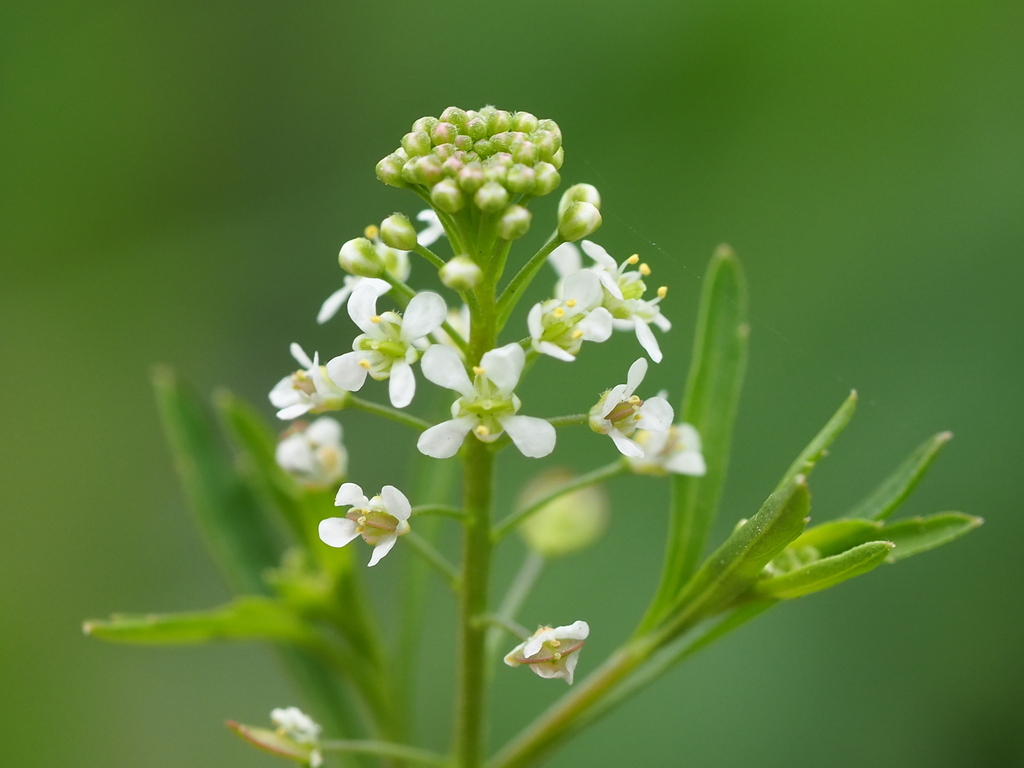
Virginia pepperweed
Lepidium virginicum
Lepidium virginicum, also known as least pepperwort or Virginia pepperweed, is an herbaceous plant in the mustard family (Brassicaceae). It is native to much of North America, including most of the United States and Mexico and southern regions of Canada, as well as most of Central America. It can be found elsewhere as an introduced species.
Virginia pepperweed grows as a weed in most crops and is found in roadsides, landscapes and waste areas. It prefers sunny locales with dry soil.
From the article Lepidium virginicum on Wikipedia (CC BY-SA), quoted section by section
Description
Lepidium virginicum is an herbaceous annual or biennial. The entire plant is generally between 10 and 50 centimeters (3.9 and 19.7 in) tall. The leaves on the stems of Virginia pepperweed are sessile, linear to lanceolate and get larger as they approach the base. As with Lepidium campestre, Virginia pepperweed's most identifiable characteristic is its raceme, which comes from the plant's highly branched stem. The racemes give Virginia pepperweed the appearance of a bottlebrush. On the racemes are first small white flowers, and later greenish fruits. All parts of the plant have a peppery taste.
At the table
The plant is edible. The young leaves can be used as a potherb, sautéed or used raw, such as in salads. The young seedpods can be used as a substitute for black pepper. The leaves contain protein, vitamin A and vitamin C.
Wikipedia: “Uses”
Where it lives
Recorded sightings
—
geo-referenced records in GBIF, from museums, herbaria and field observers.
Drag the globe to turn it. Dots are where records exist, not a range map; darker means more records.
In the stacks
Searching the stacks…
Every page naming Lepidium virginicum in the Biodiversity Heritage Library →
This page is assembled live from iNaturalist, GBIF, Wikipedia, the Source Library and the Internet Archive. It is not yet part of the hand-edited codex. iNaturalist taxon 77676.