- Plants
- ›Vascular Plants
- ›flowering plants
- ›Dicots
- ›Mustards, Capers, and Allies
- ›mustard family
- ›Brassicoideae
- ›Camelinodae
- ›Lepidieae
- ›Lepidium
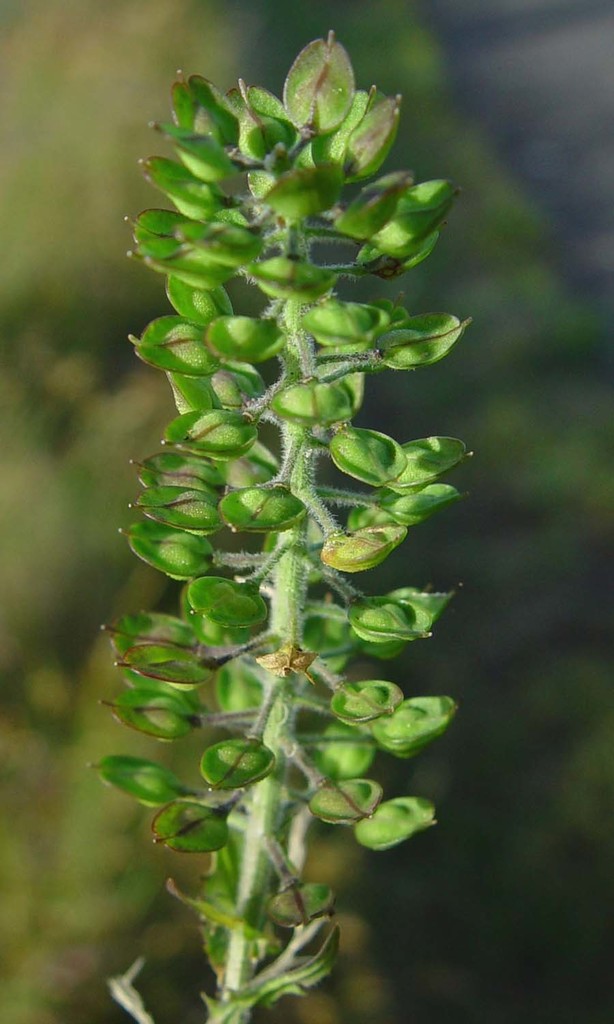
Smith's Cress
Lepidium heterophyllum
Lepidium heterophyllum (Smith's cress or Smith's pepperwort) is a species of flowering plant in the mustard family which is native to parts of western Europe, growing in shingle banks, wasteland or cultivated fields.
From the article Lepidium heterophyllum on Wikipedia (CC BY-SA), quoted section by section
Description
Lepidium heterophyllum is similar in form to native Lepidium campestre and especially at the early seedling stage, both have been misidentified in Belgium. It is a perennial, which can grow between 10–90 cm (3.9–35.4 in) tall. The hirsute (or hairy) stems, are often branched from the base, It has grey-green foliage, that has narrowly triangular, variably toothed, stem leaves which cling to the stem with long pointed auricles. The stem leaves can grow up to 50 mm long. The basal leaves are different, they have long stalks and are strap-shape, or oblong-elliptic. They can often have 1-3 pairs of small but broad sided lobes, they quickly fade at blooming time but can re-grow as the plant goes to seed. It blooms between May and August, or between May and September, in the UK, and between May and July in the US. The very small flowers (2–3.6 mm (0.079–0.142 in) long,) are on short stalks at right angles to the stem, the plant can have several crowded, parallel-sided flower spikes. The white spatulate (spoon-shaped) petals, are as long as the oblong sepals. and 6 styles, which have a notch. The flower also has stamens with violet anthers. After it has flowered, it produces a fruit capsule, which is oval and smooth, with a distinctive beak at the top. They are (4.5–8.6 mm (0.18–0.34 in) long, and inside are ovoid dark brown seeds.
Range & habitat
It is found in Europe within Denmark, France, Germany, Ireland, the Netherlands, Portugal, Spain and the United Kingdom. It is also widely naturalised in other parts of Europe such as Belgium, the Czech Republic, Finland, Norway and Sweden. As well as Canada, Chile and the United States. It has been recorded as found in British Columbia, Newfoundland and Labrador, California, Colorado, Maine, Massachusetts, New York (state), Oregon, Pennsylvania and Washington (state). The records from Maine and Massachusetts are based on old plant collections, and it is not fully known if the plant has become established as part of the weedy flora of those states. In Belgium, it was first recorded in fallow fields between 1881 and 1884 in Egenhoven, and then in 1886 near Bouillon. Later, it was observed in Stokt (in the province of Limburg, Netherlands), in the 19th century. Recently, in 2004 and 2005, it was recorded on gravelly riverbanks of River Maas (which rises in France and flowing through Belgium and the Netherlands to the North Sea).
Wikipedia: “Range”
In medicine
It was found after a phylogenetic analysis of the DNA of many species of 'Lepidium', that Lepidium heterophyllum, Lepidium hirtum, Lepidium campestre, and Lepidium perfoliatum formed a monophyletic group. It has been used in experiments growing in soils high in copper content, to determine if the plant could be used to help clean contaminated soils.
Wikipedia: “Phytochemistry”
Where it lives
Recorded sightings
—
geo-referenced records in GBIF, from museums, herbaria and field observers.
Drag the globe to turn it. Dots are where records exist, not a range map; darker means more records.
In the stacks
Searching the stacks…
Every page naming Lepidium heterophyllum in the Biodiversity Heritage Library →
This page is assembled live from iNaturalist, GBIF, Wikipedia, the Source Library and the Internet Archive. It is not yet part of the hand-edited codex. iNaturalist taxon 77669.