- Plants
- ›Vascular Plants
- ›flowering plants
- ›Dicots
- ›Mustards, Capers, and Allies
- ›mustard family
- ›Brassicoideae
- ›Camelinodae
- ›Lepidieae
- ›Lepidium
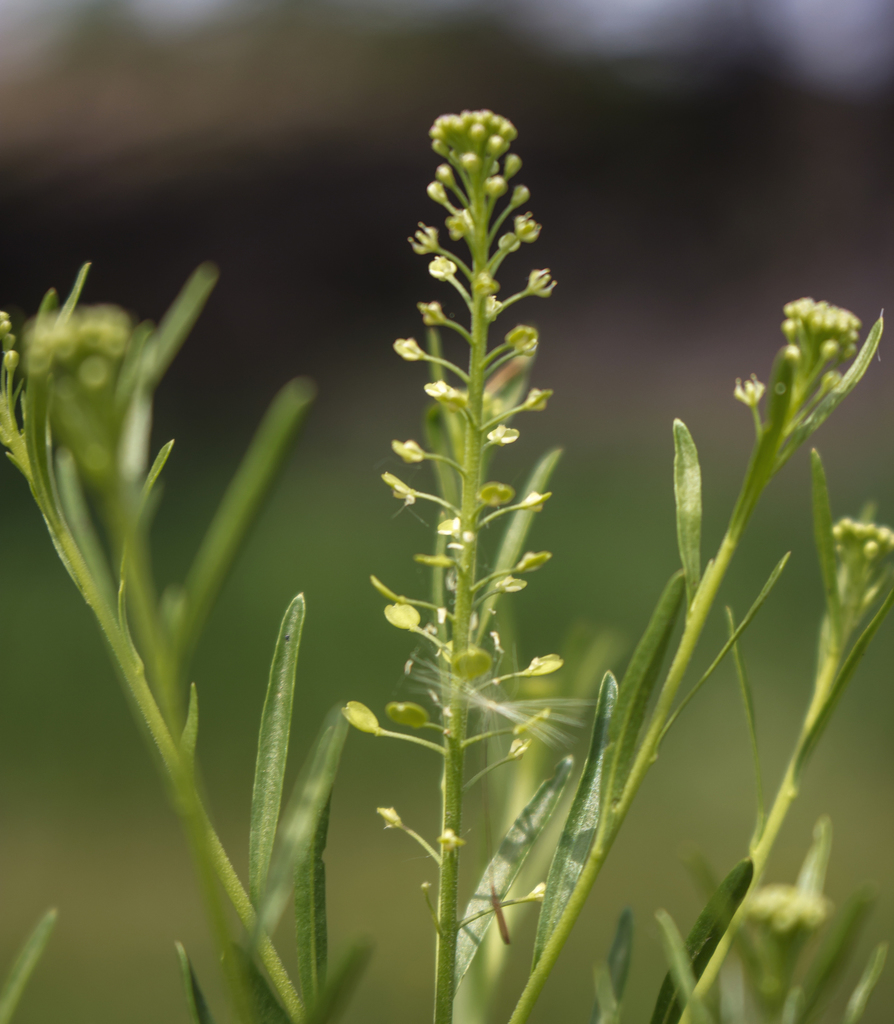
Common Peppergrass
Lepidium densiflorum
Lepidium densiflorum is a species of flowering plant in the mustard family known by the common names common pepperweed, prairie peppergrass, elongate peppergrass, hairy-fruited peppergrass, and large-fruited peppergrass.
It is a common and widespread plant in North America, where it grows in many habitats across Canada and the United States.
From the article Lepidium densiflorum on Wikipedia (CC BY-SA), quoted section by section
Description
Lepidium densiflorum is an annual or biennial herb producing a short, erect, branching stem up to about 30 centimeters in height. Leaves grow in a basal rosette at the base of the stem and reach up to about 10 centimeters long; leaves higher up on the stem are smaller and less prominently lobed. The plant produces raceme inflorescences of tiny flowers with sepals each only about a millimeter long. There are usually no petals, though sometimes vestigial petals appear near the sepals. The fruit is a few millimeters long.
Range & habitat
Lepidium densiflorum prefers sunny, moderate dry conditions, and fertile loamy soil, but it also can adapt to rocky or sandy soil easily. It is distributed throughout Ontario, Canada and is a very common weed growing in the cultivated land, the farms, the gardens, the sandy land, the roadsides and the waste areas.
Wikipedia: “Habitat”
At the table
The seeds of Lepidium densiflorum can be used to biologically control the mosquito larvae. Additionally, the 4-HBITC and SNB extracted from Lepidium densiflorum seeds have capacity to anti the oxidicability of DPPH and -OH. Moreover, the benzylic glucosinolates system was found in Lepidium densiflorum, which is related to both plant–pathogen interactions and human health.
Wikipedia: “Uses”
In human culture
The origin of Lepidium densiflorum is not entirely clear: some believe it was introduced in Europe or Eurasia, some believe it originated in western North America and east of the Mississippi River, and others believe it originated in the east. It is more likely that the species is native to North America and it was first discovered in a rubbish dump in Turku, Finland, in the early 20th century, but its distribution has expanded and it was considered a noxious and invasive herb in many states.
Wikipedia: “History”
Where it lives
Recorded sightings
—
geo-referenced records in GBIF, from museums, herbaria and field observers.
Drag the globe to turn it. Dots are where records exist, not a range map; darker means more records.
In the stacks
Searching the stacks…
Every page naming Lepidium densiflorum in the Biodiversity Heritage Library →
This page is assembled live from iNaturalist, GBIF, Wikipedia, the Source Library and the Internet Archive. It is not yet part of the hand-edited codex. iNaturalist taxon 77666.