- Plants
- ›Vascular Plants
- ›flowering plants
- ›monocots
- ›grasses, sedges, cattails, and allies
- ›Rushes and Allies
- ›Juncus
- ›Juncus
- ›Ozophyllum
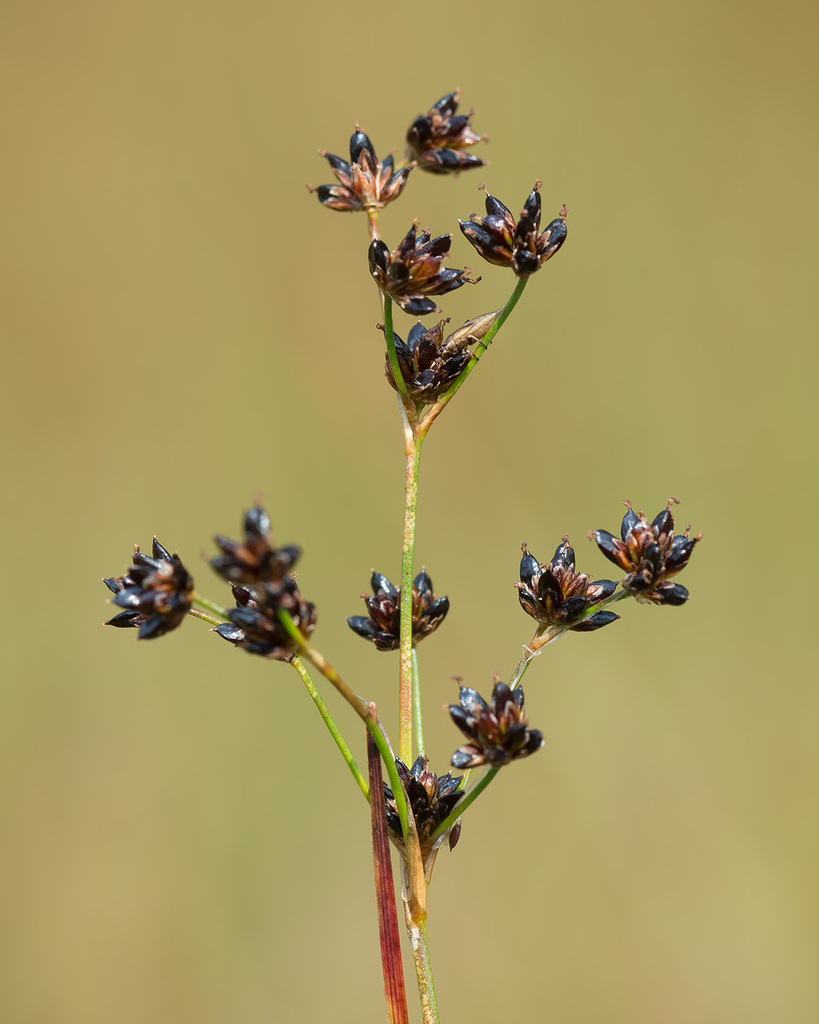
Jointed rush
Juncus articulatus
Juncus articulatus is a flowering plant species in the rush family Juncaceae. It is known by the common name jointleaf rush or jointed rush, which can also refer to J. kraussii from Australia. It is native to Eurasia, Canada, Greenland and much of the United States. It grows in moist areas, such as wet sand, and thrives in calcareous soils. J. articulatus was found to be more sensitive to drought and salt stress than its congeners J. acutus and J. maritimus. It is a perennial herb producing mainly erect stems from a short rhizome. The stem may root at nodes, and it generally has one or more flattened hollow cylindrical leaves up to 10 centimeters long. Transverse internal partitions or joints may be seen or felt in the leaf of the plant.
The inflorescence atop the stem has several branches with up to 25 clusters of up to 12 flowers each. Each individual flower has greenish to dark brown, pointed tepals 2 to 3 millimeters long, six stamens bearing anthers, and a protruding, feathery pistil. The fruit is a dark brown capsule with a pointed tip.
Where it lives
Recorded sightings
—
geo-referenced records in GBIF, from museums, herbaria and field observers.
Drag the globe to turn it. Dots are where records exist, not a range map; darker means more records.
In the stacks
Searching the stacks…
Every page naming Juncus articulatus in the Biodiversity Heritage Library →
This page is assembled live from iNaturalist, GBIF, Wikipedia, the Source Library and the Internet Archive. It is not yet part of the hand-edited codex. iNaturalist taxon 77552.