- Plants
- ›Vascular Plants
- ›flowering plants
- ›Dicots
- ›nightshades, bindweeds, gooseweeds, and allies
- ›bindweed family
- ›Bindweeds, Morning-glories and Allies
- ›Ipomoeeae
- ›Ipomoea
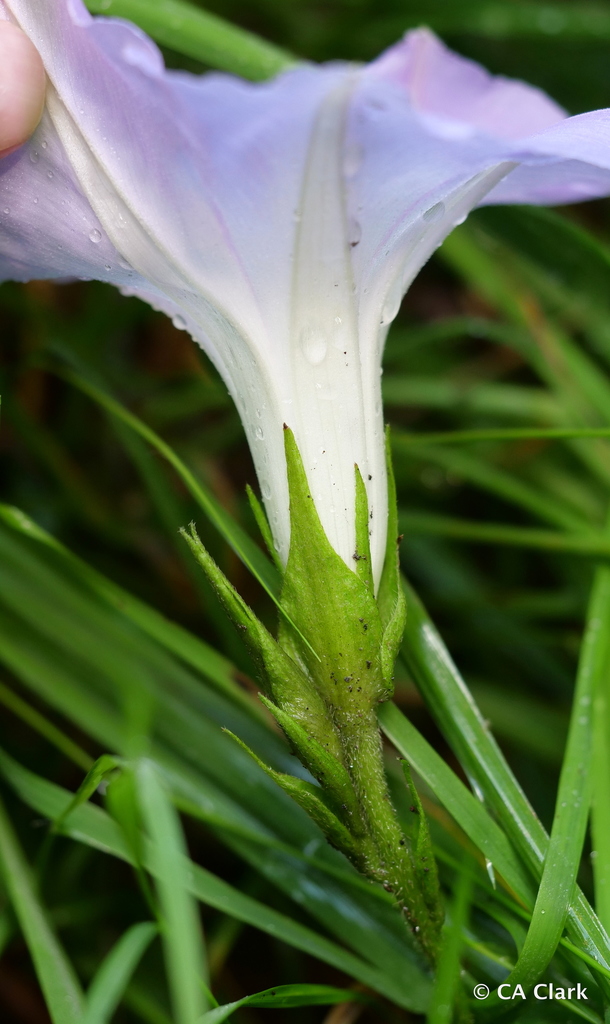
oceanblue morning glory
Ipomoea indica
Ipomoea indica is a species of flowering plant in the family Convolvulaceae, known by several common names, including blue morning glory, oceanblue morning glory, koali awa, and blue dawn flower. It bears heart-shaped or three-lobed leaves and purple or blue funnel-shaped flowers 6–8 cm (2–3 in) in diameter, from spring to autumn. The flowers produced by the plant are hermaphroditic. This plant has gained the Royal Horticultural Society's Award of Garden Merit.
The plant is grown as an ornamental for its attractive flowers, but is considered invasive in many regions of the world, being specifically listed on New Zealand's Biosecurity Act 1993.
From the article Ipomoea indica on Wikipedia (CC BY-SA), quoted section by section
Description
Ipomoea indica is a vigorous, long-lived, tender, perennial plant, a vine which is native to tropical, subtropical and warm temperate habitats throughout the world. It blooms all year long[1]. They can most commonly be found in disturbed forests, forest edges, secondary woodland, suburban gullies, and along roadsides and waterways. The plant climbs well over other plants, walls and slopes as growing on the bottom. Its climbing habit allows it to compete with trees and shrubs successfully. It is a twisting, occasionally lying, herbaceous plant which is more or less densely hairy on the axial parts with backward-looking trichomes. The stems can grow 3 to 6 centimetres (1.2 to 2.4 in) long and sometimes have roots at the nodes. The leaves are petiolate with 2 to 18 centimetres (0.79 to 7.09 in) long petioles. The leaf blade is egg-shaped or round, 5 to 15 centimetres (2.0 to 5.9 in) long and 3.5 to 14 centimetres (1.4 to 5.5 in) wide. The underside is densely hairy with short, soft trichomes, the top is more or less sparsely hairy. The base is heart-shaped, the leaf margin is entire or three-lobed, the tip is pointed or sharply pointed. The crown is funnel-shaped, 5 to 8 centimetres (2.0 to 3.1 in) long, glabrous, bright blue or bluish purple, with age they become reddish purple or red. The centre of the crown is a little paler. I. …
Range & habitat
Its exact native distribution is unclear due to it being widely cultivated throughout the tropics of Eurasia, Africa and America, but it is currently thought by most authorities to be native to the Neotropics, from Florida in the United States south to Mexico, Central America, and the Caribbean and south to South America. It is also considered native to several Pacific islands, including Palau, the Hawaiian Archipelago (where its native Hawaiian name is Koali ‘awa), French Polynesia, and Micronesia. However, other authorities consider it to be an introduced and/or invasive species in the United States, Mexico, and parts of its Caribbean and Pacific range.
Wikipedia: “Distribution”
At the table
Ipomoea indica is an ideal plant for honey production because it blooms all year long
Wikipedia: “Uses”
How it is grown
Blue morning glory is a popular species widely cultivated as an ornamental plant for its colourful flowers. It has spread throughout the tropics and subtropics of the Old World although those regions are not part of its native range. As it does not tolerate temperatures below 7 °C (45 °F), in temperate regions it is grown under glass. It likes very light and nutrient-rich soil, which should be kept evenly moist.
Uses. Ipomoea indica is an ideal plant for honey production because it blooms all year long
Wikipedia: “Cultivation”
In human culture
The Latin specific epithet indica means from India, or the East Indies or China. In this case, the name likely refers to the West Indies, as I. indica is native to the New World.
Wikipedia: “Etymology”
Where it lives
Recorded sightings
—
geo-referenced records in GBIF, from museums, herbaria and field observers.
Drag the globe to turn it. Dots are where records exist, not a range map; darker means more records.
In the stacks
Searching the stacks…
Every page naming Ipomoea indica in the Biodiversity Heritage Library →
This page is assembled live from iNaturalist, GBIF, Wikipedia, the Source Library and the Internet Archive. It is not yet part of the hand-edited codex. iNaturalist taxon 77496.