- Plants
- ›Vascular Plants
- ›flowering plants
- ›Dicots
- ›Roses, Elms, Figs, and Allies
- ›mulberry and fig family
- ›Moreae
- ›Morus
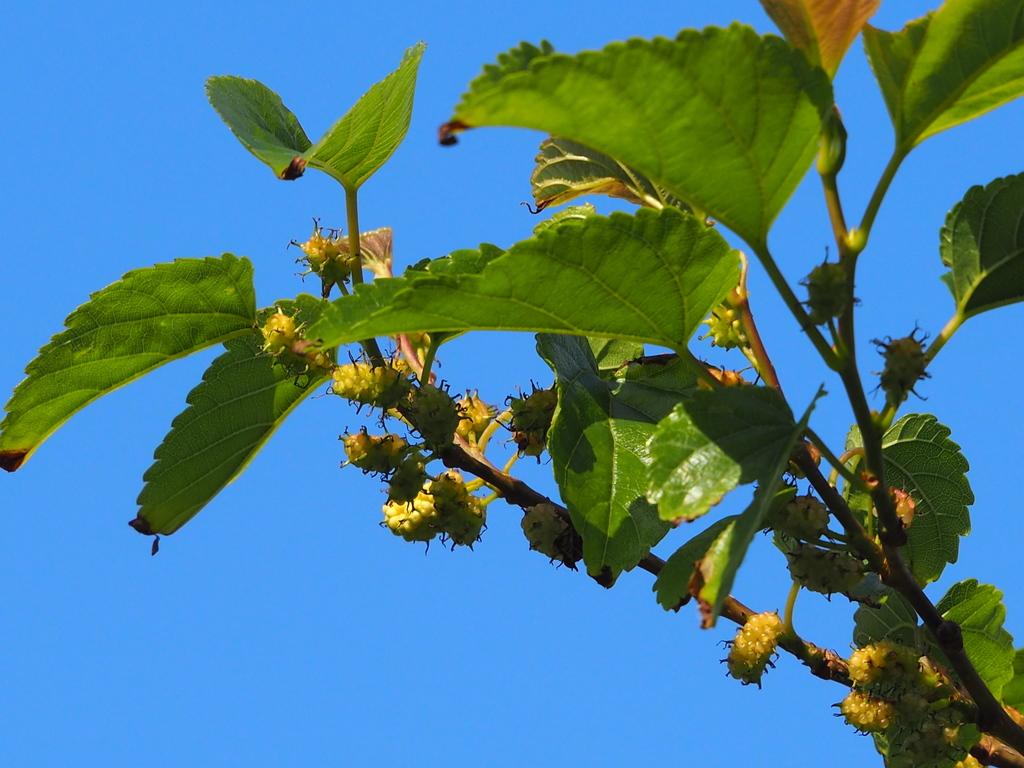
Korean mulberry
Morus indica
Morus indica is a member of the genus Morus, of the family of flowering plants Moraceae, commonly known as the mulberry family. As with other mulberries, Morus indica is a deciduous tree. Morus indica is native to the temperate and sub-tropical Himalayan region. It is currently cultivated in India, China, Japan, and East Africa.
From the article Morus indica on Wikipedia (CC BY-SA), quoted section by section
Description
Morus indica, as with other members of the mulberry family, is often described as either a small tree or a shrub, rarely exceeding 10–15 metres (33–49 feet). When young, the branches are covered in fine, soft hairs; however, the plant loses these hairs as they mature. The branches are a light gray-brown color. The leaves range from 4–12.5 centimetres (1+1⁄2–5 inches) long and 2.5–7.5 cm (1–3 in) wide, and are attached to the tree via petioles. The leaves themselves are usually ovate but sometimes lobed, coming to a narrow point, making them somewhere between caudate and acuminate. The leaves are retuse to slightly cordate, having a small lobe at the base. They are shortly serrated, with each tooth narrowing to a thin point, making them apiculate. The leaf colour is dark green, with a paler underside covered in fine hairs.
Flowers and fruit. Morus indica is a monoecious flowering plant, having male and female flowers growing on the same tree, although often on distinct branches. The male inflorescence is narrow, between 9–11.5 millimetres (3⁄8–7⁄16 in) long, and covered in fine hairs. The female flowers are subglubose, or just shy of spherical. They measure 6–9.5 mm (1⁄4–3⁄8 in) long. The stigma of these flowers is about 3.5 mm long with dense, short hair. The female flower, after being fertilized, forms a fleshy compound fruit known as a syncarp. …
At the table
Morus indica is often grown for its medicinal properties. As with most berries, the mulberries of M. indica have potent antioxidant properties. The primary medicinal use of M. indica is as a method of regulating blood glucose levels in diabetic patients. Multiple studies in humans and mice have found that the use of M. indica lowered the blood glucose levels of diabetic through multiple different pathways.
== References ==
Wikipedia: “Uses and health”
Where it lives
Recorded sightings
—
geo-referenced records in GBIF, from museums, herbaria and field observers.
Drag the globe to turn it. Dots are where records exist, not a range map; darker means more records.
In the stacks
Searching the stacks…
Every page naming Morus indica in the Biodiversity Heritage Library →
This page is assembled live from iNaturalist, GBIF, Wikipedia, the Source Library and the Internet Archive. It is not yet part of the hand-edited codex. iNaturalist taxon 773801.