- Plants
- ›Vascular Plants
- ›flowering plants
- ›Dicots
- ›pinks, cactuses, and allies
- ›Amaranth family
- ›Salsoloideae
- ›Salsoleae
- ›Halogeton
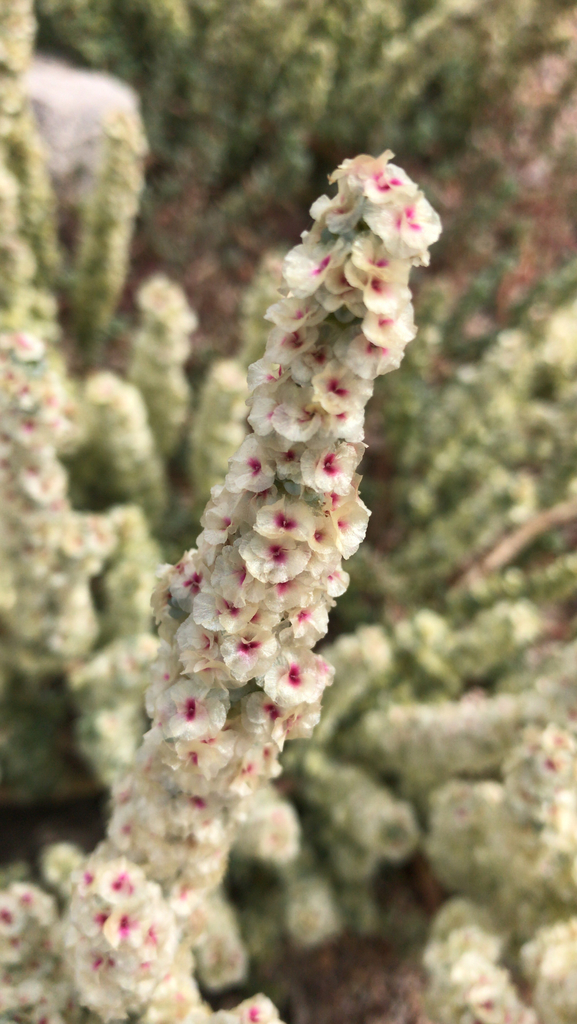
Saltlover
Halogeton glomeratus
Halogeton glomeratus is a species of flowering plant in the family Amaranthaceae known by the common names saltlover, Aral barilla, and halogeton. It is native to Russia, Central Asia and China, but the plant is probably better known in the western United States, where it is an introduced species and a notorious noxious weed. This annual herb is a hardy halophyte, thriving in soils far too saline to support many other plants. It also grows in alkali soils such as those on alkali flats and disturbed, barren habitat. It can be found in sagebrush and shadscale habitat, and it grows well in areas with cold winters.
This plant produces a usually erect stem with several curving branches up to about 25 centimetres (9.8 inches) tall. It has a taproot reaching up to half a meter deep in the soil and many lateral roots. The branches are lined with narrow, fleshy, blue-green leaves each up to about 2 centimeters long tipped with stiff bristles. The inflorescences are located all along the stem branches next to the leaves. Each inflorescence is a small cluster of tiny bisexual and female-only flowers accompanied by waxy bracts. The winged, membranous flowers surround the developing fruit, which is all that remains on the plant when it is ripe, the leaves and flower parts having fallen away. The fruit is a pale cylindrical utricle. The plant produces large amounts of seeds, which are dispersed by many vehicles, including human activity, animals (including ants), water flow, wind, and by being carried on the dry plant when it breaks off at ground level and rolls away as a tumbleweed.
Where it lives
Recorded sightings
—
geo-referenced records in GBIF, from museums, herbaria and field observers.
Drag the globe to turn it. Dots are where records exist, not a range map; darker means more records.
In the stacks
Searching the stacks…
Every page naming Halogeton glomeratus in the Biodiversity Heritage Library →
This page is assembled live from iNaturalist, GBIF, Wikipedia, the Source Library and the Internet Archive. It is not yet part of the hand-edited codex. iNaturalist taxon 77331.