- Plants
- ›Vascular Plants
- ›flowering plants
- ›Dicots
- ›nightshades, bindweeds, gooseweeds, and allies
- ›nightshade family
- ›petunias and allies
- ›Brunfelsia
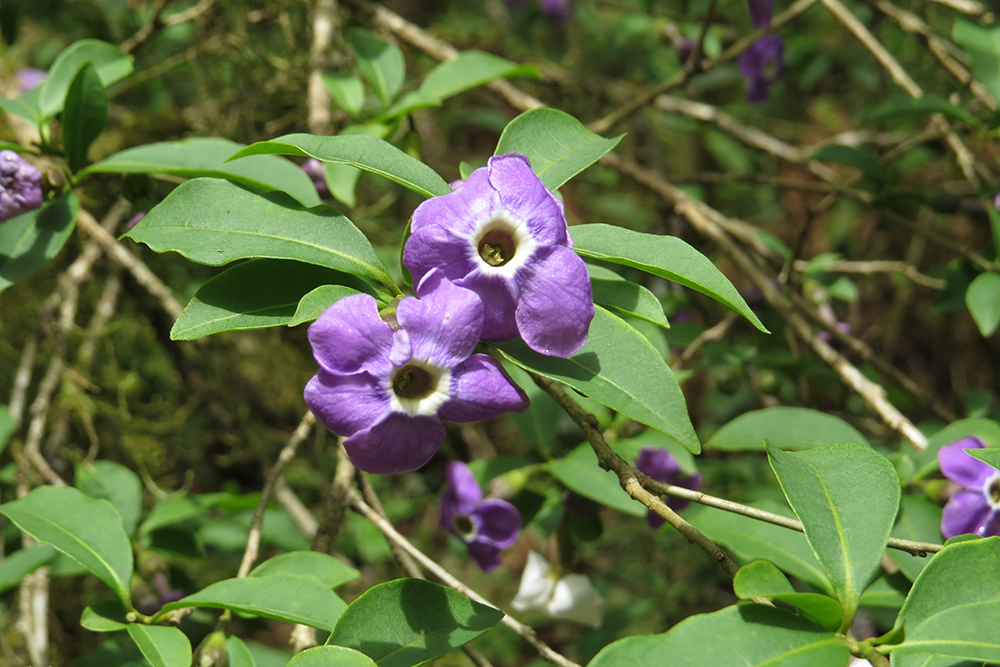
Brunfelsia plowmaniana
Brunfelsia plowmaniana is a species of flowering plant of the nightshade family that is native to the cloud forests of the Bolivian and Argentinian Andes. It was first described in 2012 on the basis of systematic DNA barcoding of specimens from the genus Brunfelsia. Specimens belonging to the new species had previously been placed in the polymorphic species B. uniflora, which a molecular phylogeny revealed as polyphyletic.
From the article Brunfelsia plowmaniana on Wikipedia (CC BY-SA), quoted section by section
Description
The shrubs or small trees mostly have a single stem of up to 14 cm in diameter at the base, and they branch only above the base, typically 1–4 m and sometimes up to 10 m high. The bark is peeling or flaking, light gray or yellow-brown. Branches with the new twigs are densely covered with up to 0.3 mm long hairs, whereas the older branches exhibit a smooth and glabrous bark. Internodes range from 4–12 mm. The shiny and dark green leaves are scattered along the branchlets and often also covered with hairs, especially on younger twigs. They vary in size and shape, but are usually widest above the middle with a rather abruptly narrowed apex, similar to many Myrtaceae. The raised and somewhat cartilaginous ring of the corolla throat is reminiscent of that of species of Prestonia (Apocynaceae) from the same geographic region; it probably reflects adaptation to pollinator foraging behaviour. Nothing is known directly of the pollinators, but the floral features described above are shared by other South American brunfelsias for which butterfly pollination has been observed. The stomata are paracytic. The flower is solitary, terminal and often nodding, fragrant during the day. Both sepals and petals are partially fused and the latter colored violet, though the color fades to white with age, as is common in the South American species of Brunfelsia. …
Range & habitat
Brunfelsia plowmaniana is known from humid forests in the Provinces of Salta and Jujuy in northwestern Argentina, and the Departments of Santa Cruz, Cochabamba and La Paz (Inquisivi Province) in Bolivia. It grows at altitudes of 1500–3200 m on the predominantly North–South ridges separated by dry to arid scrub in the intervening valleys, perhaps mostly at the lower altitudinal range in the southern part of the distribution and the upper altitudinal range to the north. It has never been collected in the neighbouring Provinces of Sud Yungas, Nor Yungas and Larecaja in the relatively well-explored central and northern parts of the Department of La Paz.
Wikipedia: “Distribution”
In human culture
The species was named in honor of the American botanist Timothy Plowman (1944-1989) who had worked on neotropical plants of ethnobotanic importance and provided the first and only comprehensive taxonomic treatments of the genus Brunfelsia.
Wikipedia: “Etymology”
Where it lives
Recorded sightings
—
geo-referenced records in GBIF, from museums, herbaria and field observers.
Drag the globe to turn it. Dots are where records exist, not a range map; darker means more records.
In the stacks
Searching the stacks…
Every page naming Brunfelsia plowmaniana in the Biodiversity Heritage Library →
This page is assembled live from iNaturalist, GBIF, Wikipedia, the Source Library and the Internet Archive. It is not yet part of the hand-edited codex. iNaturalist taxon 772024.