- Plants
- ›Vascular Plants
- ›flowering plants
- ›monocots
- ›lilies, supplejacks, and allies
- ›lily family
- ›true lily subfamily
- ›true lilies and allies
- ›Fritillaria
- ›Liliorhiza
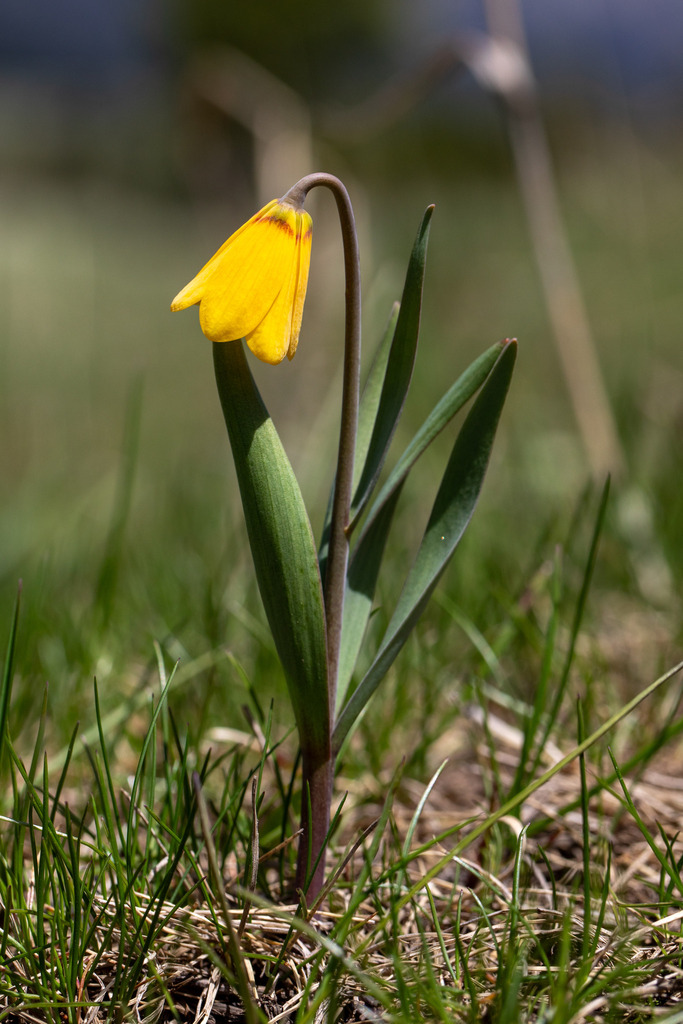
yellow fritillary
Fritillaria pudica
Fritillaria pudica, the yellow fritillary, is a small perennial plant found in the sagebrush country in the western United States (Idaho, Montana, Oregon, Washington, Wyoming, very northern California, Nevada, northwestern Colorado, North Dakota and Utah) and Canada (Alberta and British Columbia). It is a member of the lily family Liliaceae. Another common (but somewhat ambiguous) name is "yellow bells", since it has a bell-shaped yellow flower. It may be found in dryish, loose soil; it is amongst the first plants to flower after the snow melts, but the flower does not last very long; as the petals age, they turn a brick-red colour and begin to curl outward. The flowers grow singly or in pairs on the stems, and the floral parts grow in multiples of threes. The species produces a small corm, which forms corms earning the genus the nickname 'riceroot'. During his historic journey, Meriwether Lewis collected a specimen while passing through Idaho in 1806.
The corm can be dug up and eaten fresh or cooked; it served Native Americans as a good source of food in times past, and is still eaten occasionally. Today these plants are not common, so digging and eating the corms is not encouraged. The plant is called [q̓aw̓x̌e] in Salish and [ˈsɨkni] in Sahaptin.
Where it lives
Recorded sightings
—
geo-referenced records in GBIF, from museums, herbaria and field observers.
Drag the globe to turn it. Dots are where records exist, not a range map; darker means more records.
In the stacks
Searching the stacks…
Every page naming Fritillaria pudica in the Biodiversity Heritage Library →
This page is assembled live from iNaturalist, GBIF, Wikipedia, the Source Library and the Internet Archive. It is not yet part of the hand-edited codex. iNaturalist taxon 77177.