- Plants
- ›Vascular Plants
- ›flowering plants
- ›Dicots
- ›Roses, Elms, Figs, and Allies
- ›rose family
- ›brambles, roses, strawberries, and allies
- ›avens tribe
- ›Fallugia
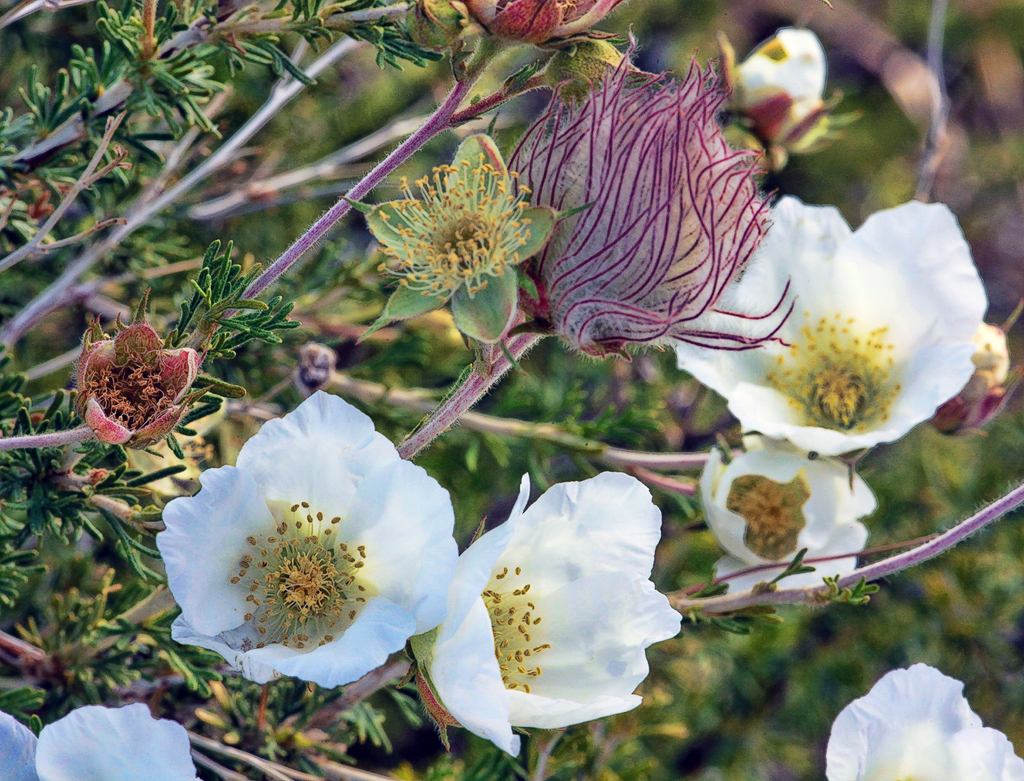
Apache plume
Fallugia paradoxa
Fallugia is a monotypic genus of flowering plants containing the single species Fallugia paradoxa, which is known by the common names Apache plume and póñil. This plant is native to the southwestern United States and northern Mexico, where it is found in arid habitats such as desert woodlands and scrub.
From the article Fallugia on Wikipedia (CC BY-SA), quoted section by section
Description
Fallugia paradoxa is an erect shrub not exceeding two meters in height. It has light gray or whitish peeling bark on its many thin branches. The leaves are each about a centimeter long and deeply lobed with the edges rolled under. The upper surface of the leaf is green and hairy while the underside is duller in color and scaly. The flower is roselike when new, with rounded white petals and a center filled with many thready stamens and pistils. The ovary of the flower remains after the white petals fall away, leaving many plumelike lavender styles, each 3 to 5 centimeters long. The plant may be covered with these dark pinkish clusters of curling, feathery styles after flowering. Each style is attached to a developing fruit, which is a small achene. The fruit is dispersed when the wind catches the styles and blows them away. Wasps such as Polistes instabilis commonly feed on its nectar.
At the table
Fallugia paradoxa is considered valuable for erosion control in desert areas where it grows. It is also used in xeric landscaping as an ornamental shrub with habitat value. Visual interest is provided by white flowers in late spring, yielding to pink plumes that gradually fade to white but continue to give the plant a feathery appearance for the duration of the growing season.
Wikipedia: “Uses”
Where it lives
Recorded sightings
—
geo-referenced records in GBIF, from museums, herbaria and field observers.
Drag the globe to turn it. Dots are where records exist, not a range map; darker means more records.
In the stacks
Searching the stacks…
Every page naming Fallugia paradoxa in the Biodiversity Heritage Library →
This page is assembled live from iNaturalist, GBIF, Wikipedia, the Source Library and the Internet Archive. It is not yet part of the hand-edited codex. iNaturalist taxon 77132.