- Plants
- ›Vascular Plants
- ›flowering plants
- ›Dicots
- ›myrtles, evening primroses, and allies
- ›myrtle family
- ›Myrtoideae
- ›gum trees
- ›Eucalyptus
- ›Symphyomyrtus
- ›Adnataria
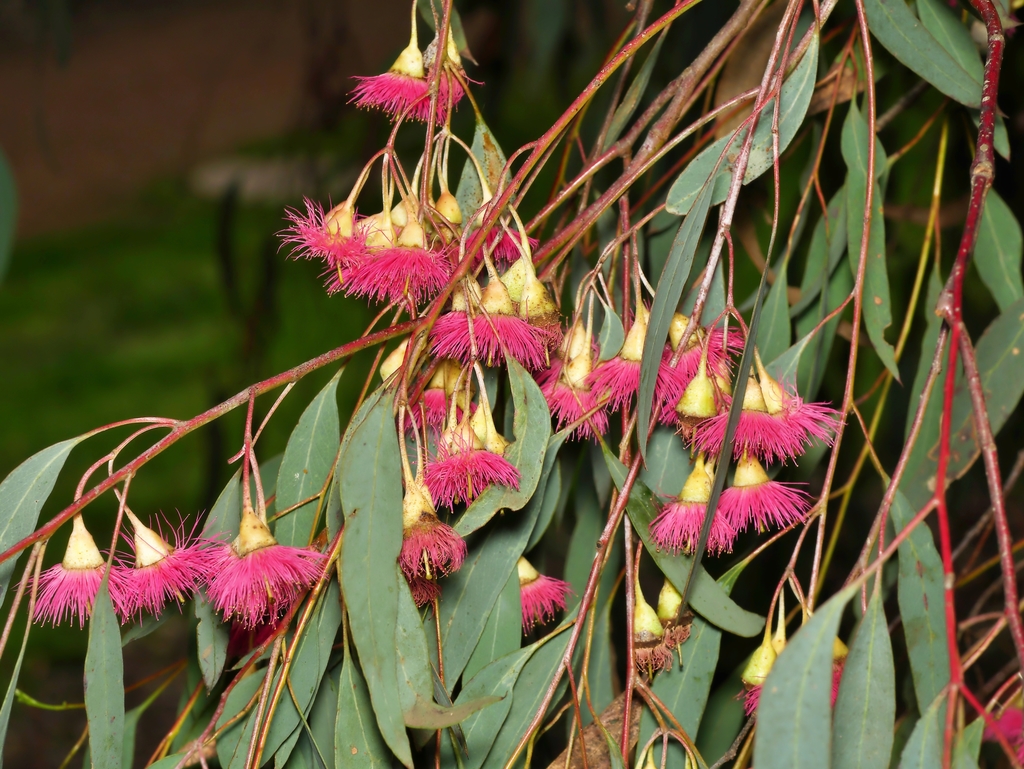
Red Ironbark
Eucalyptus sideroxylon
Eucalyptus sideroxylon, commonly known as mugga ironbark, or red ironbark is a small to medium-sized tree that is endemic to eastern Australia. It has dark, deeply furrowed ironbark, lance-shaped adult leaves, flower buds in groups of seven, white, red, pink or creamy yellow flowers and cup-shaped to shortened spherical fruit.
From the article Eucalyptus sideroxylon on Wikipedia (CC BY-SA), quoted section by section
Description
Eucalyptus sideroxylon is a tree that typically grows to a height of 25–35 m (82–115 ft) and forms a lignotuber. The bark is dark grey to black, deeply furrowed ironbark on the trunk and larger branches, smooth white to grey on the thinnest branches. Young plants and coppice regrowth have lance-shaped to oblong or linear leaves that are 30–110 mm (1.2–4.3 in) long and 5–35 mm (0.20–1.38 in) wide. Adult leaves are lance-shaped, the same shade of green on both sides, 50–140 mm (2.0–5.5 in) long and 10–40 mm (0.39–1.57 in) wide tapering to a petiole 5–25 mm (0.20–0.98 in) long. The flower buds are arranged in leaf axils on an unbranched peduncle 7–29 mm (0.28–1.14 in) long, the individual buds on pedicels 3–15 mm (0.12–0.59 in) long. Mature buds are oval or diamond-shaped, 6–15 mm (0.24–0.59 in) long and 4–6 mm (0.16–0.24 in) wide with a conical to beaked operculum. Flowering occurs from April to December and the flowers are white, red, pink or creamy yellow. The fruit is a woody cup-shaped to shortened spherical capsule 5–11 mm (0.20–0.43 in) long and 5–10 mm (0.20–0.39 in) wide with the valves below the level of the rim.
Range & habitat
Mugga ironbark is widespread and often abundant in woodland from south-eastern Queensland through New South Wales to Victoria. Subspecies improcera is only known from the Barakula State Forest north-northwest of Chinchilla.
Wikipedia: “Distribution and habitat”
At the table
The leaves are used in the production of cineole based eucalyptus oil. Apiarists in New South Wales place hives in red-ironbark woodlands to collect the honey.
Wikipedia: “Uses”
Where it lives
Recorded sightings
—
geo-referenced records in GBIF, from museums, herbaria and field observers.
Drag the globe to turn it. Dots are where records exist, not a range map; darker means more records.
In the stacks
Searching the stacks…
Every page naming Eucalyptus sideroxylon in the Biodiversity Heritage Library →
This page is assembled live from iNaturalist, GBIF, Wikipedia, the Source Library and the Internet Archive. It is not yet part of the hand-edited codex. iNaturalist taxon 77092.