- Plants
- ›Vascular Plants
- ›flowering plants
- ›Dicots
- ›saxifrages, stonecrops, and allies
- ›stonecrop family
- ›Sempervivoideae
- ›Sedeae
- ›Dudleya
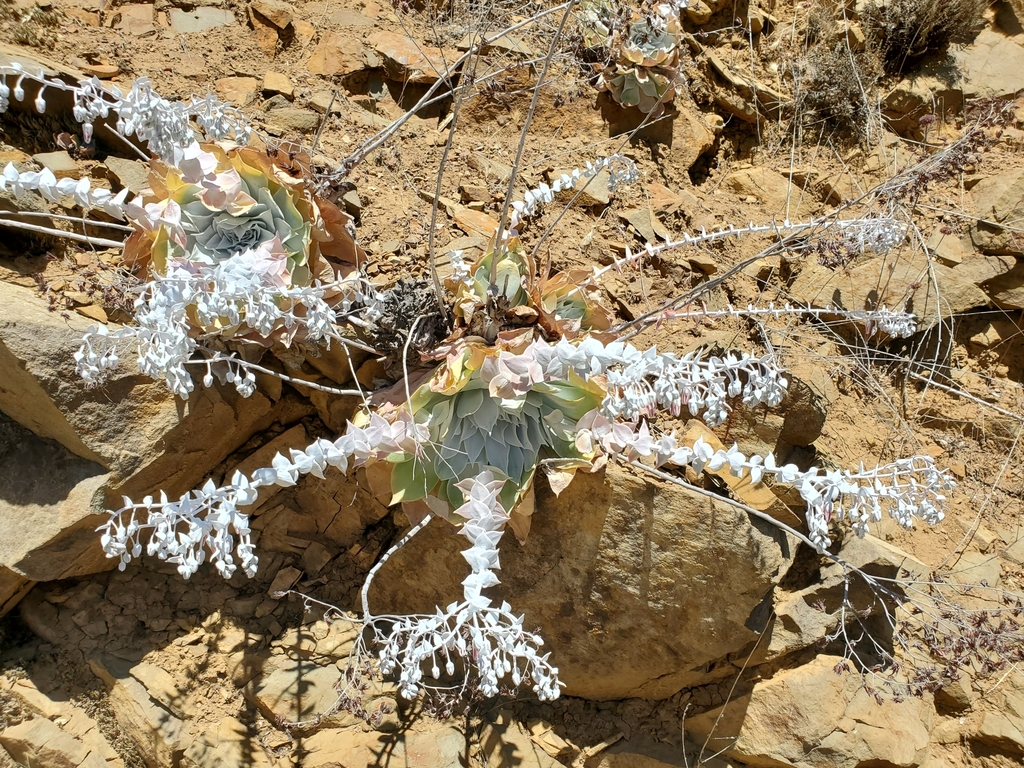
Chalk Dudleya
Dudleya pulverulenta
Dudleya pulverulenta is a species of perennial succulent plant known by the common names chalk lettuce, chalk dudleya, and chalk liveforever. It is one of the largest Dudleya, with a silvery, waxy rosette that may greatly contrast with its habitat. It is also regarded as one of the most distinctive members of the Dudleya, with one of the most specialized inflorescences in the genus, adapted to hummingbird pollination through its red pendent flowers, the longest corolla, and the highest nectar output. Dudleya pulverulenta has the largest range of all Dudleya, over 1,000 kilometres (620 mi), being found from southern Monterey County in California to the Sierra de San Borja in southern Baja California. It is closely related to Dudleya arizonica, a smaller desert species that tends to lack the specialized floral traits, and Dudleya anthonyi, which differs in a few morphological traits and is restricted to the San Quintín Volcanic Field.
From the article Dudleya pulverulenta on Wikipedia (CC BY-SA), quoted section by section
Description
Dudleya pulverulenta is a rosette-forming, succulent species of plant, covered in a distinctive chalky and mealy wax, known as a farina, or more technically, epicuticular wax. It is one of the largest species of Dudleya. All parts of the inflorescence are covered in a chalky wax, and the flowering stems may reach up to 150 cm (59 in) long.
Pollination syndrome. Dudleya pulverulenta exhibits a pollination syndrome uniquely adapted to hummingbirds. The flowers have long red petal tubes (corollas) and are unscented. The flowers hang downward (pendent), achieved by a twist at the base of the terminal inflorescence branches, known as the cincinni, which inverts the flowers from the typically erect or ascending position seen in other Dudleya. Like other hummingbird-adapted plants, the pendent flowers allow hummingbirds to readily reach the flowers from below, discouraging bees and other insect pollinators from easily landing. After flowering, the fruits are turned erect by a sharp turn of the branchlet connecting the flower to the inflorescence (the pedicel). This syndrome is only shared by the other two species in the genus, both close relatives of Dudleya pulverulenta: Dudleya anthonyi and Dudleya arizonica. D. arizonica is similar in appearance, and approaches D. …
Range & habitat
Dudleya pulverulenta is native to California and Baja California. Its range extends from extreme southern Monterey County southward to Punta Prieta in the central desert of Baja California. It is typically found in rocky cliffs, and canyons, generally under 1000 meters in elevation. It is primarily a plant of coastal distribution and can often be found within 12 miles of the coast, and more inland occurrences are typically in valleys where the heat is moderated by elevation or coastal influence. Plants are very rapid recolonizers as evidenced by proliferation on roadcuts or disturbed soil shortly after development. Their habitat preference for rocky, shallow soils and open habitats mean that fuel is limited in proximity to the plants, enabling them to survive wildfire. The plant will resprout after fire.
Wikipedia: “Distribution and habitat”
How it is grown
The plant tolerates full sun exposure or part shade. It is susceptible to aphid infestations which result in flower and rosette deformities. It is a much hardier plant for the garden environment than the more commonly available Dudleya brittonii. Dudleya pulverulenta is not noted for its longevity and may only live up to 2 or 3 years in cultivation, but some specimens in the wild may be over 40 years old in a most optimal location. When the plant dies, the rosette takes on a withered, ashy gray appearance, resembling a bird's nest. A dormant plant will often surround a few live leaves with a ring of withered leaves until the next growing season pushes them down.
Wikipedia: “Cultivation”
Where it lives
Recorded sightings
—
geo-referenced records in GBIF, from museums, herbaria and field observers.
Drag the globe to turn it. Dots are where records exist, not a range map; darker means more records.
In the stacks
Searching the stacks…
Every page naming Dudleya pulverulenta in the Biodiversity Heritage Library →
This page is assembled live from iNaturalist, GBIF, Wikipedia, the Source Library and the Internet Archive. It is not yet part of the hand-edited codex. iNaturalist taxon 76737.